
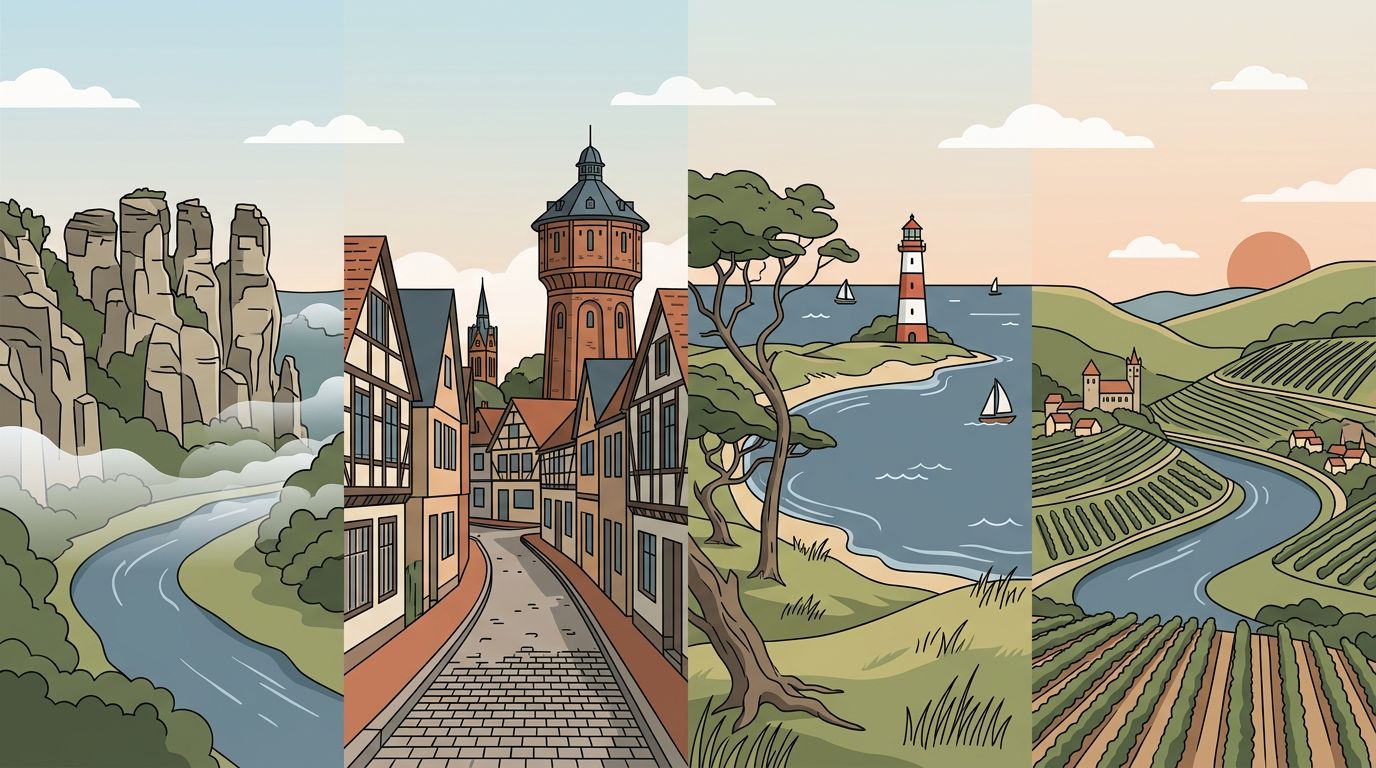
Germany’s most memorable photographs do not always come from the usual icons like Neuschwanstein Castle, the reflective waters of Eibsee, or the crowds at Lake Konigssee. Beyond the standard routes through Bavaria and the Black Forest, you can find jagged sandstone towers above the Elbe, wind-shaped islands, industrial monuments, Gothic brick streets, and rivers that fold through ancient vineyards.
These hidden Germany photo spots reward slower travel and a keener eye. Many are easy to reach by train, yet they feel far removed from the typical postcard circuit where everyone is fighting for the same angle.
Bring a flexible plan, because the light and the weather will ultimately decide more than any itinerary ever could.
Key Takeaways
- Saxon Switzerland offers dramatic sandstone ridges, river views, and ethereal foggy sunrise conditions just a short distance from Dresden.
- Northern Germany provides a wealth of maritime subjects, intricate brick Gothic architecture, vast tidal flats, and soft coastal light.
- The Harz region combines charming half-timbered towns, historic steam trains, and moody high moorland that capture the spirit of Germany without the heavy crowds found in Bavaria.
- The Rhine, Moselle, Spreewald, and Ruhr regions offer diverse compositions ranging from lush vineyards and hillside castles to winding canals and bold industrial geometry.
- Early starts and regional train connections make many of these lesser-known German photography locations practical to explore, even if you are traveling without a car.
Build a Photo Route Around Light, Not Famous Names
The strongest Germany photography locations often look ordinary at noon. A river promenade can feel flat under hard sun, while the same water catches the pale pink sky of the golden hour before breakfast. Likewise, medieval towns often need rain, mist, or low winter light to help separate their roofs and towers from the surroundings.
Plan your travel photography around a visual subject first. Do you want leading lines, weathered texture, long exposures, or a human-scale street scene? That choice helps you avoid wasting time at beautiful places that simply do not suit your specific style.
A compact kit works well for independent travel. Bring one wide lens for landscapes and architecture, plus a short telephoto for layers in hills or details on distant facades. A lightweight tripod helps during the blue hour, although some narrow viewpoints become awkward when crowded.
Fog changes everything. In valleys, it can hide clutter and turn a known lookout into something spare and atmospheric. Check local weather the night before, then leave room to change plans.
Germany’s regional rail network is useful for photographers because many stations sit close to old centers, riverbanks, and trailheads. A rental car still helps in the Moselle valley, on Rugen, and around smaller Harz villages, where buses may run infrequently.
The most useful photography itinerary leaves one sunrise unbooked for weather.
Avoid trying to collect locations like stamps. Stay two nights when you can. You will learn where the sun falls, which streets empty early, and whether an overlooked view looks better after rain.
Saxon Switzerland: Sandstone Drama Near Dresden
Saxon Switzerland, located southeast of Dresden, is one of Germany’s most impressive landscape photography regions. The Elbe Sandstone Mountains rise in jagged cliffs and dramatic pinnacles above the river, offering hiking paths that reveal vistas far more imposing than their modest elevation suggests. While many travelers enjoy this area through casual day trips from Dresden, dedicated photographers will find enough material here to justify a much longer stay.
The Saxon Switzerland National Park protects the core area, which is filled with dense forests, striking rock formations, and well-marked trails. You can base yourself in Bad Schandau, Kurort Rathen, or return to Dresden in the evenings if you prefer city amenities.
Bastei is the obvious starting point for your portfolio. The famous bridge connects massive sandstone rocks high above the Elbe valley, and the sunrise photography here is truly exceptional. Aim to arrive well before dawn in the warmer months, as the crowds of day visitors grow quickly and the popular viewpoints become congested by mid-morning.
There is a small historical detail behind the scene. Visitors originally crossed this ravine on a wooden bridge in 1824, and the sandstone structure seen today replaced it in 1851. That interplay between engineered stone arches and the wild, untamed rock gives the composition its unique tension.
For a less familiar frame, hike to the Schrammsteine or the Carolafelsen. These narrow paths and exposed overlooks require extra care, especially after rain, but they reward hikers with breathtaking panoramic views. These spots provide vast, cinematic looks at the ridges, distant fields, and the broad, sweeping curve of the Elbe, rather than focusing on a single, well-trodden landmark. These scenic landscapes are perfect for capturing the raw beauty of the region.
On a clear morning after cool overnight conditions, low-hanging clouds often pool in the valley while the upper sandstone formations catch the first light. This creates a sense of depth that a single wide-angle frame rarely conveys without careful foreground placement.
Try using a longer lens at these viewpoints. Compressed layers of rock and forest can be much more impactful than a wide scene filled with nothing but pale sky. In autumn, the changing beech leaves add vibrant warm colors against the stark gray sandstone. Winter often brings clearer air and significantly fewer people, providing a quiet atmosphere for your shoot.
Take the side road whenever possible. The quiet, winding lanes around Rathen and Konigstein reveal charming ferry crossings, historic farmhouses, and intimate vistas that work well after the main overlooks become too busy to manage.
Lubeck, Hamburg, and the Northern Coast
Northern Germany offers a distinct visual rhythm compared to the southern regions. The terrain is flatter, the skies are larger, and weather patterns move across the frame with surprising speed. This is a landscape where brick, water, wind, and vast open space define the image.
Lubeck is an excellent starting point for those interested in architecture photography. Its Old Town sits on an island formed by the Trave River, and the skyline rises in a dense group of medieval church towers. As a UNESCO World Heritage site, the Hanseatic City of Lubeck provides a beautifully preserved backdrop that rewards patient observation.
Photograph the Holstentor early in the day, then walk toward St. Peter’s Church and the historic salt warehouses along the Obertrave. The warehouses look best in soft side light, when the stepped gables cast long, dramatic shadows. Reflections appear frequently after rain, especially along the quieter canals.
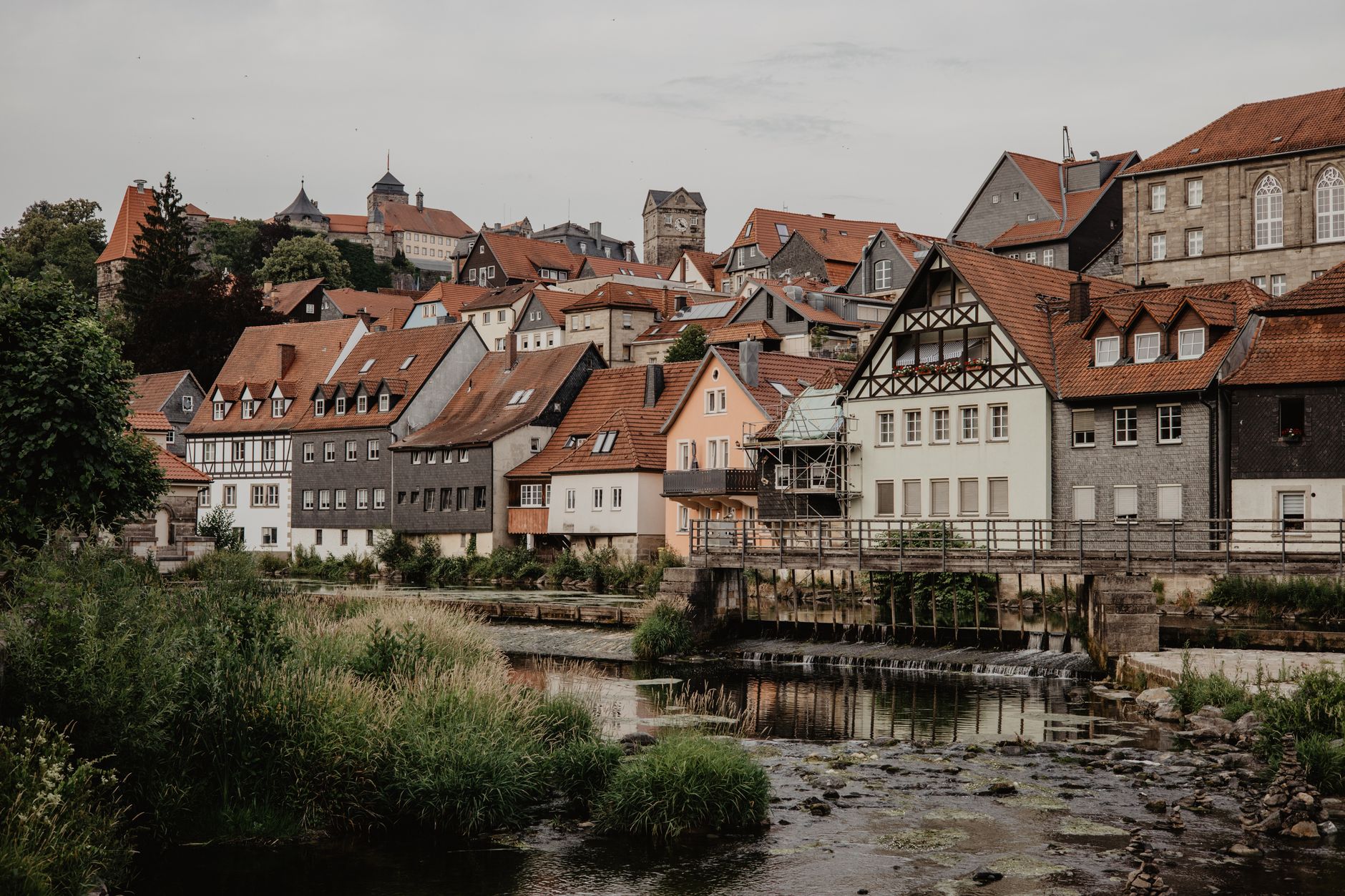
Photo by Nadin Romanova
Hamburg provides a sharper, more contemporary contrast to the medieval charm of Lubeck. The red-brick warehouses, steel footbridges, and dark canals of the Speicherstadt are ideal for street photography during overcast conditions. Blue hour works especially well near the Wasserschloss, where warm light from the windows balances perfectly against the cooler water and sky.
The Speicherstadt and Kontorhaus District is also a UNESCO World Heritage site and offers much more than just a quick stop between cafes. Walk through the area at dawn on a weekday when delivery traffic is light and the narrow bridges offer cleaner compositions. A 35mm or 50mm lens helps isolate the repeating windows and geometric lines.
For coastal work, head to the Wadden Sea near Cuxhaven, St. Peter-Ording, or the East Frisian Islands. Low tide exposes wet sand, meandering channels, and wide reflections, making this an ideal location for sunset photography. Tidal conditions change rapidly, so check official local schedules before walking far across the mudflats.
Wind is an essential part of the coastal picture. Keep your horizon level, protect your lens from salt spray, and use a cleaning cloth often. Always carry a cloth in your bag. Salt haze can soften every frame before you even notice it settling on your glass.
The Harz: Steam, Timber Frames, and High Moorland
The Harz Mountains sit across Lower Saxony, Saxony-Anhalt, and Thuringia. Their slopes are gentler than the Alps, yet the region has a strong visual identity: dark spruce, granite outcrops, old mining towns, and steam locomotives climbing through mist.
Quedlinburg is one of the best urban photography stops in central Germany. Its Old Town is a treasure trove for street photography, featuring more than 2,000 half-timbered houses that lean at odd angles or display intricate painted details. The UNESCO World Heritage site designation for Quedlinburg celebrates these historic landmarks, encompassing both the preserved town layout and the imposing collegiate church.
Morning is the right time to visit this area. A thin layer of fog often sits between rooftops, while the streets remain empty enough for clean, compelling compositions. Walk around Wordgasse and Pölle, then photograph the castle hill from the lower streets to capture the character of the historic architecture.
The Harz Narrow Gauge Railways add a sense of movement to any landscape shoot. Steam trains run toward the Brocken, the highest peak in the region, and their dark engines look striking against snow, rain, or autumn foliage. When capturing these historic trains, stand well clear of the tracks and use public crossings or platforms.
Weather on the Brocken changes quickly. Clouds can swallow the summit in minutes, which makes a bright forecast less useful than a flexible itinerary. In poor visibility, shift your attention to wet branches, railway tracks, or hikers moving through the mist.
Quedlinburg also shines after dark. The warm window light reflecting off the historic half-timbered houses creates a scene that feels lived-in rather than staged. Use a small tripod where permitted, then keep exposures short enough to avoid blurred pedestrians while you document the atmosphere of this unique Old Town.
Rhine and Moselle Views Without the Usual Cliches
The Rhine Valley and Moselle regions are famous for their rows of vineyards and fairytale castles, offering a visual experience that feels distinct from the crowded routes of the Romantic Road. Their photographic strength comes from elevation and the repetition of the landscape. Curving river bends create natural leading lines, while terraced vines add depth and texture across the steep slopes.
The Rhine section between Bingen and Koblenz is part of the Upper Middle Rhine Valley UNESCO World Heritage site. While Loreley is the most famous overlook, the smaller villages and local ferry crossings often provide better foregrounds for your compositions.
Bacharach is worth an early visit for its stunning collection of half-timbered houses. These buildings climb toward Stahleck Castle, and the riverfront provides excellent opportunities to capture passing barges for a sense of scale. Shoot toward the blue hour if you want the warm glow of town lights reflected on the water, though keep in mind that wind can break the surface reflection quickly.
The Moselle feels more intimate by comparison. Cochem’s Reichsburg is popular, so try to move beyond the standard bridge view. The Calmont vineyard near Bremm gives a high view over one of the river’s tightest bends. Trails here can be steep and exposed, so prioritize sturdy hiking shoes over fashionable travel gear.
At the Moselle bend near Bremm, the river makes a near-complete loop beneath the vineyards. Here, the village roofs and slow-moving freight boats offer enough scale to keep a broad frame from becoming a simple green and blue pattern.
Autumn is a reliable season for capturing gold vines, but spring brings cleaner greens and significantly fewer visitors. After a rainstorm, the wet slate roofs and low-hanging clouds can make the entire region feel more cinematic than a bright, traditional postcard afternoon.
Do not ignore the small details. Vineyard walls, old cellar doors, and rusted river bollards can support a wider visual story for your social media posts or a long-form photo essay. These places are at their strongest when you mix the grand, sweeping viewpoints with close, local observations.
Spreewald, Dessau, and the Ruhr’s Hard Edges
East Germany offers some of the most varied photo spots in Germany, often within a few hours by train. If you are basing your trip in the capital, the Spreewald, located south of Berlin, provides a tranquil escape from the urban density of the city and the historical weight of the Berlin Wall. Its network of narrow waterways passes cottages, alder trees, and small wooden landing stages.
Go early in the morning, before hired punts begin moving through the most popular channels around Lübbenau. A canoe lets you choose your angle, although you should keep noise low near homes and wildlife. Still water favors reflections, while rain makes reeds and wood grain more saturated.
Dessau provides a clean architectural counterpoint. The Bauhaus Building, designed by Walter Gropius, has strong geometric lines and a glass facade that changes character with the sky. The UNESCO World Heritage Bauhaus sites in Weimar and Dessau are useful for planning a more informed visit.
Use a wider lens carefully at Bauhaus Dessau. Correct verticals in camera or in editing, because exaggerated converging lines can distract from its disciplined geometry. Late afternoon brings stronger side light across concrete surfaces, although cloudy conditions suit the glass facade.
In the Ruhr, industrial structures replace storybook scenery with steel, rust, and enormous scale. This raw, metallic aesthetic provides a gritty alternative to the polished glass and steel of the modern Frankfurt skyline. Landschaftspark Duisburg-Nord is the standout. The former ironworks is open to visitors, and elevated platforms reveal pipework, furnaces, stairways, and distant city light.
Night photography is especially rewarding there. Sodium-colored lights mix with deep shadow, so bracket exposures if contrast exceeds your camera range. A wide lens shows the full structure, while a telephoto can turn pipes and stairs into abstract patterns.
Patience beats a packed schedule. Wait for a cyclist, a lone walker, or a train to enter the frame. Human scale matters in industrial scenes.
Practical Timing for Lesser-Known Germany Photo Locations
Mastering travel photography in Germany requires a balance of respecting local routines and navigating logistical access rules. Churches often close during services, historic castles frequently limit the use of tripods, and nature reserves may restrict paths during sensitive nesting seasons. Furthermore, drone regulations are strictly enforced around airports, urban centers, and protected landscapes.
Always read posted signage carefully. A dramatic frame is never worth the risk of crossing a barrier or damaging a fragile ecosystem. Many of these hidden gems are perfect for day trips from major transport hubs, allowing you to venture out and return with ease.
Use the following photography guide to help shape your route:
| Location type | Strongest conditions | Practical approach |
|---|---|---|
| Sandstone viewpoints | Cool, clear mornings after rain | Ideal for sunrise photography; arrive early with a headlamp |
| Brick cities and canals | Overcast days or blue hour | Explore during day trips before commuter traffic builds |
| River valleys | Spring, autumn, or passing storms | Pair a high-altitude lookout with a riverside scene |
| North Sea coast | Low tide with broken cloud | Check tide times before setting out for your session |
| Industrial sites | Blue hour and light rain | Use a tripod where site rules allow and safety permits |
The key is to match your subject with the right conditions rather than chasing a fixed calendar date. While summer offers long days, winter provides bare trees, quieter streets, and clearer visibility at many urban viewpoints.
Save offline maps before heading out on hikes in Saxon Switzerland or the Harz, as cell signal can fade in steep valleys and dense forests. Carry plenty of water, a reliable power bank, and a small rain cover, as German weather often changes entirely within the span of a single train journey.
If your travel photography involves local people, always ask before taking close portraits. In quiet market towns and rural villages, a brief, polite conversation often leads to a much more authentic image than a distant shot taken in haste. Respect makes your journey easier, and it almost always improves the quality of your work.
Frequently Asked Questions
Do I need a car to visit these photography spots?
Not necessarily, as Germany’s extensive regional rail network connects many of these areas efficiently. Trains often drop you within walking distance of historic centers and trailheads, though a rental car can provide more flexibility in rural regions like the Moselle Valley or on the East Frisian Islands.
What is the best season for photography in Germany?
Each season offers distinct advantages, but spring and autumn are generally preferred for their softer light and vibrant colors. Spring brings blooming vineyards and fewer crowds, while autumn provides moody conditions and golden foliage, particularly in the Harz region and along the Rhine.
Are drones allowed at these locations?
Drone regulations in Germany are strictly enforced, especially near airports, urban centers, and within many protected national parks. Always check local signage and official German aviation authority websites before flying, as unauthorized drone use can lead to significant fines or legal issues.
How can I avoid crowds at popular viewpoints?
Prioritizing sunrise is the most effective strategy, as most day-trippers do not arrive until mid-morning. If you cannot make a dawn start, visit during the shoulder seasons or mid-week to ensure you have more space to compose your shots without interference.
Final Frame
Germany’s most compelling photographs often sit outside the saturated travel routes of Bavaria or the Black Forest. Whether you are capturing sandstone cliffs, shifting tidal flats, quiet canal towns, vineyard bends, or weathered industrial ruins, these regions offer their own unique weather, pace, and visual language.
Choose fewer destinations and give each location enough time to reveal itself. Germany photo spots become significantly more personal when you commit to returning to the same viewpoint under different light.
The pale sandstone arches of Bastei are most striking when the first sun reaches the Elbe valley below. By stepping away from the typical tourist trails, you will find that the country’s most rewarding scenic landscapes are waiting in the quiet corners that many travelers overlook.
