
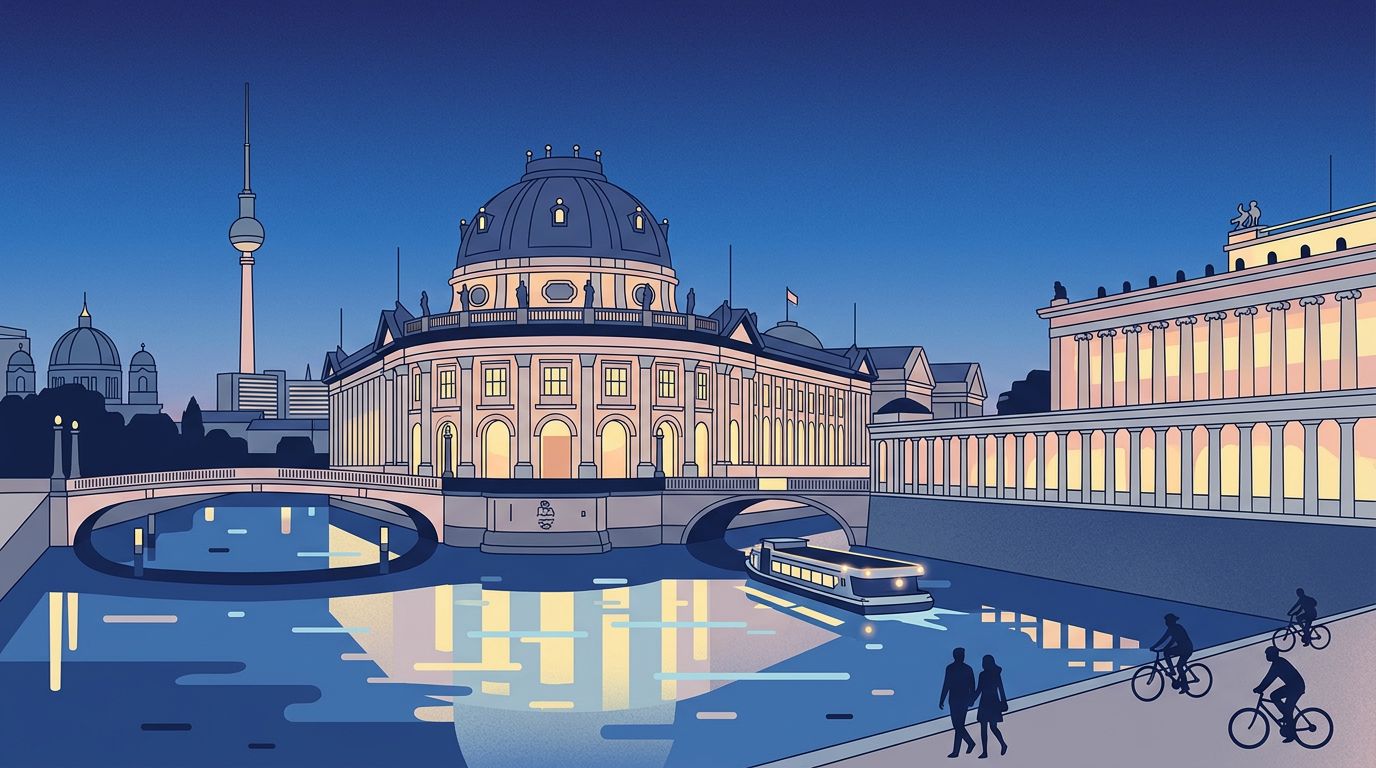
The blue hour in Berlin can turn Museum Island into a layered study of water, stone, and light. The Spree river catches the last cobalt tones of the day while domes, colonnades, and bridges begin to glow, yet the scene changes fast once the city lights overpower the sky.
If you are looking for the best Berlin photo spots that combine historic architecture with striking reflections, this compact stretch of central Berlin is hard to beat. You need precise timing, a few reliable viewpoints, and enough patience to wait through passing boats and cyclists.
Arrive before sunset, then let the fading light guide your route.
Key Takeaways
- Start your walk near the Bode Museum before heading south along the Spree toward James-Simon-Park.
- Blue hour is at its peak when the sky retains rich color and the warm building lights begin to illuminate the architecture, providing perfect conditions for night photography.
- Use a tripod to capture smooth water reflections, but remain mindful of your surroundings on busy pedestrian paths.
- The Friedrichsbrucke offers a classic view of the Bode Museum with the Spree in the foreground.
- Consider combining this route with a visit to the Brandenburg Gate, which is just a short journey away for those looking to expand their Berlin photo tour.
- Shift your position frequently, as changing bridge angles, passing boat wakes, and shifting street lamps can transform your composition in an instant.
Time Your Visit for the Spree’s Best Light
The useful shooting window begins before blue hour. Get to this historic district 30 to 45 minutes before sunset, while architectural detail is still easy to meter and you can choose a clean foreground without working under pressure.
After sunset, Berlin’s sky often shifts through pale gold, lavender, and deep blue. The warmer facade lights usually appear before the sky goes dark, which creates the contrast most photographers want. On clear evenings, the strongest balance often lasts only 15 to 25 minutes.
Clouds help. A thin broken layer can hold color above the River Spree long after a clear sky has gone flat. Heavy low clouds can work too, especially when they reflect city light, but they reduce separation around the TV Tower and the distant domes. When you look toward the horizon, the glowing presence of the Fernsehturm adds a sense of scale, especially when compared to the sleek, modern glass of Potsdamer Platz.
This area sits in the Mitte district, surrounded by major roads, bridges, and active pedestrian routes, so expect a working city rather than a silent heritage set. The overview from Staatliche Museen zu Berlin is useful for checking access and current building information before planning a longer evening.
Arrive early enough to photograph the warm phase. Blue hour looks richer when you already have a composition ready.
During a November evening, the early darkness gives you time to photograph the Bode Museum architecture under a saturated sky before dinner. In June, however, the late sunset can push the best light close to 10 p.m., and the same route feels far more crowded. That seasonal difference affects both your shooting plan and your return journey.
Friedrichsbrucke: The Classic Bode Museum Frame
Friedrichsbrucke is one of the most dependable photography locations for the complex. Stand on the north side of the bridge and look southwest toward the Bode Museum. Its pale facade, rounded dome, and the curve of the Spree form a strong, balanced cityscape. While capturing this shot, you can often spot the Berlin Cathedral in the distance, and the iconic Berlin Dom silhouette serves as a perfect backdrop if you pivot slightly toward the south.
Move slowly along the bridge rather than settling in the middle. The central viewpoint gives the cleanest symmetry, while the eastern side places more of the river into the lower frame. A slightly lower camera height can make the water feel broader, though bridge railings may intrude.
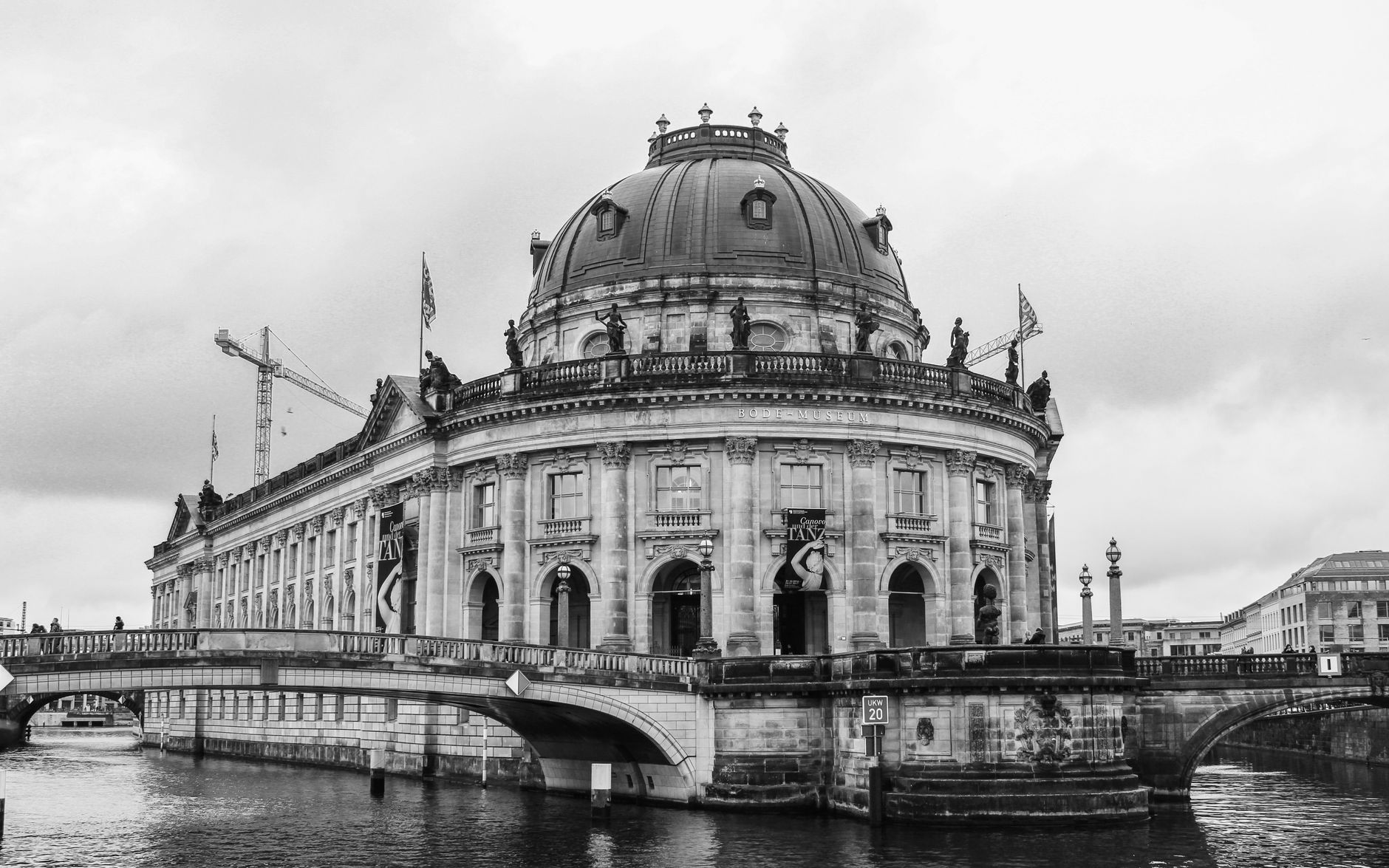
Photo by Giovana Spiller
Use a focal length between 35mm and 50mm full-frame equivalent if you want the building to retain its natural proportions. Using a wide angle lens can include more river and sky, but it also stretches the bridge edges and makes the museum seem farther away.
A tripod is useful here for capturing a smooth long exposure of the flowing water. The bridge surface can transmit small vibrations when people walk past, so wait for a gap and use a two-second self-timer or remote release. If you handhold, stabilize against the railing carefully without blocking other pedestrians.
The Bode Museum opened in 1904 as the Kaiser-Friedrich-Museum and took its present name in 1956. Its placement at the northern tip of the island explains why it photographs so well from several angles. Water wraps around it like a moat.
Best setup at Friedrichsbrucke
The choices below give a quick starting point, then adapt for the available light.
| Subject | Suggested focal length | Starting exposure approach |
|---|---|---|
| Bode Museum and river | 35mm to 50mm | Tripod, ISO 100, f/8, 1 to 8 seconds |
| Dome detail with reflection | 70mm to 100mm | Tripod, ISO 100 to 400, f/8 |
| Passing boat light trails | 24mm to 35mm | Tripod, ISO 100, f/8, 10 to 20 seconds |
| Handheld architectural frame | 35mm | ISO 800 to 1600, f/4, 1/60 second or faster |
Longer exposures soften the water, although a passing boat can turn a clean reflection into a broken ribbon. Take several frames. The river decides the final texture.
James-Simon-Park and the East Bank Views
Cross toward James-Simon-Park for a looser view across the Spree. This area gives you room to include riverbank trees, moored boats, and the active city beyond this cultural hub. It is less formal than Friedrichsbrucke, which suits photographers who enjoy the candid energy of street photography in a lived-in Berlin frame.
Face west or southwest to place the Bode Museum and Monbijoubrucke near one another. In summer, leaves can obscure parts of the architecture, so shift toward open railings and riverside gaps. During colder months, bare branches can become useful dark lines against the illuminated facades, providing a gritty contrast to the polished street art occasionally found on nearby infrastructure.
The terrace and steps near the river attract people after work, particularly on warm nights. That activity can add scale and atmosphere, but it also creates accidental distractions. A wide aperture can soften the nearest figures, while a longer exposure can blur movement into subtle shapes.
Tripod territory, especially after sunset.
The James-Simon-Galerie visitor information helps when you want to pair the photo walk with a late museum visit or need to confirm access around the area. If you are arriving from Alexanderplatz, take a moment to observe the urban transition from the high-rise skyline to the historical riverbanks. Even when museums are closed, public paths and bridges can remain busy.
For a more layered composition, use the riverbank railing as a diagonal. Keep it low in the frame and let it lead toward the museum. Avoid centering every landmark. Berlin’s visual character often sits in the gaps, a glowing window, a bicycle silhouette, or reflected ripples behind a bridge pier.
Monbijoubrucke and the View Toward the Domes
Monbijoubrucke sits north of Museum Island and provides a unique perspective on the water. It is an ideal spot when you want the bridge architecture to serve as an active element of the composition rather than just a place to stand. The iron structure, ornate lamps, and river traffic can beautifully frame the Bode Museum or draw the eye toward the historic buildings farther south.
A vertical composition works well here. Place a bridge lamp in an upper corner, then allow the river to draw the eye down toward its shimmering reflections. Watch for lamp flare, though. Shield the front element with your hand or lens hood, taking care not to enter the frame.
The bridge also works well with a telephoto lens. Compress the far riverbank, museum facades, and small boats into stacked planes. At 85mm or 100mm, you can isolate light patterns that often disappear in wider city views. As you look across the water, the architectural density feels reminiscent of Berlin’s complex Cold War history, where the division of the city once dictated how these views were perceived.
Blue hour does not forgive clipped highlights. Set your exposure for the bright lamps or illuminated windows, then lift the darker architecture later if your file allows it. RAW files give you far more control when the sky and street lighting differ by several stops.
On the west side, the Berlin WelcomeCard transport guide can help visitors plan an evening route back through the city. Once you finish your session, the nearby Hackescher Markt U-Bahn station provides a practical connection for onward travel. If you are looking for more elegant architectural shots after finishing your night, the Gendarmenmarkt remains a highly recommended location to continue your photography.
Frame the Spree Rather Than Treating It as Empty Space
The Spree is not merely a foreground element in your photography. It carries reflection, movement, and scale. When the water is calm, you might see the iconic silhouette of the TV Tower shimmering in the surface alongside the illuminated museums. While the Spree here feels elegant and historic, it lacks the gritty, industrial atmosphere found further east at the Berlin Wall or the vibrant murals of the East Side Gallery. Despite this difference, the river remains a powerful compositional tool. When a sightseeing boat passes, its wake breaks the image into bright pieces, creating an energetic frame that feels distinct from the static, grand vistas captured at the Oberbaumbrücke.
Wait for river traffic to clear if you want mirror-like reflections. Conversely, shoot immediately after a boat passes when you want streaked lights and shifting texture. Both results are valid, but they require different shutter speeds.
A one to three-second exposure keeps some character in the surface. At 10 seconds or longer, the water often becomes smoother and more abstract. Strong wind can prevent a clean reflection at any shutter speed, so turn your attention to architectural shapes and the dramatic sky.
Composition choices that hold up after dark
- Use bridge arches or railings to create a clear edge around the frame.
- Keep the horizon level, especially when water reflections make small tilts obvious.
- Leave room above domes and towers so the blue sky remains part of the image.
- Look for a single warm light in the lower frame to counterbalance the cooler sky.
- Check frame edges for cropped bicycles, half-visible signs, and bright lamps.
A small change in position can remove a distracting streetlight or align a dome with an open patch of sky. Review the corners before the light fades to ensure your composition is balanced and clean.
Camera Settings and Blue-Hour Field Habits
Start at ISO 100 when your tripod is stable to achieve the highest image quality. Set your aperture to f/8 for wide architectural scenes, then adjust the shutter speed after checking your histogram. When you want to capture a crisp long exposure of the riverfront, you may find that f/11 helps manage light, although longer durations increase the risk of vibration.
For handheld night photography, prioritize a fast shutter speed above all else. A sharp 1/60-second image at ISO 1600 is much more useful than a blurred ISO 100 file. Modern cameras handle moderate noise well, and a slightly grainy city scene often feels more natural than smeared details caused by camera shake.
Turn off image stabilization when your camera sits on a sturdy tripod if your manufacturer recommends it. Also, use electronic front-curtain shutter or a delayed release when available. These small technical choices make a significant difference during multi-second exposures.
Carry a microfiber cloth at all times. River humidity and light rain can settle on the front element, and street lamps will turn each droplet into a distracting glowing spot. Check your lens carefully after each change of location.
Keep your gear compact. The pathways near the water are busy, and a sprawling camera bag creates problems for everyone nearby. A camera, two lenses, a tripod, a spare battery, and a weather layer cover most evening sessions effectively.
Respect the Location After Dark
Museum Island is a UNESCO World Heritage site, but it is also a public space used by residents, visitors, staff, and cyclists. Keep paths clear, avoid placing tripods across narrow walkways, and do not climb walls or railings for a higher angle. This level of respect for public property should extend to other sensitive locations in Berlin, such as the Holocaust Memorial or the area surrounding the Reichstag building, where quiet and consideration are essential.
Security personnel may ask you to move near entrances or construction zones. Cooperate without argument and find another angle. Berlin offers plenty of photographic opportunities within a few minutes walk of any restricted area.
Be considerate around people on the riverbanks. A long exposure can make strangers disappear visually, yet they remain present in the space. Avoid pushing equipment into seating areas or repeatedly photographing someone who has not agreed to be included.
Night photography needs calm judgment. Protect your gear, stay aware of bikes, and pack before the scene becomes too dark to see small accessories.
Frequently Asked Questions
Is it necessary to use a tripod for blue hour photography on Museum Island?
Using a tripod is highly recommended if you want to capture smooth water reflections and maintain high image quality at lower ISO settings. While modern cameras perform well handheld, a stable support allows for longer exposures that transform the Spree into a calm, reflective surface.
What time of year offers the best lighting conditions for this route?
Autumn and winter are often favored by photographers because sunset occurs earlier, providing a longer window for blue hour while the city is still lively. In the summer, sunset happens quite late, which can lead to larger crowds and a shorter duration of prime shooting light before the area becomes very dark.
Can I photograph near the museum buildings at night?
Yes, the public paths around the island are open, but please remain respectful of the UNESCO heritage site status. Always keep your equipment out of the way of pedestrians and cyclists, and be mindful that security personnel may restrict access near certain building entrances or construction areas.
Which lens focal lengths are best for capturing the architecture?
A focal length between 35mm and 50mm is ideal for capturing natural proportions of the Bode Museum and surrounding structures. If you want to include more of the river or bridge elements, a wider lens is useful, while a telephoto lens around 85mm to 100mm helps compress the scene and isolate architectural details.
Final Light on Museum Island
The best Berlin photo spots often reward those who slow down and react to the changing sky rather than chasing every landmark. Friedrichsbrucke provides a clean architectural perspective, while the east bank and Monbijoubrucke offer dynamic frames featuring water, bridges, and city movement.
These locations are conveniently clustered, allowing you to revisit a composition as the light shifts. While this area remains a highlight, many photographers also make time for the Brandenburg Gate or the historic murals at the East Side Gallery during their trip. To conclude your evening, you might finish at Friedrichsbrucke as the Bode Museum dome sits above a darkening river and the lamps begin to glow. Once you have captured your shots, consider heading toward Kreuzberg or Friedrichshain to experience the local nightlife and relax after your session.
