
Some of Lithuania’s strongest frames sit in plain sight. If you’re hunting for photo spots in Lithuania that give you old stone streets and wide sand ridges, this trip is easy to shape.
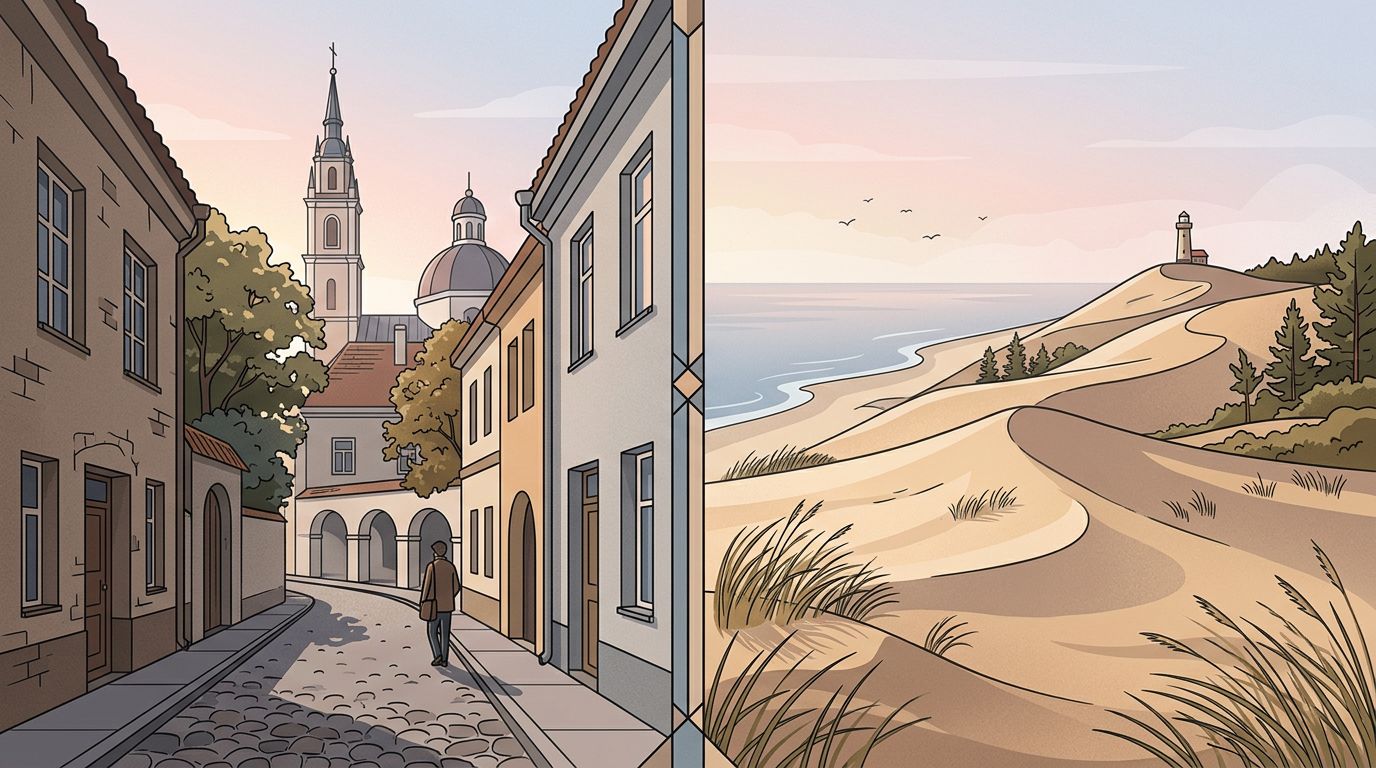
Vilnius gives you towers, courtyards, and cobbles. The Curonian Spit gives you wind, open space, and dunes that shift a little every year. Start there, and your camera roll changes fast.
Vilnius Old Town for narrow streets and church towers
Mist on cobbles. Vilnius often looks best before breakfast, when the streets are still quiet and the light has not yet flattened the old facades. The city rewards slow walking, because many of its best angles hide one turn away from the main squares.
For a quick route, the Go Vilnius photo guide is useful for finding courtyards and small streets without wandering in circles.
Cathedral Square and Gediminas Hill
Cathedral Square gives you room, scale, and a clean view of the skyline. It works well when the light is soft and the square is still opening for the day. If you want the classic rooftop view, keep climbing toward Gediminas’ Tower views, where red roofs, church spires, and narrow lanes stack into one frame.
Go early.
Crowds build fast.
From the hill, the city looks calm. Down below, you still hear footsteps and tram lines. That contrast is why the view holds up so well in photos.
Gate of Dawn and Aušros Vartų Street
The Gate of Dawn is one of those places that looks best when people are still moving through it quickly. Morning light hits the pale walls well, and the gold icon inside has a quiet glow that suits a tighter frame. On Aušros Vartų Street, the cobbles and church towers give you a stronger sense of depth than a single landmark shot.
If you like street-level scenes, walk slowly here. Look for window reflections, old signs, and small gaps between parked cars. They help the image feel lived in.
Glass Quarter and Literatų Street
The Glass Quarter is better than it sounds. Courtyards, polished surfaces, and café tables give you layers without much effort. Literatų Street works in a different way, with small art pieces that pull your eye from wall to wall.
One rainy afternoon, I watched a small group stop beside a doorway in the Glass Quarter, wait for the rain to thin, and then get three strong shots from the same spot before the street filled again. That kind of moment happens a lot in Vilnius.
Crowds shift fast.
That helps you.
The best time here is often between the rush hours, when the streets feel open but not empty. You can keep moving and still find a frame worth keeping.
Trakai and Kaunas for a wider old-town frame
Vilnius is the obvious stop, but Lithuania gives you a few more old-town scenes that photograph well without much setup. Trakai brings water into the frame. Kaunas brings sharper edges and more texture.
Trakai Castle before the boats wake up
Trakai is strong when the lake is still and the castle reflects cleanly. Early morning works best, especially if you want the towers without too many people on the shore. The shot changes with weather, too. A pale sky can make the castle feel almost painted on.
Walk the path slowly.
The shore gives you options.
You can shoot the castle from farther back for a broad view, or move closer for the waterline and the wooden bridge. Either way, the scene feels balanced, because the lake gives the eye a place to rest.
Kaunas streets after sunset
Kaunas is a good choice if you want old-town stone with a different rhythm. The streets are tighter in places, and the light can slide across façades in a nice way after sunset. The city also gives you more room for detail shots, from courtyards to street corners.
If you want ideas before you go, the Kaunas photo ideas page is a handy place to start. It helps when you want a route, not just a list.
Kaunas works well for people shots, too. The streets feel less formal than Vilnius, so a person walking through the frame can make the scene feel more natural.
The Curonian Spit turns sand into a subject
The dunes are why many photographers make the long trip west. On the Curonian Spit, the light has room to spread, and the land feels open in a way old towns never do. The best scenes come from patience, because the wind changes the shape of the sand and the mood of the sky together.
The Parnidis Dune page gives the basic visitor details, while Parnidis Dune sunsets shows why the viewpoint keeps drawing people back.
Parnidis Dune and the sundial
Parnidis Dune is the classic shot in Nida. It sits about 1.5 km south of town, and the wooden stairs make the climb easy enough for most visitors. At the top, the sundial adds a clear focal point, while the lagoon and the sea spread out behind it.
Because the dune is high and open, sunrise and sunset both work well. Sunrise gives you fewer people and a cooler palette. Sunset gives you longer shadows and warmer sand. On clear days, the scene can feel almost unreal, because the dune line seems to keep going after the eye thinks it has already reached the edge.
One evening in Nida, I watched a small group stop beside the boardwalk, all checking the sky, then lift their cameras at the same second when the sun touched the lagoon. Pink sand. Quiet air. Then the wind came back.
Dead Dunes for texture and distance
The Dead Dunes, also called the Grey Dunes, give you a rougher look. The sand feels older here, and the lines are less tidy. That makes the area good for wider landscape shots and for frames where the foreground matters as much as the horizon.
Stay on the boards.
The area is protected.
As of May 2026, the Dead Dunes are open daily from late April to October, roughly 9 a.m. to 8 p.m., with €5 entry. That makes spring a smart time to visit, before the busiest summer weeks arrive.
Check drone rules before you go.
The dunes can be beautiful, but they are fragile. Walking only on marked paths keeps the sand from breaking down faster than it should.
How to plan the day around light and movement
A little timing saves a lot of wandering. Old towns usually work best in soft light, while dunes need lower sun and fewer shadows on the sand. If you split the day this way, the trip feels smoother and your frames look more deliberate.
| Spot | Best light | What it gives you |
|---|---|---|
| Vilnius Old Town | Early morning, blue hour | Empty streets, church towers, window glow |
| Trakai Castle | Sunrise | Calm water, soft sky, clean reflections |
| Parnidis Dune | Sunrise or sunset | Long shadows, open horizons, warm sand |
| Dead Dunes | Late afternoon | Texture, contrast, fewer harsh highlights |
The pattern is simple. Soft light suits stone. Low sun suits sand. If you’re driving onto the Curonian Spit, plan for the ferry from Klaipėda Old Port and the road toll before you leave, because those small details shape the day more than people expect. Walk-on travel is easier, but a car gives you more freedom once you’re there.
Bring water.
Bring sun cream.
Bring a cloth for sand.
Wide-angle lenses help in the old towns and on the dunes, while a small tripod can help when the light drops after sunset. Don’t forget comfortable shoes, because the best frames often sit a little farther than the closest viewpoint.
Conclusion
Lithuania works well for photographers because it gives you two very different backdrops without much wasted travel. Old towns bring hard lines, warm walls, and close detail. The dunes bring space, wind, and changing light.
If you want one trip that feels varied, start in Vilnius, add a stop in Trakai, then leave time for the Curonian Spit. The light at the dunes changes fast, and the best frames often happen when you wait a little longer than feels necessary.
Will you catch the last light on the brass lines of the sundial at Parnidis Dune?
