
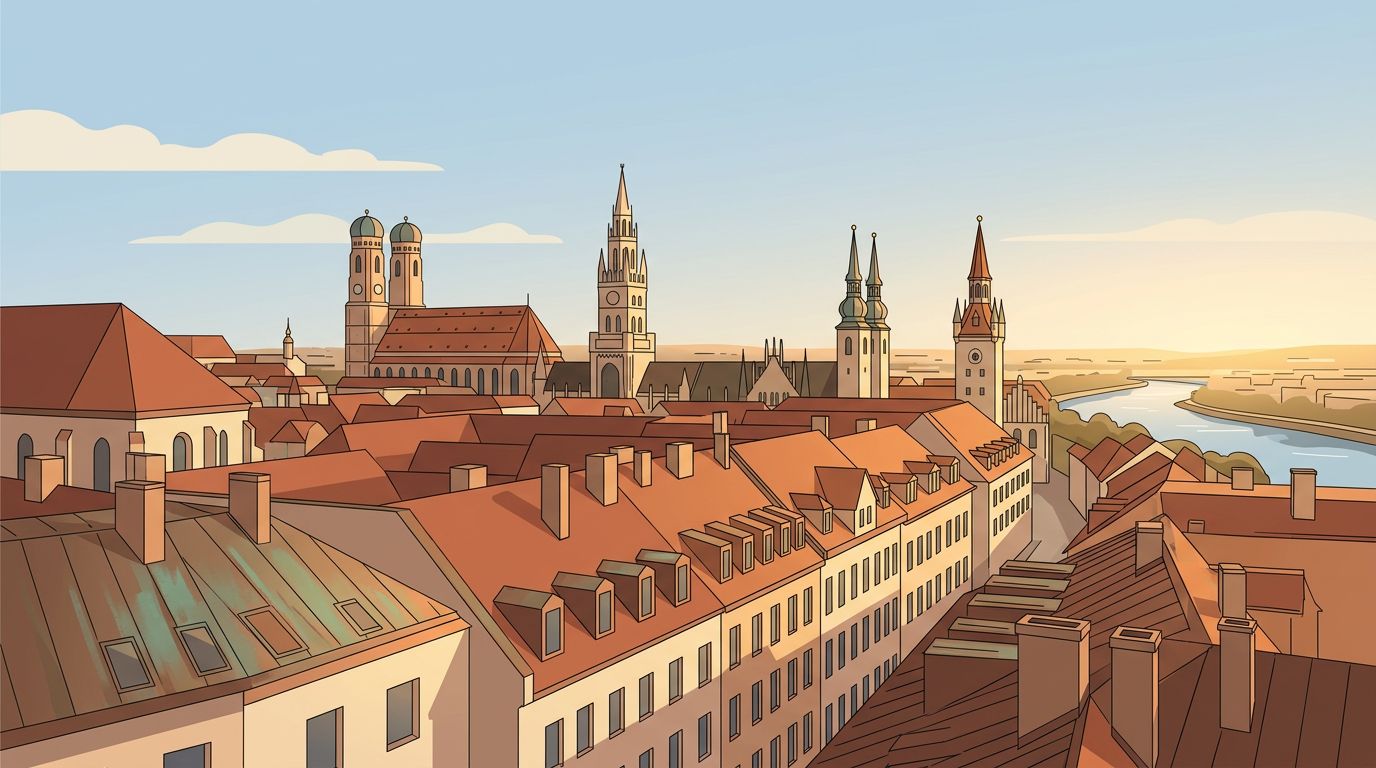
Munich’s cleanest photo light often arrives before the first tour groups fill Marienplatz. The city rewards patience, because a few minutes can turn blank gray roofs into a layered pattern of tile, copper, towers, and chimney stacks.
The strongest Munich photography spots are close together, yet their best conditions rarely overlap. Plan around tower hours first, then let sunrise, sunset, and blue hour decide the walking route.
Start with Munich’s changing light
Old Town façades face several directions, so one sunset plan won’t suit every street. Morning light reaches high church spires before it reaches the narrow lanes, while late afternoon gives warm side light to stonework around Marienplatz and Viktualienmarkt.
Clouds change the plan. A thin, broken layer can hold color after sunset, whereas a solid gray ceiling makes rooflines look flatter and calls for tighter architectural frames.
Work with low-angle and reflected light
Because the church towers catch the first side light while the narrow lanes remain dim, a clear morning can give you layered depth without pushing highlights into the blank white blocks that make Old Town scenes feel flat. Start around Petersbergl, Rindermarkt, or the lanes beside the Viktualienmarkt, where taller buildings create useful shade.
At first light, a pocket of quiet before the first tram. Use that pause to photograph fixed compositions without people crossing the frame.
For the river, arrive before sunrise or stay after sunset. A 20 to 30-minute blue-hour window often gives the Isar its best balance of sky color and visible detail along the banks.
A tower that closes before sunset can still be useful. Shoot roof geometry from above in the afternoon, then repeat the same focal-length idea at street level or beside the Isar.
Munich photography spots above the Old Town
Height reveals the logic of Munich’s center. Instead of chasing every church tower, choose one elevated viewpoint, then use the rest of your time for closer and more personal frames.

Photo by Ehsan Haque
Alter Peter for dense rooftop patterns
Alter Peter is the classic choice for packed red roofs, the Frauenkirche domes, and the New Town Hall’s elaborate silhouette. The official Alter Peter visitor page confirms why the tower remains one of the city’s strongest panoramic viewpoints.
Bring a 24-70mm lens rather than relying only on ultra-wide glass. At 50mm or longer, you can isolate the Frauenkirche against overlapping roofs and avoid the curved edges that make distant towers lean.
In summer, Alter Peter’s posted hours can reach into the evening, but they still may end before the best late blue hour. Check access on the day, particularly around church events, and travel light for the stair climb.
New Town Hall and Frauenkirche viewpoints
The New Town Hall tower gives a different angle because its viewing platform looks across Marienplatz and toward the surrounding church towers. Its official booking page lists lift access, daily opening from 10 a.m. to 8 p.m., and a last ascent at 7:40 p.m.
For a high, open view, the Frauenkirche South Tower is another option. However, its tower tickets and opening details show a much shorter shooting window, generally ending at 5 p.m. It works best for afternoon clouds and crisp daylight, not summer sunset.
Build Old Town frames at street level
The elevated views establish the city’s shape. Street-level work gives the photographs a sense of place, scale, and weather.
Use Marienplatz without photographing the obvious
Start on the outer edges of Marienplatz instead of standing in its center. A position near Weinstraße can place the New Town Hall façade at an angle, while the edge near Dienerstraße gives you room to include cyclists, café tables, or passersby beneath the tower.
Midday is for scouting. Look for narrow gaps between façades where a church spire appears above a single roof plane. The best compositions often have one dominant tower, a simple foreground, and enough negative space for the sky.
A 35mm lens is useful here. It feels wide enough for the square but avoids the stretched perspective of a 16mm frame.
Find texture beyond the postcard view
Walk toward Petersbergl and the lanes around Viktualienmarkt when the square becomes crowded. Roof tiles, carved signs, old shutters, and wet cobbles can anchor a frame that includes only a sliver of skyline.
On June 3, 2018, photographer Gerhard Willhalm photographed the cannonball at Alter Peter for Munich’s City History archive. That modest subject offers a useful cue: photograph one overlooked detail before chasing the broad panorama.
A roofline image feels more convincing when the foreground belongs to Munich. A weathered church wall or market awning often does more than another full-width skyline.
Follow the Isar for reflective blue hour
The Isar changes the rhythm of a Munich photo walk. Water softens the city, adds movement to still scenes, and holds the last color after the towers have gone dark.
Begin near Maximiliansbrücke
Maximiliansbrücke is a practical first stop after Old Town shooting because it sits close to the center. From there, work both banks and look downstream for layers of water, trees, and bridge arches.
Munich’s official guide to walking the Isar from Maximiliansbrücke follows the east side of the river, a useful route when you want to keep moving rather than wait at one bridge.
Use a polarizer carefully near sunset. It can reduce glare on leaves and wet stone, but it also costs light and can weaken reflections. Remove it before blue hour if shutter speeds begin to drag.
Reichenbachbrücke, Wittelsbacherbrücke, and Flaucher
Reichenbachbrücke gives you a more lived-in river scene, with paths, cyclists, and people lingering along the banks. Keep the bridge structure out of the center when possible, then let its lines enter from a corner and guide the eye toward the water.
On a calm evening, work one scene from the bank and a second from the bridge, because a small shift in height changes whether the Isar holds a clean reflected stripe or breaks into bright, distracting ripples. Bring a cloth for spray and mist.
Farther south, Wittelsbacherbrücke and Flaucher offer more trees, pebbled edges, and less obvious architecture. Those locations suit long exposures of moving water, especially when a low cloud ceiling keeps color in the western sky.
Carry a lean kit and protect the shot
A long Munich walk is easier when every item earns its weight. The city center has cobbles, stair climbs, crowded pavements, and damp river paths.
Choose lenses for the frames you need
A 24-70mm zoom covers most Old Town scenes. Add a compact 70-200mm only if you want compressed roof patterns or isolated tower details from the riverbanks.
Bring a microfiber cloth. River spray, rain, and fingerprints show quickly against blue-hour highlights.
A small tripod helps after sunset, but use it with care near bridges and narrow paths. Keep legs close together, avoid blocking pedestrians, and wait for a clear moment before setting up. A two-second timer or remote release also helps when a bridge vibrates under foot traffic.
Respect access, worship, and public space
Church viewpoints are working religious spaces, not open-air studios. Keep your voice down, follow staff directions, and don’t bring large equipment into a crowded tower stairwell.
Commercial productions need more preparation than a personal travel shoot. Munich states that filming in public green spaces requires a separate permit. That matters if you plan to use crew members, lights, stands, or a formal production setup beside the Isar.
For personal still photography, courtesy carries most of the work. Leave room on paths, don’t climb barriers, and move on when a location stops feeling comfortable.
Build a route around access windows
The most useful Munich photography spots fit into one day when you treat tower access as fixed and riverside light as flexible. Start early, but don’t force every landmark into the same session.
Use morning for streets and the first tower
Begin around Marienplatz and Petersbergl at sunrise. The square will still have delivery traffic and cleaners, yet the quieter surrounding lanes offer stronger compositions.
Then move to Alter Peter when it opens. Shoot wider scenes first, because haze can build later in the day. After that, use the light for close roof patterns and the Frauenkirche dome profile.
If visibility is poor, skip the tower. Low cloud can erase the Alps and distant edges, while street scenes remain productive.
Save the river for the final frames
Book the New Town Hall tower for an afternoon slot if its angle suits your plan, then walk toward the Isar before sunset. A route through Maximilianstraße gives you a final chance to photograph the ornate city center before the river path opens up.
Keep one lens mounted as daylight fades. Lens swaps beside the water invite dust and cost the minutes when the sky turns from warm gray to cobalt.
Finish with enough battery for the return walk. The blue-hour frame often arrives after the schedule has already ended.
Finish with the river’s last color
Give the rooftops their clear daylight moment, then let the Isar handle the softer part of the day. A flexible plan beats rushing between towers when clouds or crowds change the conditions.
Carry one dependable zoom, watch the platform closing times, and keep the final hour open for the water. At blue hour, point a 24mm lens west beneath Reichenbachbrücke, where the Isar can hold the last cold-blue reflection beneath the bridge arch.
