
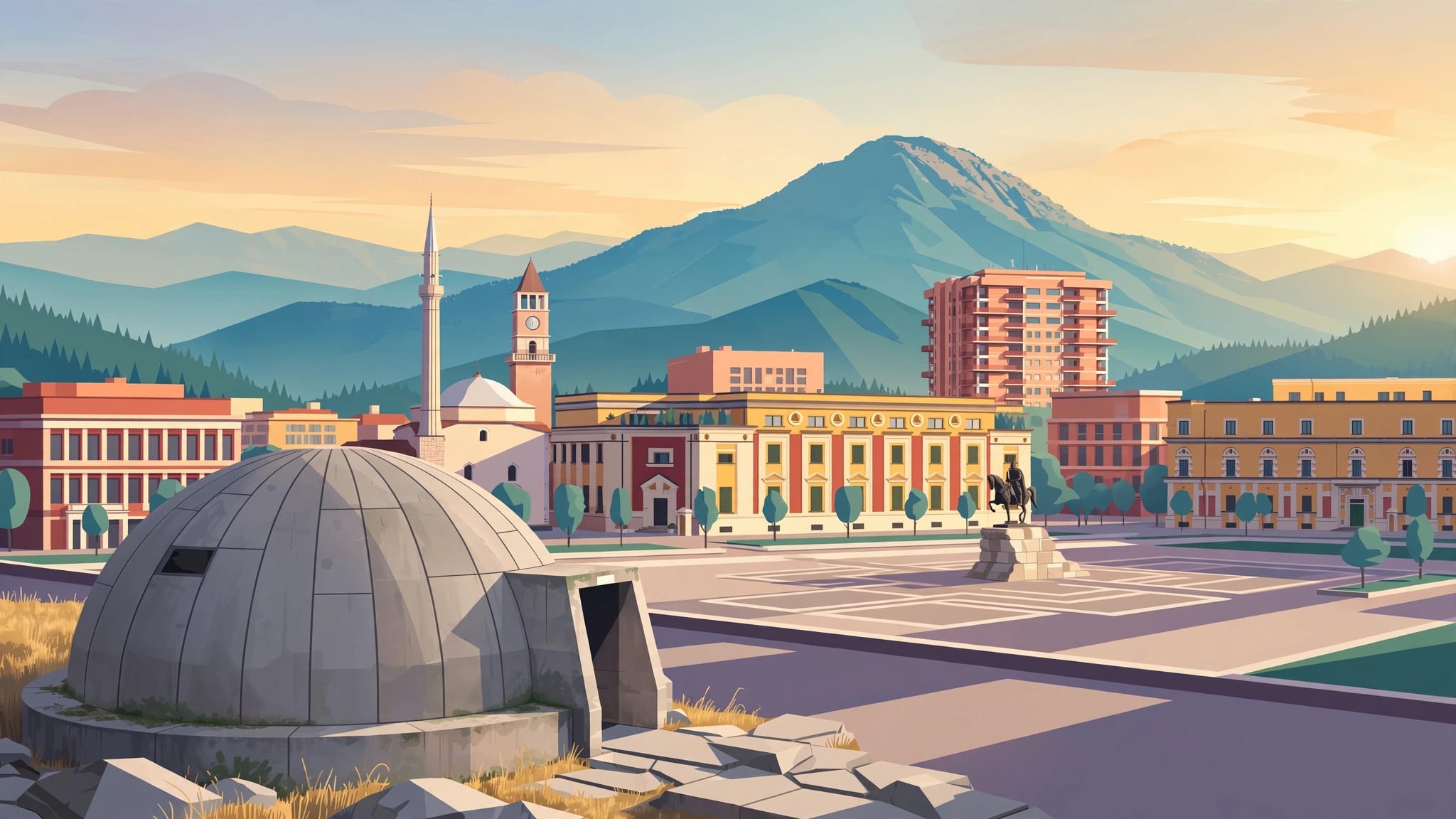
Tirana rewards photographers who pay attention to contrast. In a single day, photographing Tirana can move from a Cold War bunker to a bright square, then finish above the city on Dajti Mountain.
The capital doesn’t offer one polished postcard scene. Instead, it gives you sharp angles, lived-in streets, Ottoman detail, colorful facades, and distant ridges that change with the weather.
Start early. The streets are calmer, the mountain air is clearer, and your frames will have more room to breathe.
Plan a route around changing light
A practical route begins in the compact center, reaches the Pyramid by late afternoon, and saves Dajti for a clear morning or a long golden-hour visit. Use these photo spots as anchors, but keep your camera out between stops. A coffee counter, a cracked pavement reflection, or a passing bus may reveal more through street photography than a landmark alone.
Begin at Skanderbeg Square
Skanderbeg Square gives you scale. Arrive near sunrise and work around the outer edges instead of standing at the center. The wide paving can look empty and harsh at midday, yet low light creates long shadows that pull the eye toward the surrounding buildings.
Frame the Ethem Bey Mosque and Skanderbeg Square landmarks from an angle, with a small foreground element such as a cyclist or bench. The mosque’s fine detailing needs a tighter lens or your phone’s telephoto setting. Meanwhile, step back for the National Museum of History facade, where its large mosaic works best in even morning light.
Colorful facades reflect layers of urban development. Some changes are associated with Edi Rama, but not every building shares that origin.
Don’t rush it. Treat each square and park as shared public space, wait for movement, and avoid blocking pedestrians.
Walk toward Tanners Bridge and the Grand Park
From the center, follow smaller streets toward Tanners Bridge. Its low stone arch looks stronger when you shoot close to the riverbank level, using the curve as a leading line. Skip an overly symmetrical view if pedestrians or parked cars clutter the frame.
Later, the Grand Park of Tirana and Tirana Lake Park offer a softer counterpoint to concrete and traffic. Use tree branches as a natural border, then look for backlit walkers along the paths. Clouds can help here because flat light keeps foliage from becoming a dark, messy mass.
A useful morning rhythm is simple: photograph hard architecture first, then spend the softer late hours among water, trees, and people.
Photograph the Pyramid of Tirana with context
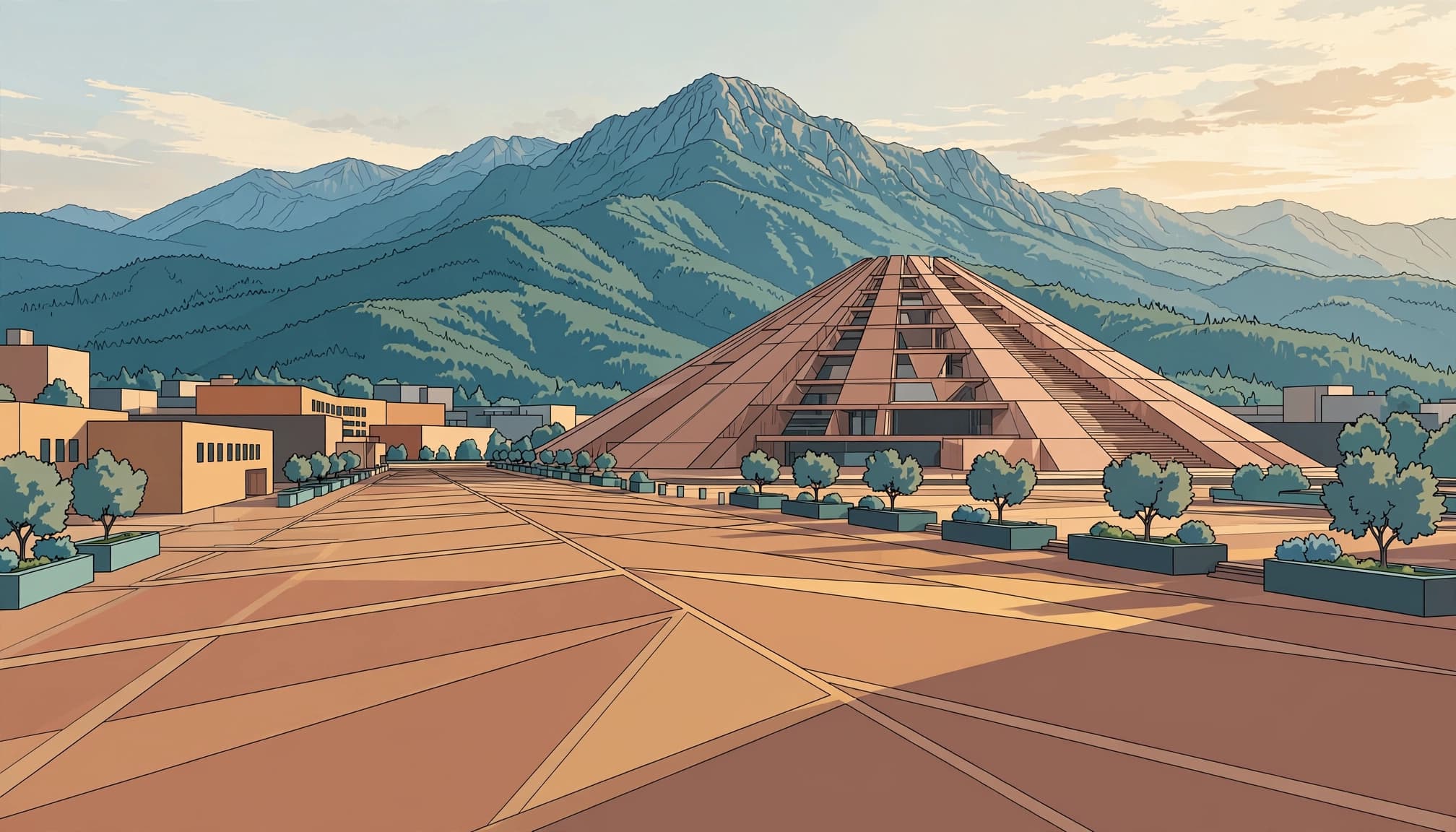
The Pyramid of Tirana is one of the city’s most adaptable photo spots because it refuses to look settled. This major example of communist architecture was built as a museum honoring dictator Enver Hoxha. Today, TUMO uses the repurposed building for youth-focused technology and creative programs.
That history matters in your photographs. The structure isn’t only an unusual shape. It carries Albania’s difficult past and the city’s later reinvention.
Use the geometry, not only the full facade
Stand low and close to one of the Pyramid’s sloping lines. A wide lens will exaggerate its triangular planes and make the building feel larger. For a quieter composition, crop out most of the skyline and isolate stairs, rails, shadows, and concrete intersections.
Late afternoon is often the best time because light skims across the surfaces. Expose for the bright concrete, then lift darker areas later if needed. Black and white also suits the site when the sky is pale or surrounding colors distract.
Access information for indoor areas and upper levels can change, with different published schedules circulating. Check locally before planning a rooftop or interior shoot.
Pair the Pyramid with nearby street scenes
The strongest sequence mixes architecture with ordinary life. Look for someone crossing the plaza, children using the steps, or mountain haze behind the structure. Keep people small in the frame unless you have permission for a close portrait.
During one late-afternoon walk, a photographer can find the Pyramid nearly empty at first, then watch the scene change as skateboarders, families, and students gradually fill the steps. That shift is worth photographing as a short series, beginning with clean geometry and ending with a more active public space.
The Pyramid’s changing role in Tirana also makes it a useful anchor for a visual narrative about historical change and contemporary city life, rather than a single stop for an architectural snapshot.
Find bunker images without treating history as a prop
Tirana’s bunkers are inseparable from Enver Hoxha’s isolationist regime, which built thousands of defensive structures across Albania. In the capital, Bunk’Art sites offer accessible settings for photographs that connect this history with personal testimony and preserved interiors.
Respect comes first. These museums and memorial spaces preserve important cultural heritage, not abandoned sets.
Work with bunker interiors in low light
Bunker corridors are dark, narrow, and often lit by mixed artificial light. A fast lens helps, but you can also shoot handheld with a phone’s night mode while bracing against a wall or resting the device on a small support.
Use doorways to create layers. Photograph a lit room through a darker corridor, then expose for the highlights so lamps and screens retain detail. A single figure at the far end can add scale, but don’t stage dramatic scenes or photograph visitors closely without care or permission.
Don’t touch exhibits or move objects for a better frame. Tripods and flash may be restricted in museums, so ask staff before using either.
Tell a restrained visual story
Avoid trying to make every bunker photograph ominous. Rusted details, ventilation pipes, faded directional markings, and curved concrete already hold enough visual weight. Close frames often work better than a rushed wide shot.
Bunk’Art can also sit beside the Pyramid in the same photo essay. One location records underground fear and control, while the other shows a former ideological monument in above-ground public use. The Pyramid and Bunk’Art route context can help you plan a day that joins these locations without reducing either to a backdrop.
In dark interiors, protect the brightest lamps first. A slightly dark corridor is easier to recover than a blown-out light source.
Shoot Dajti Mountain when the city air is clear
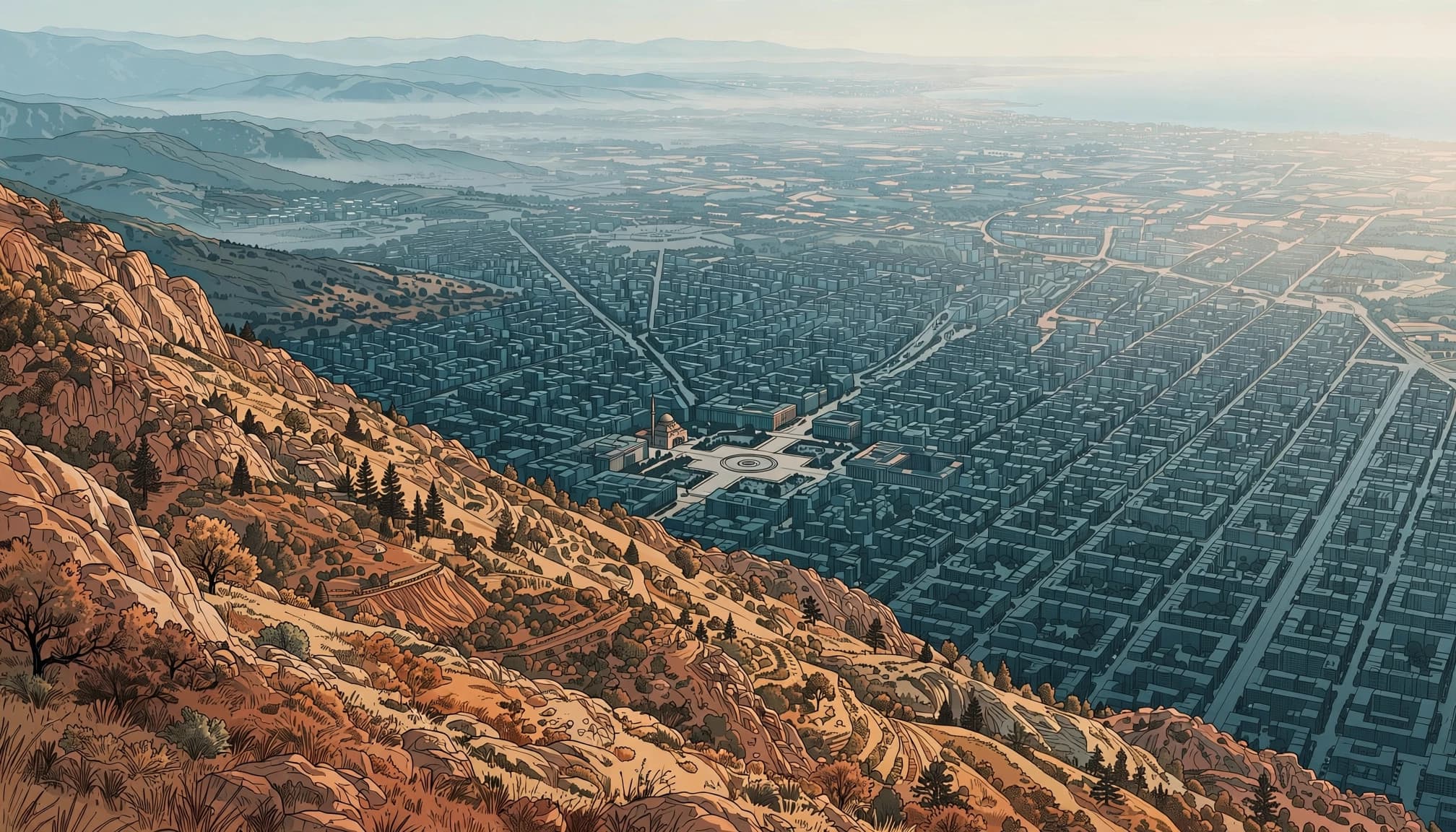
Dajti Mountain changes the scale of your visit. Tirana below can appear dense and almost flat at street level. From above, you can see parks, squares, broad avenues, and other public space across the plain. The mountain rises to 1,613 meters, according to a guide to Tirana’s major attractions.
For the clearest distant view, go after a cool night, light rain, or a morning with little haze. Heat and pollution can soften distant buildings into one gray layer.
Use the Dajti Ekspres strategically
Dajti Ekspres tickets are sold at the lower station only. The operator recommends arriving between 9:00 and 11:00, when the air may be clearer before afternoon haze develops.
The usual timetable lists service from 9:00 to 18:30 on Monday, Wednesday, Thursday, and Friday. Saturday and Sunday service normally runs until 19:00. The cable car usually closes on Tuesdays for maintenance, except on public holidays. Check the operator’s official schedule and access conditions before travelling, since hours and mountain operations can change.
Start at the cable-car arrival area and use any clearly accessible city-facing overlooks. Walking routes and mountain conditions may vary, so don’t assume every viewpoint is open or easy to reach.
Bring a lens cloth. Mountain moisture and dust can quickly appear on a front element or phone lens.
Build depth into the panorama
Don’t point straight at the city and rely on a giant skyline. Include a fence, grass, rocky edge, or tree branch in the foreground. That near detail adds depth and makes the distant city feel farther away.
A wide lens captures the full spread, while a short telephoto lens can compress foothill layers and isolate landmarks below. Shoot several vertical frames for a panorama if the view is too wide for one image. Keep exposure consistent and overlap each frame by about one-third.
The best Dajti photos usually contain both city and mountain. Let the slope occupy part of the frame instead of cropping it away.
Mobile photography settings for Tirana streets
A phone is enough for an observant day in Tirana. The limitation is usually not the camera. It’s shooting too quickly, at eye level, with a busy background. Reserve Touch Retouch App for minor cleanup after you’ve made the strongest composition possible.
Handle harsh sun and low-light scenes
In Skanderbeg Square, tap on the brightest part of the pavement or facade, then lower exposure slightly. This protects the pale stone and keeps the sky’s color. At the Pyramid, use the grid overlay to keep strong diagonals intentional.
After sunset, avoid digital zoom. Move closer, stabilize the phone, and take several frames because people and traffic can blur differently in each. Apps such as ProCamera App can give photographers more direct control, while Adobe Lightroom is useful for recovering highlights and correcting uneven color temperature.
A fast lens is helpful if you carry a dedicated camera. Narrow lanes and bunker rooms can stay dim even at midday.
Clean up distractions with restraint
Touch Retouch App can remove a stray bin, wire, or isolated object near the edge of a composition. Use it sparingly. Removing an entire crowd or a row of vehicles can turn a travel scene into something that no longer resembles the place you visited.
Instead, change your position first. Lower the camera to hide parked cars behind a wall, wait for a gap in foot traffic, or crop closer around a strong architectural detail. These choices look more natural and take less editing time. Use Touch Retouch App only for isolated distractions that still remain, not for elements that define the scene.
Bring a focused kit and leave room to walk
You don’t need a heavy bag for this city. Tirana involves walking, while Dajti adds elevation, changing weather, and uneven ground.
A compact setup covers nearly every scene. It suits amateur photographers, while professional photographers can use a preferred body or lens without carrying a heavy bag:
- A wide lens or phone camera for the Pyramid, plazas, and mountain views.
- A 35mm, 50mm, or short zoom for doors, faces, mosque details, and compressed city layers.
- A small tripod or tabletop support for blue hour, bunker interiors, and steady mobile night shots.
- A spare battery, power bank, lens cloth, and light rain cover.
Wear shoes with grip if you plan to explore mountain paths or climb stairs around the Pyramid. Keep your bag light enough that you can walk back for another angle. Often, the better frame is behind you.
Follow Tirana Photo Festival updates
Tirana Photo Festival connects visiting photographers with Albania’s local visual arts community. DMO Albania organizes the festival, which has included an exhibition program, talks, workshops, and a photography competition.
Visit Tirana’s events listing shows June 19 to 21, 2026, at Tirana Lake Park, a public space. Treat those details as a listing, not a confirmed future schedule, and check the Tirana Photo Festival website before booking around them.
The official 2025 call used the theme “Mediterranean / Mesdhe” and accepted Photo Singles, photo stories, and video. Its deadline was June 10, 2025. Future themes, categories, entry fees, deadlines, and submission requirements may differ, so prepare your strongest edited sequence as a visual narrative, but don’t submit until the current rules are published.
Where to find licensed Tirana stock photos
If you need an image for travel photography, a client presentation, editorial layout, publication, or exhibition, buy an appropriate license instead of copying photos from social media. Search results for Tirana tourism stock images include aerial views, city landmarks, and travel scenes.
Use stock imagery as visual research, not a substitute for your own work. Study the time of day, focal length, lighting, and viewpoint, then find your own framing when you arrive.
Key Takeaways
Tirana’s best photo route is built on contrast: central civic spaces in early light, bunker interiors when the sun is high, the Pyramid in late afternoon, and Dajti Mountain when the air clears.
Keep compositions simple. Strong diagonals, a clean foreground, and patient timing will do more for your images than extra equipment.
FAQ
What are the best photo spots in Tirana?
Start with Skanderbeg Square, Ethem Bey Mosque, the National Museum of History, Tanners Bridge, the Pyramid of Tirana, Grand Park of Tirana, and Dajti Mountain. Add Bunk’Art for historical interiors and darker, more intimate frames.
Can I photograph inside mosques and museums?
Rules vary by site and event. Dress respectfully in religious spaces, avoid interrupting worship, and ask staff before using a tripod or flash. When photographing people in a public space, remain unobtrusive and respectful.
When should I visit Dajti Mountain for photos?
Morning usually offers the clearest view of Tirana. Late afternoon can bring warmer mountain light when haze stays low. Check the weather and Dajti Ekspres timetable before travelling.
Final thoughts
Many memorable images here emerge in public space, between ordinary street life and a bunker corridor after bright pavement, a mosque detail beside a broad civic square, or the city shrinking beneath Dajti’s ridges.
Give each place time. Tirana photography becomes more personal when you stop chasing only famous viewpoints and wait for the shifting light on the Pyramid’s concrete steps.
