
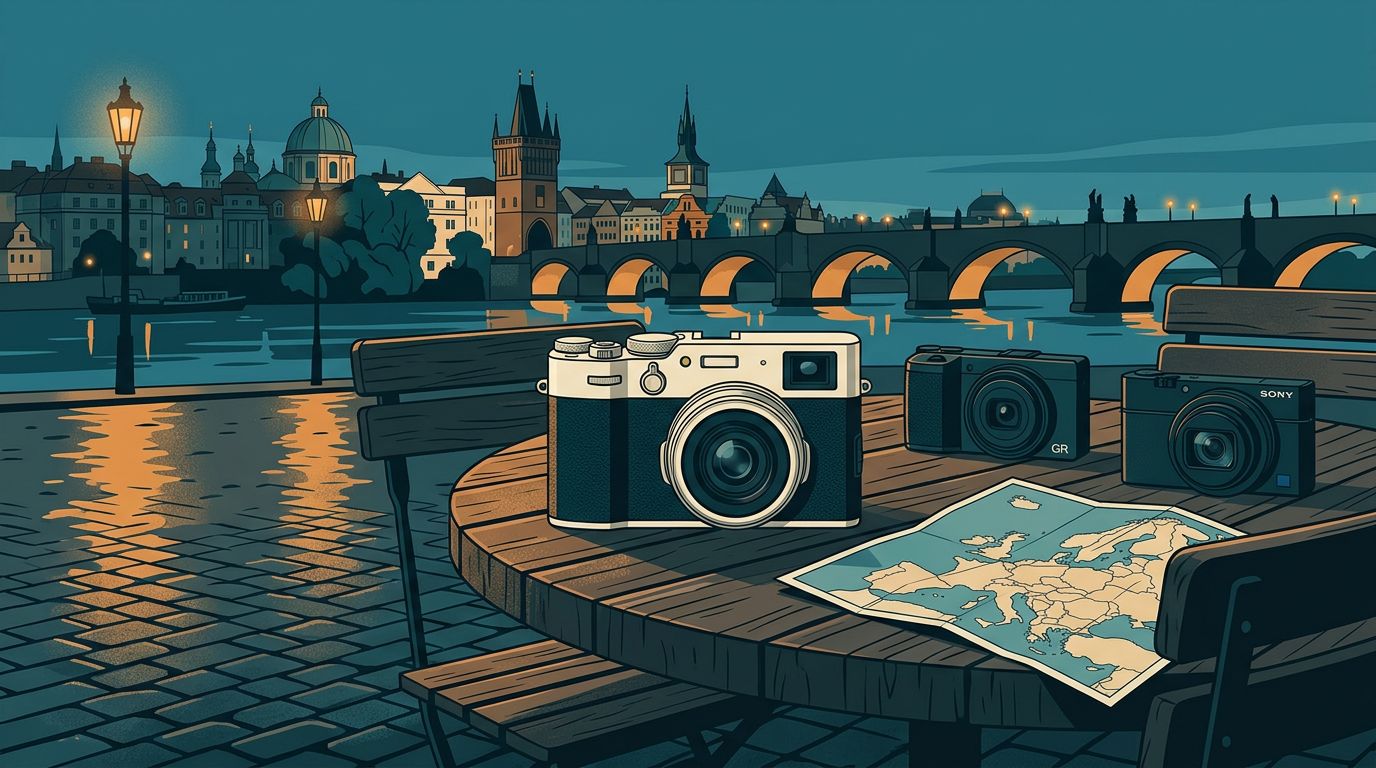
Europe rewards the camera you still have with you at 8 p.m., when rain clears over a Prague square or a tram turns into Lisbon’s last patch of sun. The best compact travel cameras give you more control than a phone for travel photography, without asking for a second bag.
A city break calls for a pocketable camera; museum days demand low weight. Street photography needs quick handling, while landscapes and alpine trips may need greater focal length and reach.
Start with the photographs you want to make, then match the camera to your route and shooting habits. For 2026, we prioritize models currently available in Europe and flag older or regionally limited choices later.
Key Takeaways
- Choose the Fujifilm X100VI for excellent image quality and a fixed 35mm-equivalent perspective for street photography, food, and everyday travel photography.
- Buy the Ricoh GR IV if you want a truly pocketable camera, but plan around its limited battery life.
- Pick the Sony RX100 VII for its 24-200mm-equivalent optical zoom, the best choice for changing itineraries, museums, distant architecture, and landscapes.
- APS-C is enough for most European travel photography. Full-frame models help after dark, but their lenses often cancel out the weight advantage.
- Bring a spare battery and a second memory card. Small preparations prevent big disappointments.
Less weight. More photographs.
The Best Compact Travel Cameras for Europe
These compact travel cameras suit different shooting styles, so the “best” option isn’t always the most fashionable or expensive. For travel photography, the right lens and carrying habits often matter more than maximum resolution.
| Camera | Portability | Image quality | Lens flexibility | Low-light suitability | Battery life | Weather protection | Ease of use | Value | European availability |
|---|---|---|---|---|---|---|---|---|---|
| Fujifilm X100VI | Jacket-friendly, 521g | 40.2MP APS-C sensor | Fixed 35mm-equivalent view | Strong for interiors and evening scenes | Moderate | Protect from heavy rain | Intuitive controls and film simulations | Premium, but capable | Widely sold, stock can vary |
| Ricoh GR IV | True pocketable body, 262g | 25.74MP APS-C sensor | Fixed 28mm-equivalent view | Good for city scenes | Limited | Protect from moisture | Fast and discreet | Expensive for a specialist camera | European stock is improving, but check locally |
| Sony RX100 VII | Pocket-sized, 302g | 20.1MP 1-inch sensor | 24-200mm-equivalent zoom | Adequate, with smaller-sensor limits | Limited | No dedicated protection | Strong autofocus and automatic modes | Good if found at a fair price | Stock-dependent in 2026 |
| Leica D-Lux 8 | Compact, 403g | 17MP Four Thirds sensor | 24-75mm-equivalent zoom | Good with its bright lens | Moderate | Protect from heavy rain | Simple, premium controls | Expensive | Generally available through Leica dealers |
| OM System OM-3 | Small for an interchangeable-lens body, 496g | 20.4MP sensor | Broad choice of lenses | Good with suitable lenses | Strong | Weather-resistant construction | Flexible, but more involved | Strong for active trips | Widely available |
The table points to a practical truth: lens choice shapes your trip more than megapixel count alone.
Fujifilm X100VI for city scenes
The Fujifilm X100VI is the strongest all-round choice for photographers who enjoy a fixed perspective. Its 35mm-equivalent focal length and f/2 lens suit cafes, museums, markets, architecture, and contextual portraits. The 40.2MP sensor also delivers excellent image quality for prints and cropping.
The camera includes in-body image stabilization and Fujifilm’s film simulations. Its JPEG output often needs little editing, which helps when you’re moving between cities. It isn’t designed for heavy rain, so use a cover or put it away when conditions turn wet.
Fujifilm lists the X100VI at EUR1,799, making it a serious purchase rather than a casual upgrade. The official X100VI specifications explain why demand remains high.
Its limitation is also its appeal. You can’t zoom across a canal or isolate a distant mountain ridge. Instead, you walk closer and build a more deliberate frame.
Ricoh GR IV for a real pocket
The Ricoh GR IV is the compact camera for travelers who dislike carrying gear. At 262g with battery and card, it’s a genuinely pocketable camera. Its 28mm-equivalent focal length works beautifully for tight streets and broad city scenes.
The Ricoh GR IV official store listing gives its European price as EUR1,449.99 and quotes roughly 250 shots per charge. That battery figure makes a spare essential.
Compared with the Ricoh GR III, the newer model brings a back-illuminated sensor, revised lens design, quicker processing, and five-axis stabilization. The GR III is an older used-market alternative, not a current equivalent. Check its condition, warranty, and EU availability before paying.
The trade-off for true pocketability is the absence of optical zoom. You need to move your feet when the 28mm view doesn’t fit the scene.
Sony RX100 VII for zoom flexibility
The Sony RX100 VII is the answer when one zoom lens must cover almost everything. Its 24-200mm-equivalent optical zoom captures a wide Florence facade, then reaches a statue high above a square without changing position.
At 302g, it remains genuinely small. Its autofocus system is useful for wildlife, children, and unpredictable subjects. The 1-inch sensor has less room for dark interiors than larger-sensor rivals, however, and battery capacity is limited.
For landscapes, distant church details, museums, or family trips, that zoom range can beat a larger camera. In 2026, check European stock and pricing before buying, since availability is stock-dependent rather than universal.

Are Compact Cameras Still Worth Buying Over a Smartphone?
Yes, when you want intentional photography rather than quick records. A dedicated camera gives you physical controls, better ergonomics, and a real shutter response. Many small mirrorless cameras also offer lenses that make different pictures possible.
A larger sensor and bright lens can hold detail and color indoors. That combination improves image quality and low light performance in restaurants, churches, museums, and rainy streets. It also gives you more control over depth of field, creating natural background blur at close range.
Smartphone cameras remain excellent for maps, sharing, and fast HDR scenes. Their computational processing can rescue difficult exposures and provide convenient digital reach. A camera’s optical zoom preserves detail on distant architecture, statues, and landscapes, where digital enlargement can look thin.
A camera earns its space in your bag when it changes how you shoot, not when it merely duplicates your phone.
In Lisbon last spring, a traveler with a heavy kit built around a full frame camera stopped halfway up the Alfama steps to shift his bag; its full-frame image quality wasn’t worth the weight for that itinerary. A friend with a small APS-C setup kept walking and caught the yellow tram as it rounded the corner. The lighter camera was ready.
Sensor Size and Low-Light Performance
Megapixels don’t tell the full story. Sensor size, lens aperture, image stabilization, and autofocus all affect image quality and sharpness.
APS-C is the sweet spot
For most travelers, an APS-C sensor offers the best balance of image quality, cost, and size. Premium APS-C compacts produce files with enough detail for large prints and heavy crops. They’re also easier to carry than a full frame camera with fast lenses.
APS-C also improves low light performance. A bright f/2 or f/2.8 lens at a useful focal length lets the camera use a faster shutter speed indoors. That helps reduce blur from moving people in dim museums, evening streets, and busy restaurants.
A full frame camera still has advantages for night scenes, high ISO files, and shallow depth of field. It also gives you more control over depth of field. However, the extra bulk becomes obvious after eight hours on cobbles. Most travel photos don’t need it.
Micro Four Thirds and one-inch sensors
The Leica D-Lux 8 uses a Four Thirds sensor, similar in size to micro four thirds, and a bright 24-75mm-equivalent f/1.7-2.8 lens. That combination suits travelers who want better low-light ability than a small-sensor zoom, while retaining a useful framing range. It weighs about 397g with its battery.
Meanwhile, a one-inch zoom compact offers worthwhile optical zoom for its size. It won’t match an APS-C compact in a dark bar, but it provides reach that a 28mm or 35mm compact can’t. The format remains a practical alternative to micro four thirds for landscapes and distant details.
Choose the lens first. Then choose the sensor.
Fixed-Lens Compact or Mirrorless Camera?
Fixed-lens compacts encourage simplicity. Mirrorless cameras give you options, which can be helpful or exhausting.
When a fixed lens makes more sense
A fixed-lens camera is ideal for travelers who want to walk, notice, and shoot. A chosen focal length builds consistency across street scenes, narrow alleys, museums, and cafes.
The X100VI’s 35mm-equivalent focal length feels natural for everyday scenes. Wider alternatives suit cramped interiors, while longer options help isolate distant details. A bright lens can also create a shallower depth of field without making the camera complicated.
Because the lens is built in, you avoid packing decisions and sensor exposure during lens changes. That matters on dusty paths, windy coastlines, and packed train platforms.
The constraint improves consistency. After a day or two, you begin to see frames at your chosen focal length before lifting the camera.
When to choose mirrorless cameras
Mirrorless cameras are better when your itinerary has conflicting demands. The Canon EOS R50 offers beginner-friendly controls, a compact kit lens, and a capable autofocus system for city breaks.
Its zoom lens is more flexible than a compact’s built-in option, but the kit is less pocketable. It’s a small mirrorless kit, not a true pocket camera. Check current 2026 European pricing and stock before buying, since retailer listings change often.
The OM System OM-3 is a higher-end alternative for travelers who want interchangeable lenses without moving to full frame. This Micro Four Thirds model weighs 496g with a battery and card, and is rated for approximately 590 shots.
Its claimed weather sealing applies when the body is paired with appropriately protected lenses. Even then, a small interchangeable-lens kit takes more space than a compact.
For most city-heavy trips, one small camera beats a bag of choices.
Weather Protection, Batteries, and Daily Care
European weather changes quickly. A dry morning in Amsterdam can become a wet afternoon before the next canal bridge.
Protect an X100VI realistically
The X100VI isn’t fully protected at the front of the lens straight from the box. Fit an AR-X100 adapter ring and a 49mm protective filter for front-of-lens protection and complete its weather sealing. A dedicated Fujifilm weather-resistant kit pairs those parts.
That setup protects against dust and light rain, but it doesn’t improve the camera’s general weather rating. It isn’t waterproof, and it remains unsuitable for sustained rain or immersion. Keep it under your jacket, dry it with a clean microfiber cloth, and never pack it away damp.
Avoid cheap filters with poor coatings. They can create flare around streetlights and soften images.
Carry power and protect files
Compact cameras often have limited battery life. Pack one spare for a normal city day, and two for winter conditions or heavy video use. For museum-heavy itineraries, carry a spare because indoor shooting can quickly reduce your options. Charge overnight and keep batteries warm in an inside pocket when temperatures drop.
Memory cards deserve equal care. Use two smaller, reliable cards instead of relying on one huge card. Back up each day’s images during a short hotel-room routine, before the next train or ferry complicates the plan.
A lightweight travel tripod can help with blue-hour landscapes, but European streets add restrictions and crowds. Choose a model under 3 pounds with a short folded length, so it’s easier to carry and convenient on public transit.
Budget Choices Under EUR1,000
A new premium compact can cost more than a beginner camera kit. If your budget stops below EUR1,000, resist inflated resale prices for scarce models.
Canon EOS R50 for beginners
The canon eos r50 with its compact 18-45mm kit lens is a sensible starting point. It gives beginners autofocus help, interchangeable lenses, and a zoom range suited to streets, meals, buildings, and group shots.
It isn’t pocketable, but a small sling solves that. The kit offers more flexibility than a fixed-lens compact. Add a spare battery and a dependable memory card, then use the remaining budget for the trip itself.
Used cameras need a careful check
A used Fujifilm X-T30 II, Sony a6400, or older, used-market ricoh gr iii can be a stronger buy than an overpriced new camera. In 2026, these models may be used-only or regionally variable, so check European retailer listings before assuming new stock.
A used camera can also deliver better image quality than an overpriced entry-level model. Test the shutter and every control before committing. Check the card slot, battery door, LCD, sensor, lens movement, and battery condition.
Confirm the seller’s return rights and any remaining warranty. Request clear photos.
A bargain becomes expensive if it fails on day two. Card errors and worn battery doors have a habit of appearing far from home, usually at the moment the light gets good.
FAQ
What is the absolute best compact camera for travel photography?
The Fujifilm X100VI suits many European travelers, with stabilization, an f/2 lens, and a 35mm-equivalent view. Its low light performance is strong, but it lacks zoom reach and true pocket storage.
For a pocketable camera, choose the Ricoh GR IV. For distant subjects, choose the Sony RX100 VII for its optical zoom, but verify official EU stock and warranty coverage first.
Is the Ricoh GR IV better than the Ricoh GR III?
The Ricoh GR IV improves stabilization, processing, lens design, and sensor technology. It also uses a newer DB-120 battery, which helps frequent low-light shooting.
The Ricoh GR III still makes excellent photographs, but it’s primarily a used-market choice unless verified new European stock is available. If it costs substantially less and passes a careful condition check, spend the difference on travel, storage, and a spare battery.
Do I need a full frame camera for Europe?
No. APS-C is sufficient for streets, landscapes, portraits, museums, and travel albums. Full frame helps most in very dark conditions or when you need extensive cropping.
A smaller camera you carry every evening will usually make more photographs than a larger kit left in your room.
Choose the Camera You Will Carry After Dinner
The best camera for travel photography is the one you’ll carry after dinner. Choose by itinerary: a compact city-break option, a strong choice for museums and dark interiors, or extra reach for landscapes and long day trips.
Start with the focal length that matches your eye. The Ricoh GR IV suits tight streets and quick city breaks, while the Fujifilm X100VI gives street photography more context. For distant alpine or coastal details, the Sony RX100 VII adds optical zoom without changing cameras. That reach sets it apart from the fixed-perspective alternatives.
For museums and dark interiors, prioritize image quality and dependable battery life. For long days and landscapes, choose the Sony’s reach; for relaxed street photography, choose the camera you enjoy carrying. Check 2026 European stock, warranty coverage, and retailer pricing before buying, especially for older or regionally limited models.
