
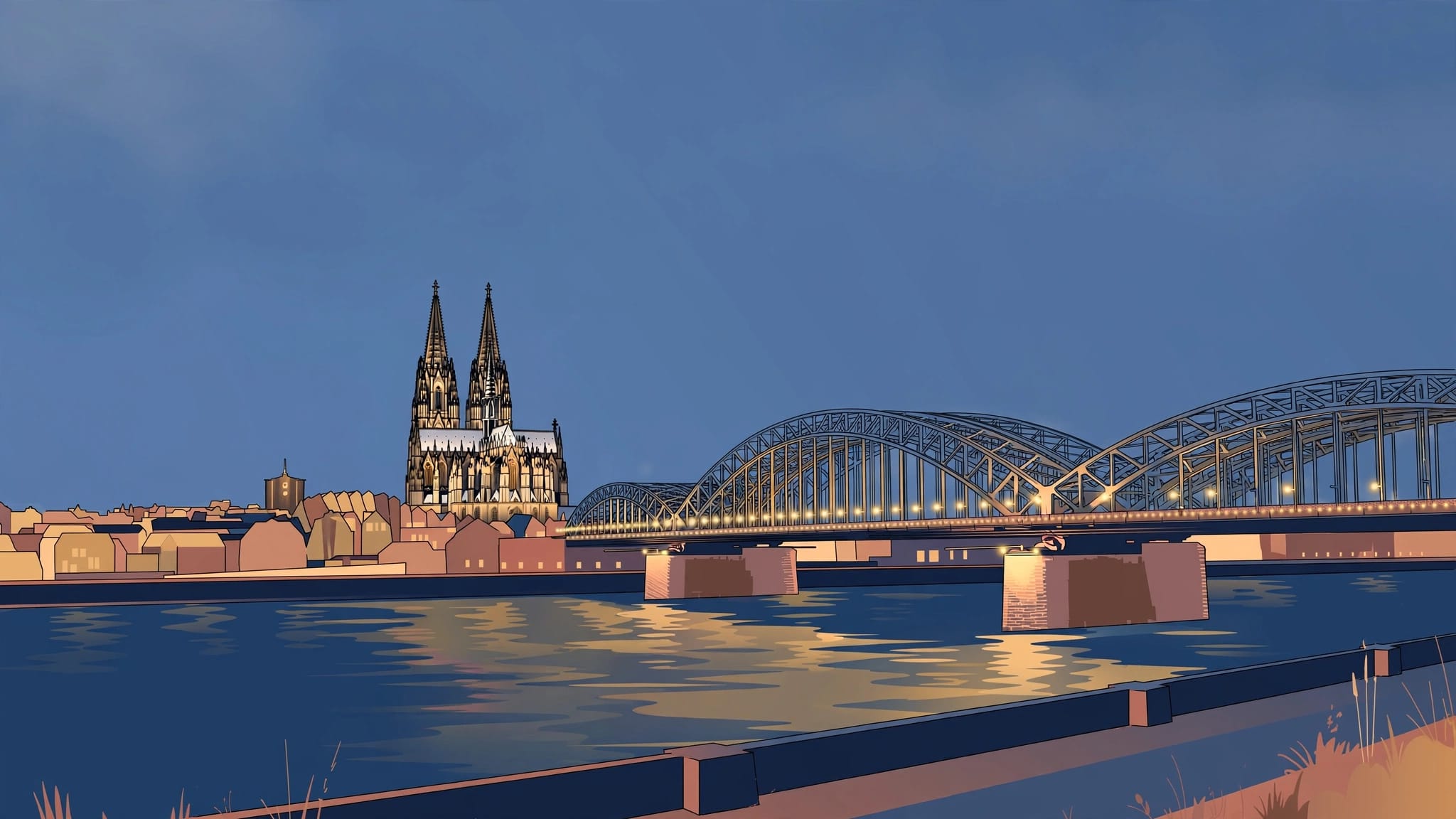
Cologne rewards photographers who slow down. The cathedral dominates the skyline, yet the strongest frames often come after you cross the Rhine, wait for the bridge lights, or explore side streets for street photography before breakfast.
This Cologne photography guide is also a practical travel photography guide for planning images around the Dom, Hohenzollern Bridge, riverfront, and Old Town without racing between viewpoints. Start with the light, then let the route follow.
Key takeaways for better Cologne photos
- Photograph the cathedral exterior at sunrise or blue hour, when the square and riverbanks are less crowded. During the Christmas markets, the Dom area gets busier, so arrive earlier or use the Deutz side for quieter frames.
- Cross to Deutz for the most complete skyline view, with the Dom rising behind Hohenzollern Bridge.
- Use the KölnTriangle observation deck for a higher viewpoint that includes the cathedral, Hohenzollern Bridge, the Rhine, and the Old Town roofline.
- Bring a compact tripod for outdoor dusk work, but check rules before setting one up indoors or on managed property.
- Keep a rain cover close. Damp cobbles and broken clouds can improve city scenes.
A Cologne photography guide for planning your days
One full day captures the signature locations if you’re willing to begin early and stay out after dusk. Two days gives you room for changing weather, a relaxed Old Town walk, and time for street photography instead of rushing between major viewpoints.
Build each day around one light window
Start before sunrise. Photograph the cathedral from the Deutz side first, then walk back across Hohenzollern Bridge as the light reaches the western bank. Midday suits interiors, close architectural details, and cafés rather than broad skyline shots.
Reserve sunset for Rheinboulevard or the KölnTriangle observation deck, which is useful for elevated skyline compositions. Golden hour lighting warms the cathedral, bridge structure, and river before cooler blue-hour exposures begin. Stay after sunset as the city lights appear.
That schedule gives you a daytime fallback if clouds flatten the sky.
Choose a base near the first location
Base hotel recommendations on your first planned shooting location. Choose Deutz for sunrise skyline work, or Altstadt and Dom/Hbf for early cathedral and Old Town access.
Deutz puts you close to Rheinboulevard and the KölnTriangle, so you can leave your hotel with only a camera and a warm layer.
Both sides of the river are walkable, although a short transit ride saves energy after a long evening shoot.
Photographing Cologne Cathedral with purpose
The Cologne Cathedral looks different with every shift in position. Close up, its scale overwhelms the frame. Across the Rhine, it becomes the vertical anchor in a larger city scene.
The cathedral’s visitor information lists current access details and rules, so check it before an early visit. Opening schedules can change around services and special events.
Find exterior angles that avoid the obvious frame
For a symmetrical front view, arrive at Roncalliplatz square before the tour groups gather. A wide angle lens between 16mm and 24mm captures the full west facade, but keep the camera level. Tilting upward can make the towers look as if they are falling inward.
Around the cathedral’s sides, look for tighter studies. A normal lens suits architectural details, while gargoyles, flying buttresses, weathered stone, and passing tram lines create a more personal result than another centered postcard view.
On the east bank, use Hohenzollern Bridge as a diagonal. Let its arches or rail lines enter at a lower corner, then guide the eye toward the twin towers.
Treat the interior as a working church
Inside, still photography for private use is allowed under restrictions, but flash and extra equipment aren’t. The cathedral also restricts photography during services, and tripods need written permission in advance. Commercial, promotional, or published work requires authorization.
Keep your camera quiet and move slowly. A 24mm or 35mm lens is more useful than an ultra-wide here because it holds the columns together without excessive distortion.
The most successful interior image often isolates one pool of colored light or one receding aisle, rather than trying to fit the entire nave into a single frame.
Rhine views at Hohenzollern Bridge and Rheinboulevard
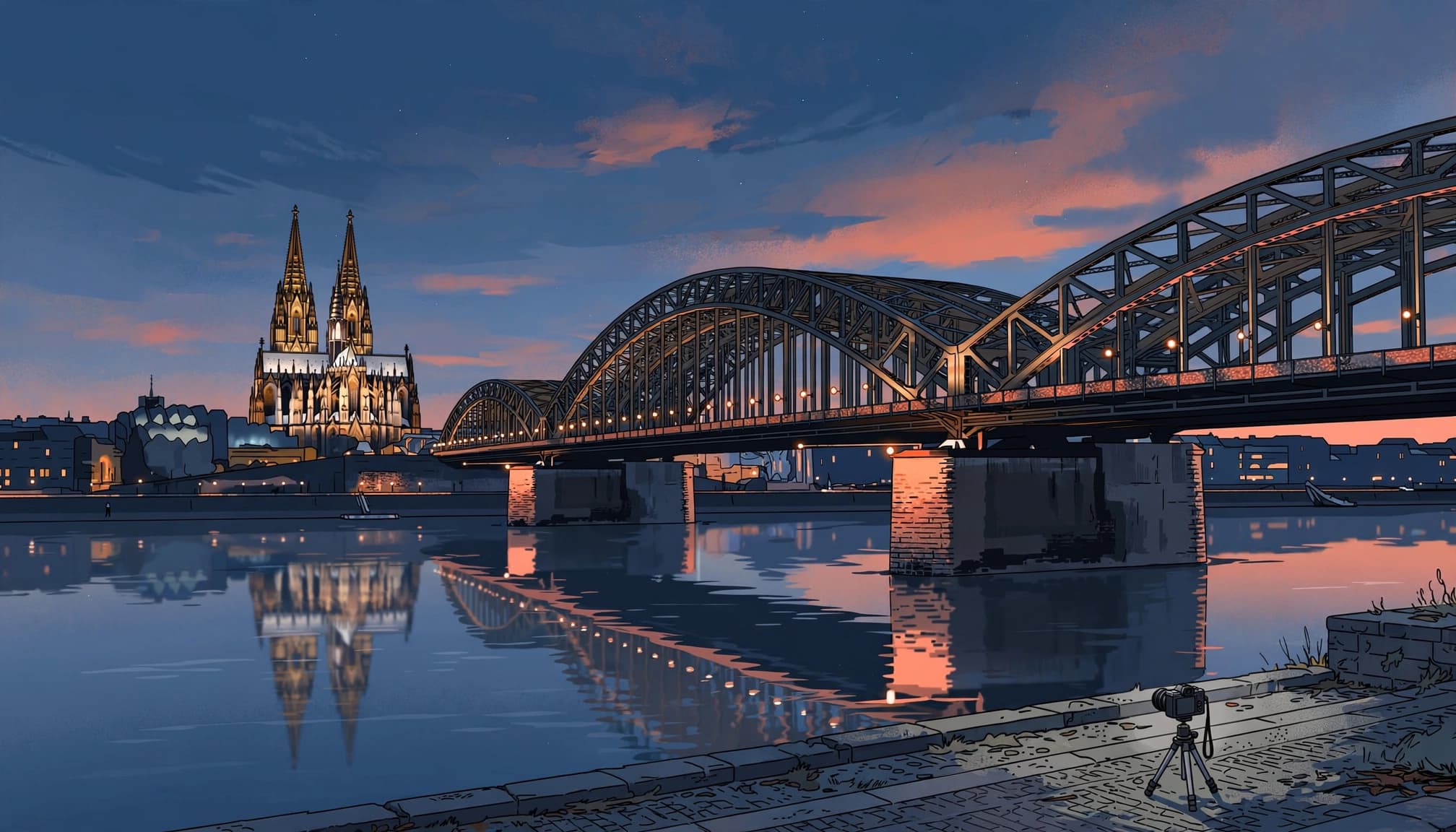
The east bank is Cologne’s strongest wide-angle stage. The Rheinboulevard promenade is the lower east-bank viewpoint for broad skyline frames, while Hohenzollern Bridge supplies movement, structure, and a direct line to the cathedral.
A broad, quiet stage.
Work the bridge into the composition
Avoid placing the bridge straight across the middle of every frame. Instead, stand farther south along the Deutz riverfront and use its repeating arches as a lead-in. A person walking along the bank can add scale without competing with the skyline.
For a compressed view, use a short telephoto around 70mm to 100mm. It brings the cathedral and bridge closer together, which helps when the sky lacks texture.
Watch passing trains. Their bright windows can become a useful band of light at dusk, although they also shake the bridge if you’re standing on it with a slow shutter speed.
Plan for blue hour photography
Set up 20 to 30 minutes before sunset, then stay after the sun has gone. The most balanced exposures often arrive when the sky remains blue and the cathedral lighting has switched on.
For long exposure shots, use ISO 100, an aperture around f/8, and a two-second self-timer on a tripod. Begin with shutter speeds near one second, then use a faster speed if wind, passing trains, or bridge vibration disturb the frame.
Rain can improve the scene. Wet pavement reflects amber lights, while cloud cover softens harsh contrast across the river.
KölnTriangle observation deck for the complete skyline
The KölnTriangle viewing platform at Ottoplatz 1 offers panoramic views that ground-level locations cannot. The 400-square-meter platform faces the Dom, Hohenzollern Bridge, Old Town roofline, and broad curve of the Rhine.
Admission is listed at EUR5 for adults and youths, with reduced EUR4 tickets for pupils, students, and qualifying groups. Summer hours extend later on Fridays and Saturdays. Storms can close the platform, so confirm the official listing on the day you plan to shoot.
A 24mm to 70mm zoom covers most compositions. Start wide, including the river and bridge, then tighten toward the cathedral as the sky gains color. Because you’re shooting through protective fencing or glass elements, keep the lens close to the barrier. Shade it with your hand if reflections appear.
Old Town details beyond the skyline
Start an early Old Town Altstadt loop before souvenir shops and restaurant terraces fill the narrow lanes. Leave the grand skyline behind for an hour and work with color, texture, and small moments.
Fischmarkt Cologne and Great St. Martin Church
At Fischmarkt Cologne, use the gabled houses and cobbles as a low-angle foreground for Great St. Martin Church. Get close to the pavement to emphasize the street’s curve, then step back for the Romanesque tower.
Avoid centering every building. Return to Fischmarkt Cologne for pavement reflections, a passing bicycle, or a different viewpoint that breaks up the architecture.
Let bad weather change the assignment
Overcast light is ideal for colorful facades because it reduces bright highlights. After rain, reflections along the pavement add a second layer without requiring a long exposure.
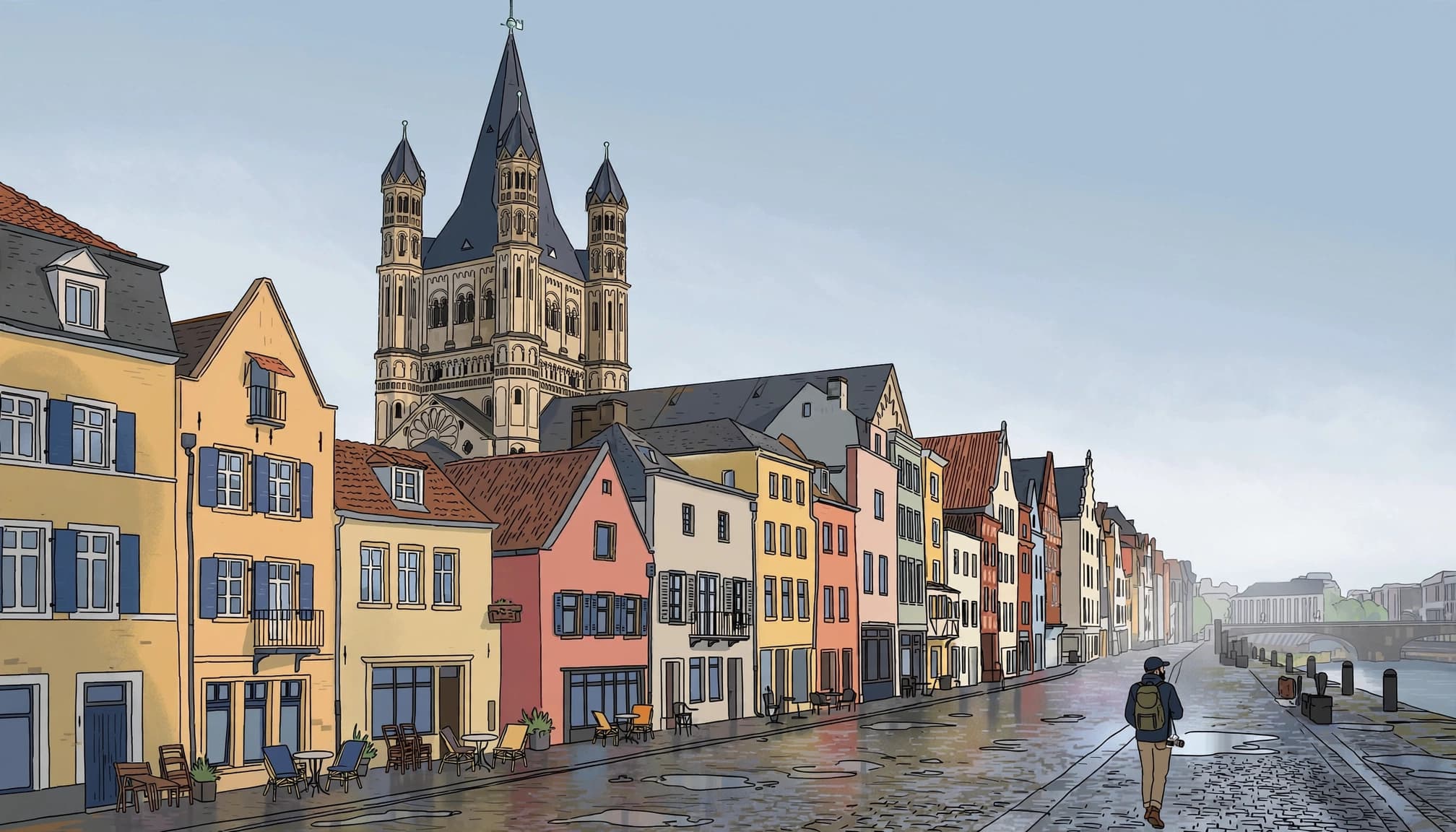
For street photography, keep a respectful distance and ask before making close portraits. Belgian Quarter murals work well as graphic compositions, rather than as a reason to document every block. For an optional extension, photograph Rheinauhafen architecture through geometric lines, reflections, and changing light. Respect residents wherever you shoot.
Camera gear recommendations and editing for Cologne’s changing weather
Pack less than you expect. Cologne is easy to walk, but cobbles, bridges, and stairs make a heavy camera bag tiring by sunset.
A compact kit covers the essentials
A weather-sealed camera helps, but any interchangeable-lens camera or modern smartphone can work well. Bring one wide zoom, such as 16mm to 35mm or 24mm to 70mm, plus a small travel tripod for outdoor dusk and blue-hour exposures. For indoor cathedral photography, check permission rules before using it.
A 70mm to 200mm lens earns its place if you enjoy architectural compression. It can isolate the cathedral between bridge details or stack river traffic against the skyline. Add spare batteries, a microfiber cloth, and a simple rain cover.
Edit for stone and water, not drama
Start by correcting vertical lines in cathedral images. Then lower highlights slightly to recover pale sky and stone texture. Raise shadows only enough to retain the cathedral’s dark Gothic detail.
On Cologne’s Rhine, wait for wind, cloud, water, or a passing train to change the frame. That patience often produces a more natural image than pushing sliders in post-processing.
Getting around and respecting restrictions
The KVB network connects major shooting areas efficiently. Walking handles the Rhine riverfront route linking Dom/Hbf, Hohenzollern Bridge, Rheinboulevard, and Deutz. Dom/Hbf, Heumarkt, and Severinstr. are useful landmarks when checking a journey. With extra time, a day trip to Dusseldorf is an optional extension, not a replacement for the Cologne itinerary.
The KölnCard includes local bus and train travel and lists a 24-hour individual option at EUR9. Travelers sharing plans can compare the group offer through the VRS KölnCard details, which covers up to five people.
Plan for weather instead of a fixed calendar
Spring and autumn often give softer light, changeable skies, and fewer crowds than high summer. Winter brings bare trees and earlier blue hour. Christmas markets add decorative lights and larger crowds near the Dom, so arrive earlier for cleaner compositions.
Check the forecast just before leaving. If a clear sunrise turns gray, move to Old Town alleys or shoot the cathedral interior within the visitor rules.
Leave the drone packed away
Drone restrictions around Cologne Cathedral and its surrounding grounds prohibit drones and other unmanned aircraft. These rules are site-specific, so photographers must also check local airspace, property permissions, and commercial-use requirements elsewhere in Cologne.
For commercial shoots, contact the relevant venue or property manager before arriving. Public-facing work at the cathedral needs prior authorization, and a tripod can change the permission needed even for a small setup.
Frequently asked questions
How many days do photographers need in Cologne?
Two days is the practical sweet spot. Use the first for the cathedral, bridge, and Rheinboulevard, then keep the second for KölnTriangle, Old Town, and weather-dependent reshoots. One day works if your schedule centers on sunrise and blue hour.
Can a smartphone capture the Cologne skyline?
Yes, especially from Rheinboulevard and KölnTriangle. Use the phone’s standard lens rather than the ultra-wide setting when possible, tap to protect bright cathedral lights, and brace the device against a railing for dusk images.
Where is the best sunset view of Cologne Cathedral?
The Deutz side of the Rhine gives the clearest full skyline view. Rheinboulevard offers a lower viewpoint, while the KölnTriangle observation deck creates an elevated composition above the river, with the cathedral set within the wider city.
The frame worth waiting for
Cologne’s famous views work because the river gives the cathedral breathing room. Give yourself that room too, by arriving early, carrying a small kit, and returning when conditions shift.
At blue hour, wait until the cathedral’s lit towers and the Hohenzollern Bridge lamps appear at the same exposure.
