
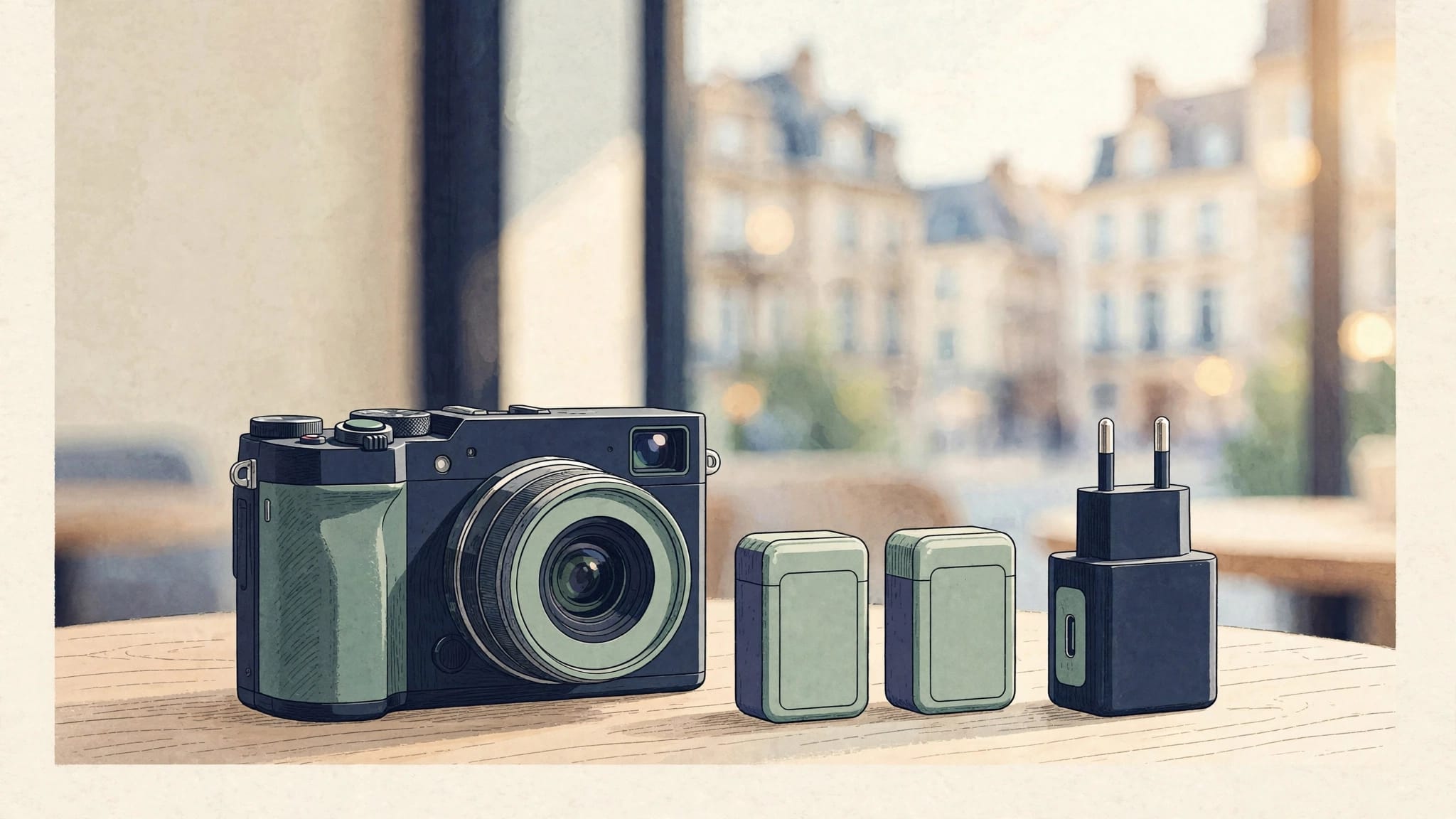
The light gets good just as your battery warning appears. If you’re crossing Europe with a digital camera, the best camera batteries and chargers are the ones that fit your exact model, work with the outlets on your route, and fit safely in your cabin bag.
Compatibility comes first. A compact USB-C charger is useful only if it accepts your battery, and a spare helps only if it’s charged when you leave. Start with the battery code printed on the cell already in your camera.
Key Takeaways
- Match every replacement battery and charger to the exact battery code, not just the camera brand.
- Take at least one spare for a long shooting day. Add a second if you shoot extensive video or have little time to recharge.
- Check both the charger’s input rating and the plug types used at every destination.
- Carry spare lithium batteries and power banks in cabin baggage, with their terminals protected.
Match the battery before choosing a charger
Find the precise battery code
Camera brands use several battery designs, sometimes across bodies that look nearly identical. Sony’s NP-FZ100, Fujifilm’s NP-W126, and batteries in Canon’s LP-E6 family aren’t interchangeable simply because a retailer groups them under “mirrorless accessories.”
Open your camera’s manual or inspect its existing battery. Then check the maker’s compatibility information for both the replacement cell and the charger. Even a familiar battery-family name may have variants worth checking before you order.
Fujifilm’s battery and charger compatibility FAQ is a useful example: it identifies supported combinations and gives separate USB-charging guidance for the NP-W126. That level of detail matters more than a listing that promises to fit “most Fujifilm cameras.”
Choose a spare you can trust
An original-manufacturer battery is the straightforward choice when you want clear compatibility guidance. A third-party battery may cost less, but confirm its exact supported camera models, charging method, seller, and return policy. Don’t assume it will behave like the battery supplied with your camera.
Inspect older cells before departure, too. A battery that drains unusually fast, swells, or no longer seats properly shouldn’t go in your travel bag. Buy a replacement early enough to charge it, use it in the camera, and check the charge indicator at home.
Best camera batteries and chargers to compare
No single charger suits every photographer. Your choice depends on the battery code and whether you need to charge one cell, several cells, or the camera itself overnight.
Compact options for one camera system
A manufacturer charger is a sensible starting point if you already own it. Check its input label before packing it for Europe; a plug adapter changes the plug shape but doesn’t change voltage.
For a smaller USB-powered kit, SmallRig sells a dual-slot Camera Battery Charger with a USB-C input. Its product information describes simultaneous charging and a 22.5 W USB-C port, but you’ll still need the version made for your battery. Stewart’s Photo listed a SmallRig USB-C dual charger at $29.99; treat that as a retailer price, not a guaranteed fare for your trip.
Nitecore’s USN4 Pro is another model-specific option for Sony NP-FZ100 batteries. Nitecore Australia listed it at $27.95. If you carry Nikon, Canon, or Fujifilm gear instead, look for a charger explicitly rated for your battery code rather than assuming another Nitecore model shares the same trays.
When a multi-slot charger earns its space
Photographers using several Sony NP-FZ100 cells can compare SmallRig’s 4839 four-channel charger. Its specifications describe four charging positions and a 60 W USB-C input. A European retailer listed it at €39 before VAT, with €47.58 shown including VAT, so check the checkout total before treating either figure as your final cost.
A four-slot unit makes sense when you return late with several empty batteries and need them ready together. For a city break with one spare, a smaller charger takes less bag space. SmallRig’s charging guide also outlines in-camera USB charging as a possible way to leave a separate charger at home, provided your particular body supports it.
Make the charger work with European outlets
Separate plug shape from electrical input
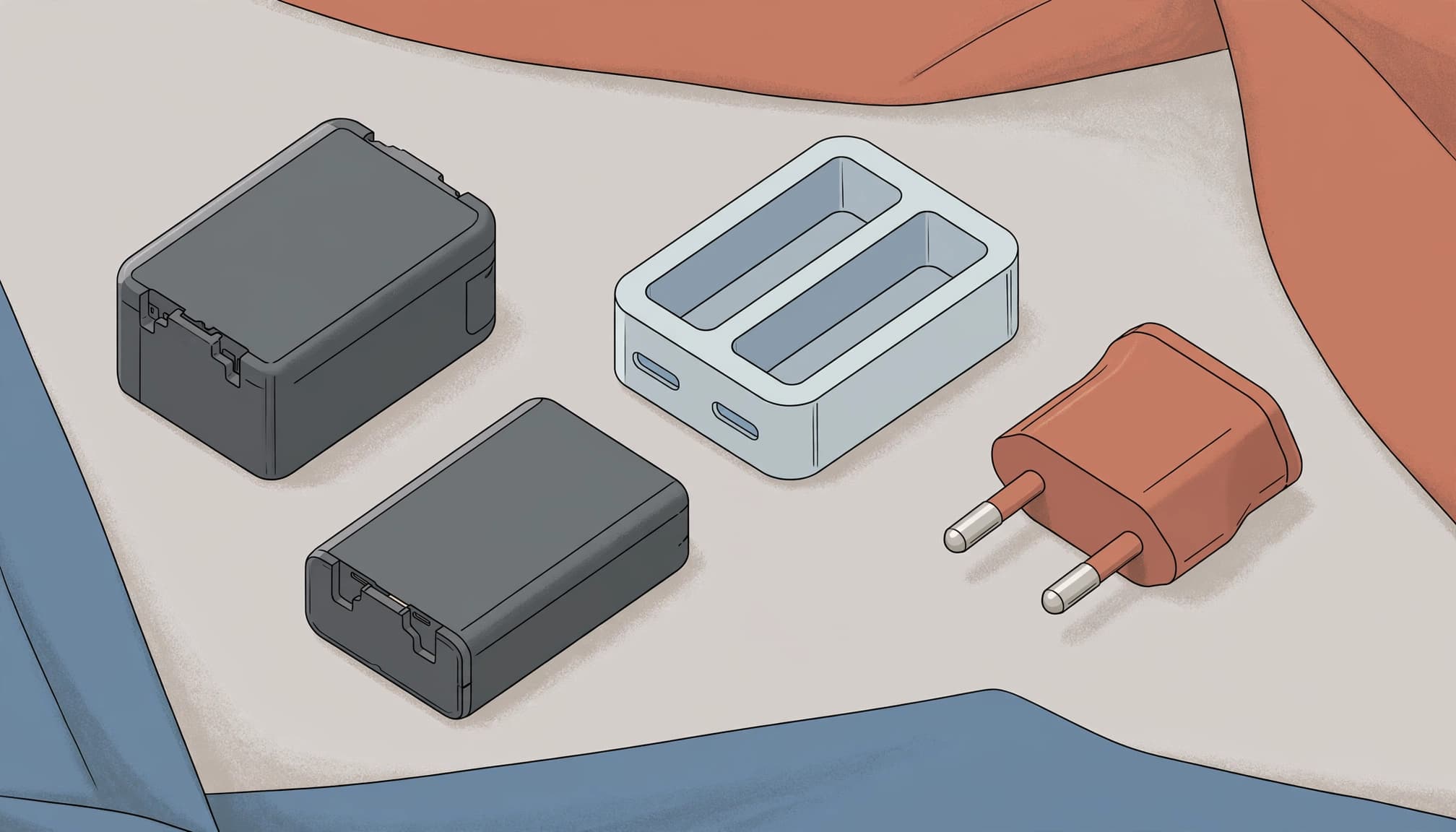
Many European destinations use a nominal 230 V, 50 Hz supply, but plugs vary. Type E is common in France and Belgium; Type F appears in Germany, Austria, the Netherlands, and Spain. The UK and Ireland use Type G. Don’t buy one “Europe adapter” without checking every stop on your itinerary.
Read the input rating printed on your charger’s power supply. If it accepts the local voltage and frequency, an appropriate plug adapter may be all you need. If the rating doesn’t cover your destination, don’t plug it in and hope: use a suitable power supply or a charging setup approved for that electrical input.
Check how the charger receives power as well. A USB-C battery dock still needs a compatible USB-C wall supply or power bank. Packing the dock without its required cable leaves you with an empty charging tray beside a perfectly good socket.
Decide whether to charge in-camera
Some cameras recharge their installed battery through USB-C; others need an external charger, and some restrict charging while the camera is on. Check the manual for your body and test the full cable-and-power-supply combination before leaving.
In-camera charging saves space on a light trip. However, the battery stays inside the camera while it charges. An external dock lets you charge a spare while the camera remains ready with another cell. If you shoot until midnight and leave again at sunrise, that difference can decide which setup fits your schedule.
Keep enough power for the whole travel day
Pack for your shooting habits
One spare is a practical baseline for a day away from outlets. Video, frequent playback, cold weather, and heavy viewfinder or screen use may call for another. Your camera’s advertised shot count can’t tell you how a particular day of filming or reviewing images will unfold.
A travel photographer described a cold ferry ride in Seattle when the main battery faded before the skyline light did. The spare in a jacket pocket kept the camera working over Elliott Bay. On a winter outing in Europe, an accessible spare is similarly useful; keep it protected rather than loose among keys.
The remaining option: finding an outlet. You may not have time for that between a train arrival and sunset.
Give every battery a place
Keep charged spares in individual protective cases or covered slots near the top of your day bag. Separate depleted cells so you don’t swap an empty battery into the camera by mistake. A simple routine works: charge each evening, move full batteries to one side of the pouch, and check them before checkout.
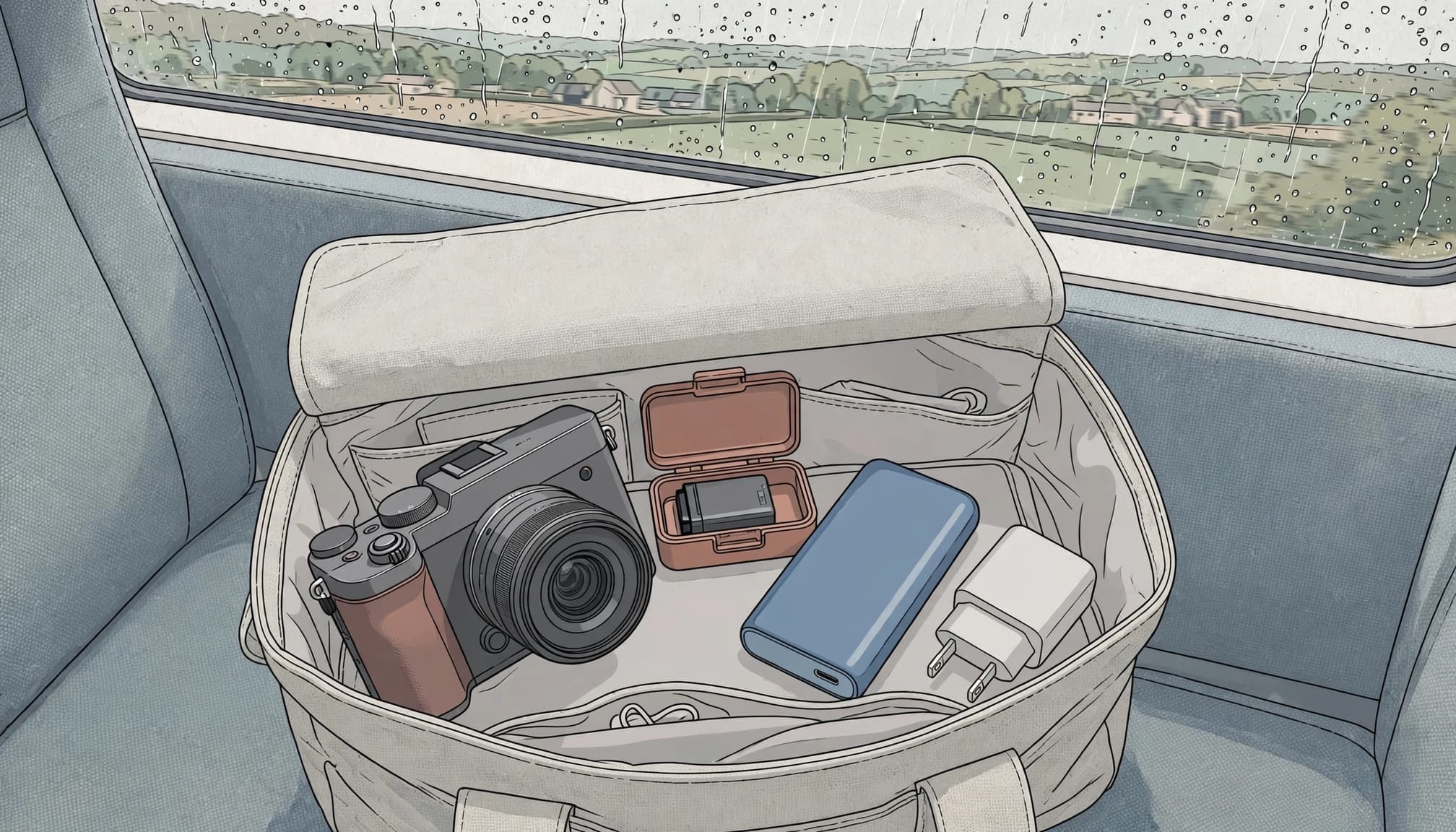
A USB-C power bank can extend your options if your camera or battery charger accepts its output. Check the required connection and charging behavior at home, especially if you expect to top up during a train journey rather than at your hotel.
Fly with batteries safely
Keep spares accessible in cabin baggage
Spare lithium batteries and power banks belong in your carry-on, with terminals protected against short circuits. The FAA’s battery guidance for passengers explains the carry-on rule and describes acceptable ways to protect spare batteries.
Use the original terminal cap, a dedicated battery case, or a suitable individual pouch. No loose cells. Put the pouch somewhere you can reach if airport staff ask to inspect it. If your cabin bag must go into the hold at the gate, remove the spare batteries and power bank first and keep them with you.
Ordinary camera batteries are generally well below the limits applied to large professional packs. Still, check the watt-hour marking if you’re carrying a high-capacity power bank, drone battery, V-mount pack, or monitor battery. Bigger packs can require airline approval or fall under stricter rules.
Check each airline on the route
Battery rules aren’t a single Europe-wide packing allowance. Airlines may restrict the number of power banks or apply conditions to larger batteries. A connection or separate ticket can put you under another carrier’s policy.
Review the dangerous-goods page for every airline before departure. For example, Air New Zealand’s battery policy sets out its own limits for spare batteries. European aviation guidance also says spare batteries, including power banks, should not be recharged on board. Don’t make an aircraft seat outlet the foundation of your charging plan.
Test the complete kit before departure
Run one realistic charging cycle
Charge the battery in your camera, charge every spare, and then use each one in the body. Confirm that the charger indicates progress and completion as its manual describes. If you plan to charge through the camera, test the exact wall supply and cable you’ll pack.
Try charging two depleted batteries at once if that’s why you’re buying a dual-slot dock. A charger that accepts two cells may draw power differently depending on its supply, so test it with your own USB-C adapter. Charge both before you leave.
Pack for the smallest bag allowance
A battery kit should be easy to find without unpacking your entire camera bag at security. Keep cells protected in a compact pouch, with cables coiled separately. That also makes a gate-check request easier to handle.
Measure the loaded cabin bag against the smallest allowance on your itinerary. A charger may seem tiny on a shopping page, but the wall supply and cables take room too. For a short trip, removing one redundant dock may matter more than shaving a little weight off each battery.
FAQ
Can I use my phone’s USB-C charger for a camera?
Possibly. Your camera or external battery dock must support charging through that connection, and the phone charger must provide a compatible output. Check the device manual and test the combination before travel. A USB-C socket alone doesn’t promise that every cable and supply will charge your camera.
Will a continental European plug adapter work in London?
Don’t count on it. The UK uses Type G sockets, unlike the Type E and F outlets common in several continental destinations. Check the plug types for each country, then pack the appropriate adapter. Remember that an adapter addresses physical fit; your charger’s input rating determines whether it accepts the local electricity.
Can I charge a power bank during my flight?
Check your carrier’s current rules before boarding. The European Union Aviation Safety Agency’s dangerous-goods guidance advises that spare batteries, including power banks, shouldn’t be recharged on board. Arrive with the bank charged, and keep it available as a backup after landing.
Conclusion
A flat battery at the right moment is frustrating because it’s preventable. Match your battery code first, test the charger and power supply together, and keep protected spares in your cabin bag.
Before the first flight, put one fully charged spare where you can reach it without opening your suitcase.
