
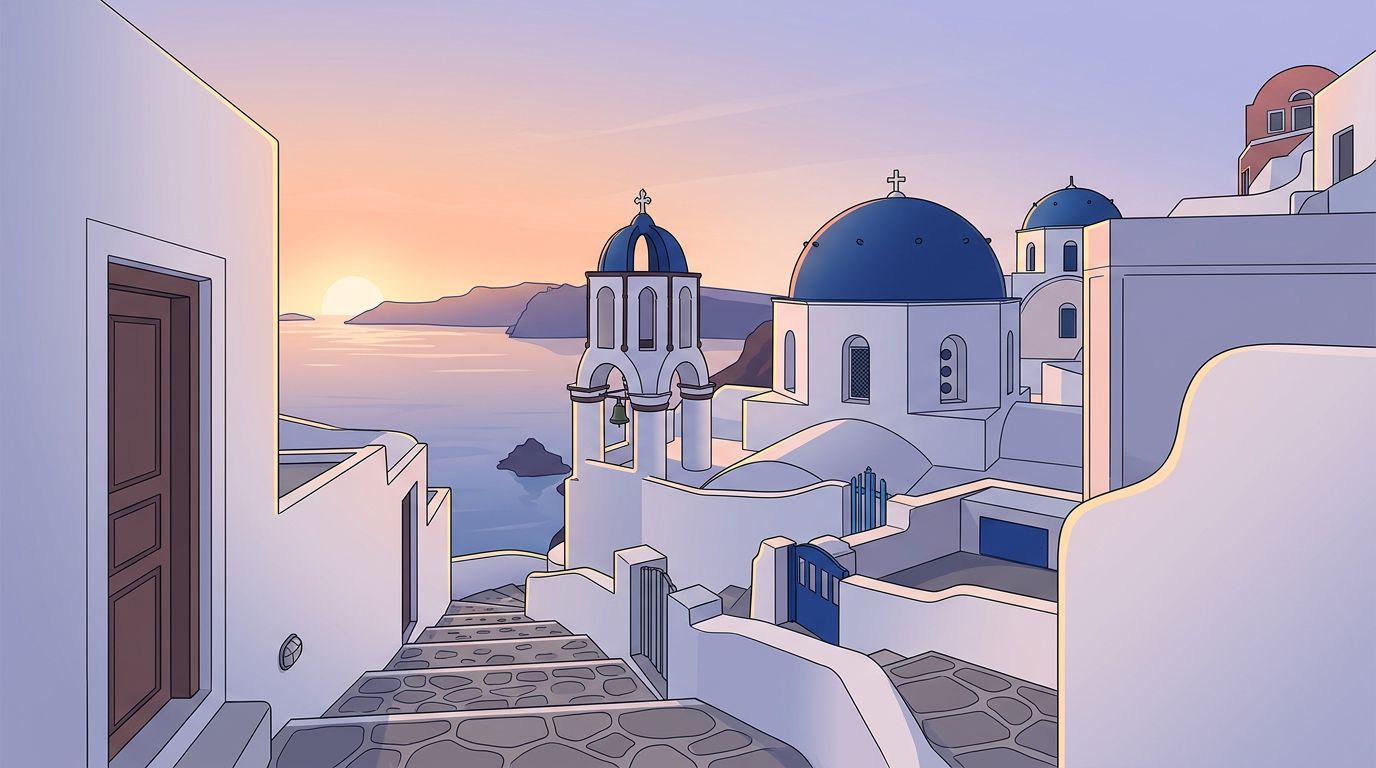
At sunrise, Oia feels briefly returned to its residents. The lanes are hushed, the white walls hold a faint blue cast, and the famous domes catch a warm edge of light before the village fills.
Santorini sunrise photography rewards preparation more than luck. You need the right stairway, a realistic arrival time, and a plan for handling bright white buildings beside a glowing sky. Get there before first light.
Santorini sunrise photography starts before dawn
The sun rises in the east, but Oia’s cliffside layout changes how light reaches every lane. The first color often appears over the sea before the domes receive direct sun. That short interval gives you soft shadows, clean blue paint, and detail in the whitewashed walls.
Arrive at your chosen viewpoint at least 15 minutes before official sunrise. In summer, sunrise can fall around 5:45 to 6:30am. During spring and autumn, it often shifts closer to 6:30 to 7:15am. Check the date-specific forecast the night before.
Because Oia’s lanes fall away toward the caldera and the domes sit below eye level, arriving without scouting the exact stairway leaves you wasting the short interval when the eastern sky warms but direct sun has not yet flattened the white walls.
A guide to Santorini photo locations recommends reaching some sunrise viewpoints around 5:40 to 6:15am. Use that as a prompt to check your own sunrise time, not a fixed schedule for every season.
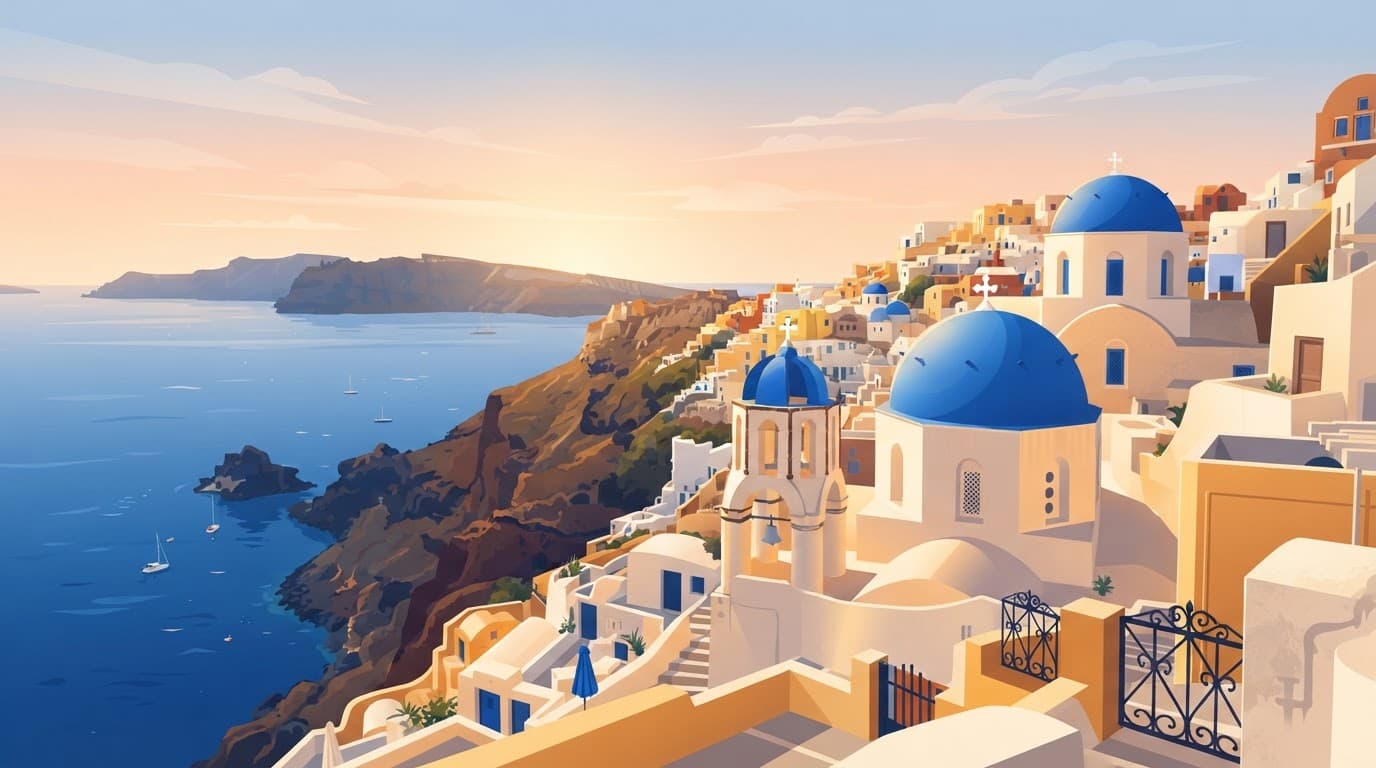
Clouds can be a gift. A thin bank on the horizon may turn pale light peach, coral, or lavender, while an empty blue sky gives a sharper, more graphic result.
Before the crowds
Sunrise is quieter than sunset, but the classic dome view is no secret. Expect a few photographers in peak season, particularly between June and September. Respect their frames, then take your turn.
One photographer behind a recent Blue Domes Viewpoint reel advised arriving before 7am after having waited in line for the image. That small anecdote matches the practical reality in Oia: early does not always mean empty.
Don’t rush away when the sun clears the horizon. The next 30 to 60 minutes bring warm side light across staircases and church facades. By 8:30am, the stronger light and growing foot traffic usually make tight architectural compositions harder.
Find Oia’s classic three-blue-domes view
The familiar composition looks down across three blue domes, white bell towers, and the Aegean. It sits near the stairway area around Anastasis Church and the Church of Panagia Akathistos Hymn. Narrow walkways and changing elevations make it easy to miss.
Start near the blue-domed churches, then walk slowly through the side passages rather than following the busiest caldera path. Look for a raised stairway where the domes sit at different heights. Your goal is separation. When one dome overlaps another, the scene loses its layered rhythm.
Local visitors often point newcomers toward Oia’s smaller side walkways in community advice on finding the domes. Explore with care, since many doors, terraces, and stairs belong to homes or hotels.
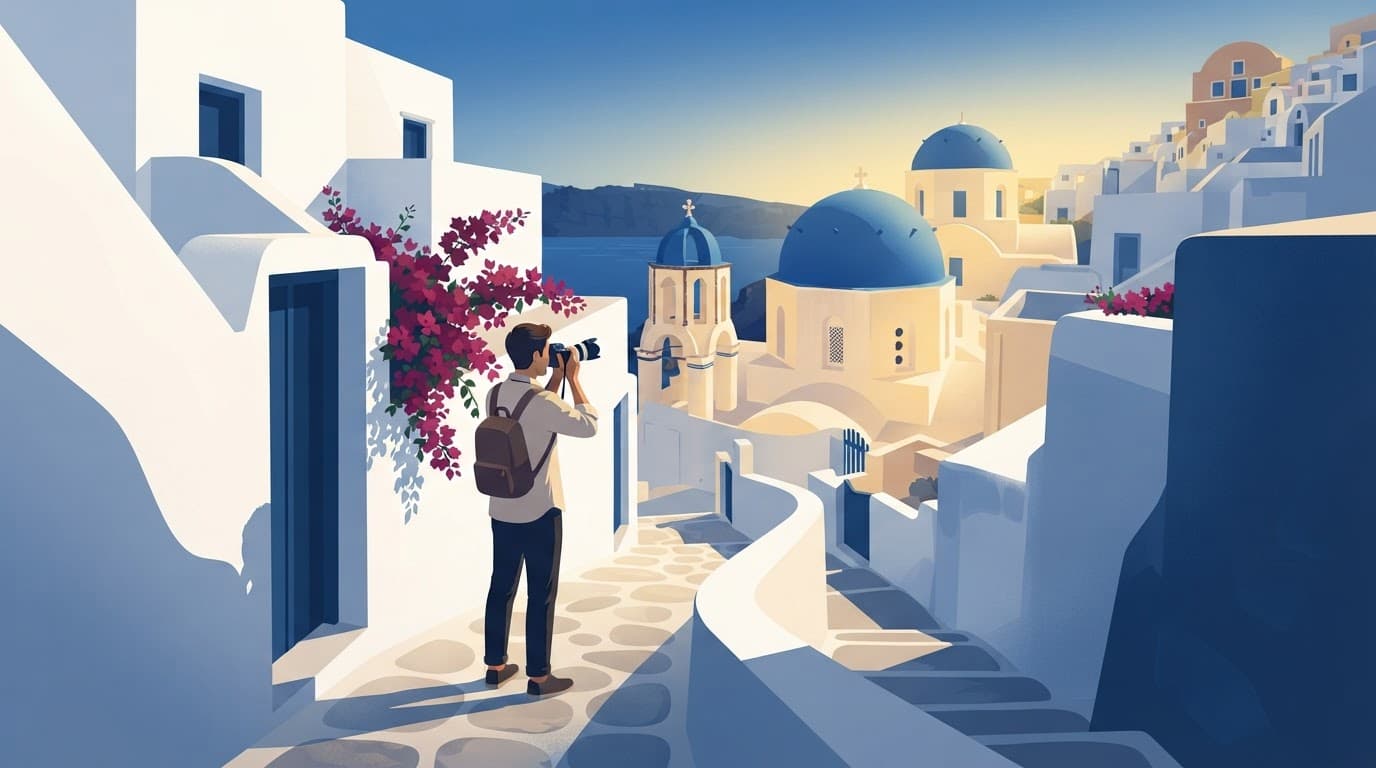
A wide view needs more than domes. Include a curving wall, a small section of staircase, or a strip of sea to give the buildings scale. For a tighter image, use a longer focal length and let the domes fill the center of the frame.
Photograph Oia without crossing a line
Oia is a living village, not a set. Stay on public paths, never climb walls, and don’t step onto roofs or hotel terraces for a picture. Move your tripod when people need to pass.
Keep voices low near homes and churches. If a resident needs access, clear the route immediately. These small choices matter more than one extra frame.
Camera settings for blue domes and white walls
The exposure challenge is real. White buildings can clip to blank patches while the sky still looks dull. Protect the highlights first, because shadow detail is easier to recover than blown white paint.
For Santorini sunrise photography, shoot RAW whenever your camera or phone allows it. RAW files give you more room to correct white balance and recover highlights later. If you use a phone, turn on its RAW or Pro mode when available.
These starting settings work in most early-morning conditions:
| Situation | Starting setup | What to watch |
|---|---|---|
| Handheld wide scene | ISO 100 to 400, f/5.6 to f/8, 1/125 sec or faster | Keep walls sharp and avoid motion blur |
| Tripod composition | ISO 100, f/8 to f/11, 1/10 sec to 1 sec | Use a two-second timer or remote |
| Dome detail with telephoto | ISO 100 to 400, f/5.6 to f/8, 1/250 sec or faster | Wind and hand shake show quickly |
| Smartphone Pro mode | Lowest ISO, tap exposure down slightly | Watch for clipped white highlights |
For mirrorless and DSLR users, start with exposure compensation around -0.3 to -1 EV when the sun brightens the walls. Check your histogram, not only the screen. A bright display can hide lost highlight detail.
Bring a small cloth. Sea air and morning condensation can leave a faint film on a front element or phone lens. That haze is easy to overlook until you zoom into the images later.
A tripod helps for careful framing, but don’t let it slow you down. If you’re carrying one, use a compact model that fits close to your legs in narrow passages. Smartphone photographers can brace against a wall or railing, then use a short self-timer to reduce shake.
Compose for depth, not a postcard copy
The famous shot is worth taking, but Oia has more than one picture. After you secure the classic frame, shift a few steps and search for foreground shape. A white parapet can guide the eye toward a dome. A shadowed arch can frame the light beyond it.
Light changes fast. Recompose as the first sunlight moves. A dome that looked flat five minutes ago may gain texture on its curved surface, while a lane behind it falls into useful shade.
Avoid placing every dome dead center. Try a vertical frame with a bell tower rising through the upper third, or a horizontal composition that leaves open water beside the architecture. Negative space keeps white buildings from becoming a busy block.
The most convincing Oia images show a relationship between the domes and their cliffside setting, rather than treating the churches as isolated objects.
If people enter the scene, decide whether they help. A single figure walking down a stairway can add scale. Several people standing in the focal point usually pull attention away from the architecture. Wait a few seconds instead of cloning them out later.
Edit sunrise color with restraint
Santorini’s white surfaces are not pure white at dawn. They may hold blue shadow, warm reflected light, or pink from the sky. Preserve those shifts, because they show the hour you photographed.
Start by lowering highlights, lifting shadows gently, and adjusting white balance until the walls feel believable. Then increase blue saturation in small increments. Oversaturated domes can turn electric and lose the painted, weathered quality that makes them compelling.
Correct perspective if the buildings lean inward from a wide lens. However, don’t straighten every line until the village looks sterile. Oia’s stairs, angles, and stacked roofs have an irregular structure.
For phone photos, edit the original file instead of a social-media screenshot. Save a full-resolution version before cropping for vertical posts. A 4:5 crop often suits the domes and stairs, while a wider crop works better when the caldera and sea carry equal weight.
Let the morning stay visible
The strongest Santorini sunrise photography comes from arriving early enough to observe before shooting. Learn the stairway, watch the color form, and wait for the domes to separate in your frame.
Leave room for Oia’s imperfect geometry and changing light. Your final image might be the classic three domes, or it might be a quiet blue cupola above a shadowed stairway at 6:42am.
