
Puglia’s brightest scenes are rarely the easiest to photograph. Puglia travel photography asks you to balance white walls, deep shade, weathered stone, and a sun that can turn a promising frame flat within minutes.
A good image here needs more than a famous viewpoint. It needs patience with light, respect for private spaces, and enough time to pull over when an old olive trunk catches the late sun. Start with a route that leaves room for such stops.
Puglia Travel Photography: Build a Route Around Light
A rental car gives you the freedom this region rewards. Trains connect major places, but they won’t take you down the lanes between Ostuni and Ceglie Messapica, where ancient olives sit behind low dry-stone walls.
Use a loose circuit that pairs Ostuni, Ceglie Messapica, Alberobello, and Locorotondo, then leave several unplanned hours for farm tracks whose dry-stone boundaries and empty gateways change character when the sun drops. Check your map in advance, but don’t turn the day into a race between pins.
An independently written Puglia photography travel guide can help you identify broad areas worth exploring. Still, treat every published location as a starting point. Road access, construction, parked cars, and light direction can change the result.
Historic centers often limit vehicle access through ZTL zones. Park outside the old town, walk in with a small bag, and pay attention to local signs. A long lens and tripod don’t help if you’re worrying about a traffic fine.
For Puglia travel photography, select one town for dawn and one countryside area for late afternoon. That simple choice keeps the work focused and gives you time to revisit a promising lane.
Let the sun decide the order
East-facing streets brighten first. In Ostuni, that means you can find cool blue shadow beside sunlit limewash before the day gets busy. Meanwhile, west-facing facades often suit the last part of the afternoon.
Coastal scenes need a different plan. Polignano a Mare faces the Adriatic, so morning light often works well for the cliffs and water. The inland country near Fasano and Ceglie Messapica usually looks stronger when long shadows describe the ground.
Keep the road in frame. A narrow lane can give a grove structure that a field-wide view lacks.
Use Puglia’s Strong Light With Care
Harsh noon light flattens everything. It also pushes white buildings toward featureless highlights, even when they look fine to your eyes.
Arrive before the shutters open. At dawn, the air is cooler, streets are quieter, and shadows have clean edges. A current Puglia photography spot guide also recommends early and late light for trulli, olive trees, and the region’s stone towns.
In narrow streets, white walls bounce enough light into the shade that scenes your eyes read as gentle can produce pale doorframes and blacks that close too fast if the camera bases exposure on a dark doorway. Shoot RAW, watch the histogram, and expose with the brightest wall in mind.
A small amount of underexposure is often safer than trying to rescue blown limewash later. If your camera has highlight warnings, turn them on. Then make a second frame after moving one step sideways, because reflected light changes fast near a white corner.
At 7:15 one May morning near Ostuni Cathedral, I framed an empty stairway until a cafe owner set two metal chairs outside, giving the white passage a human scale that the first clean frame did not have. The better photograph took another five minutes, not another lens.
A polarizer can deepen a blue sky and reduce glare on leaves. However, it can make wide-angle skies look uneven, so check the corners before committing to the frame.
Bright walls aren’t blank. Their cracks, brush marks, chipped thresholds, and reflected color carry the character of the town.
Photographing Puglia’s White Towns Beyond the Obvious
White towns can look sterile when you isolate only the cleanest walls. Look for the marks that interrupt the whiteness: a faded green shutter, a red geranium, or the shadow of a wrought-iron balcony.
Ostuni: compress the maze
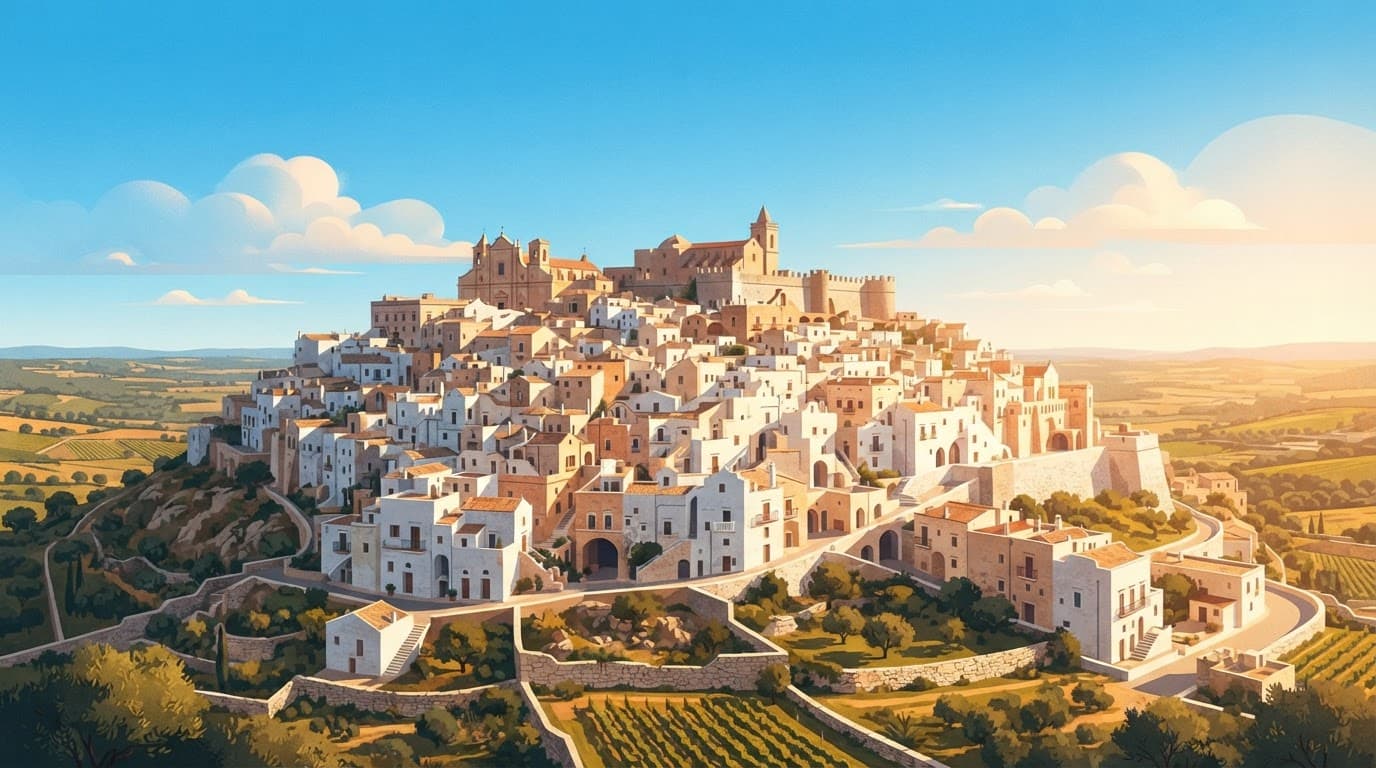
Ostuni, widely known as the Citta Bianca, works best when you stop treating it as one huge white panorama. Start outside the old center for a hilltop view, then head inside for tight compositions with doorways, stairs, and archways.
Use a 35mm or 50mm lens when the alleys feel too busy. Those focal lengths cut out distracting parked cars and let a single doorway hold the frame. For wider scenes, place a foreground wall close to the lens so the lane doesn’t become a flat tunnel.
La Porta Blu draws many visitors, yet the surrounding streets can offer more original photographs. Follow the changing light and take turns that aren’t marked on a map. A southern Puglia white-town discussion is useful for visual ideas, but it can’t predict who will be in a lane when you arrive.
Then wait. Especially for a figure crossing a white wall. The pause can turn a tidy record into a living scene.
Locorotondo and Ceglie Messapica: work smaller details
Locorotondo’s circular old center has whitewashed homes and clean sightlines. Its lanes reward photographers who use repeated balconies or receding steps rather than trying to show an entire street.
Ceglie Messapica feels less polished in places, which helps. Search for old doors, worn limestone, hand-painted house numbers, and small courtyards with deep shade. Photograph details at eye level, then step back for one wider frame that establishes the setting.
Keep people anonymous when they are incidental. If someone becomes the subject, ask first.
Alberobello and the Geometry of Trulli
Alberobello’s trulli are easy to recognize and difficult to make personal. Their conical roofs repeat so perfectly that wide shots can feel like postcards unless you give the eye a path through the scene.
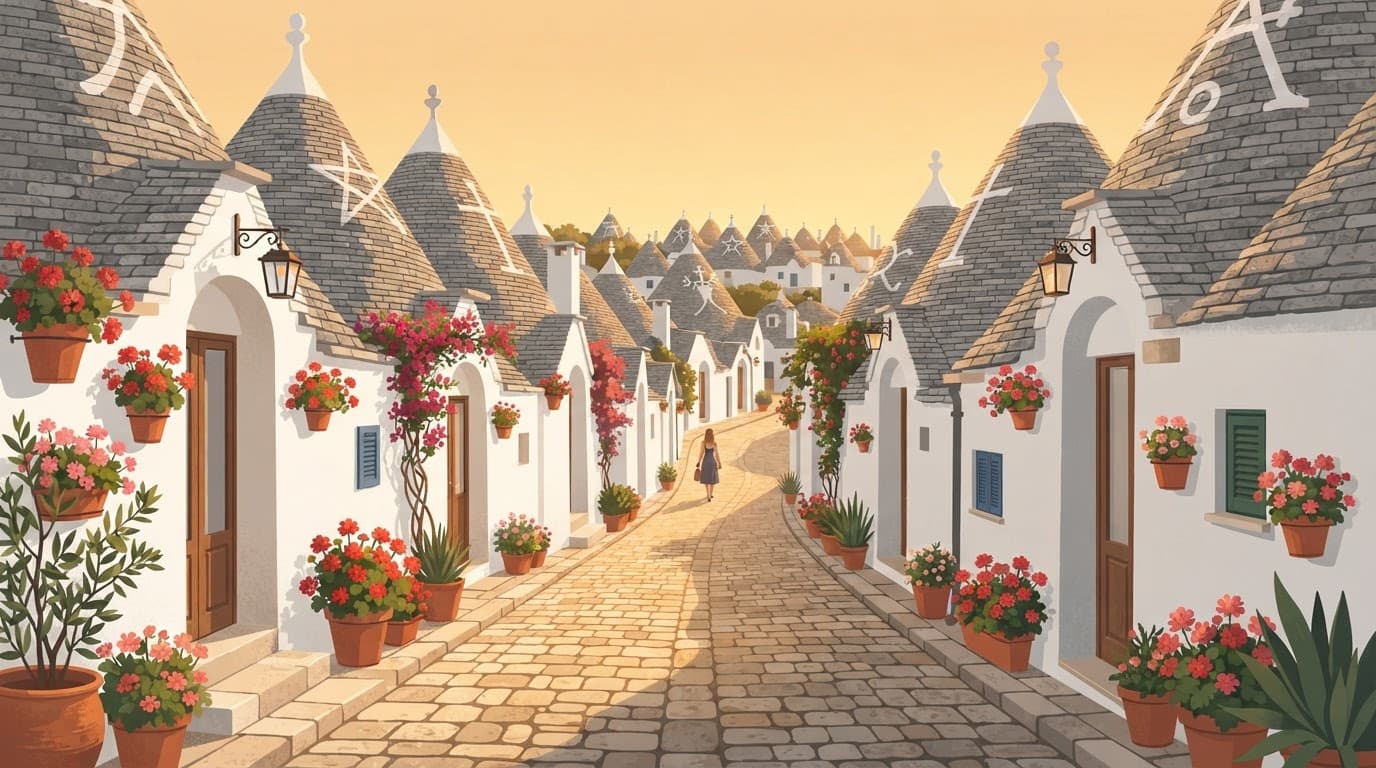
Belvedere Santa Lucia gives you the classic overview, especially around dawn when the roofs catch soft side light. Afterward, walk into Rione Monti and search for visual interruptions: a laundry line, a bicycle, or a lone chimney against the sky.
Use a longer focal length from the viewpoint to compress the roof cones. Inside the lanes, switch to a moderate wide lens and keep vertical lines straight. Tilting up too far can make the stone structures appear to fall inward.
Alberobello gets crowded quickly. Therefore, shoot the broad view first, then use the crowds as part of the story. A person walking between two trulli can provide scale if their placement feels deliberate.
The Valle d’Itria also holds trulli outside the famous center. These isolated buildings often sit beside small fields and old trees, which creates a calmer frame than the busiest streets. Keep an eye on Itria Valley visual notes for the kind of country roads worth exploring, then seek your own composition.
Ancient Olive Groves Need Space and Respect
The country around Ostuni, Fasano, Monopoli, and Ceglie Messapica has olive trees with trunks that twist, split, and fold over themselves. Treat each tree as a portrait subject rather than background decoration.
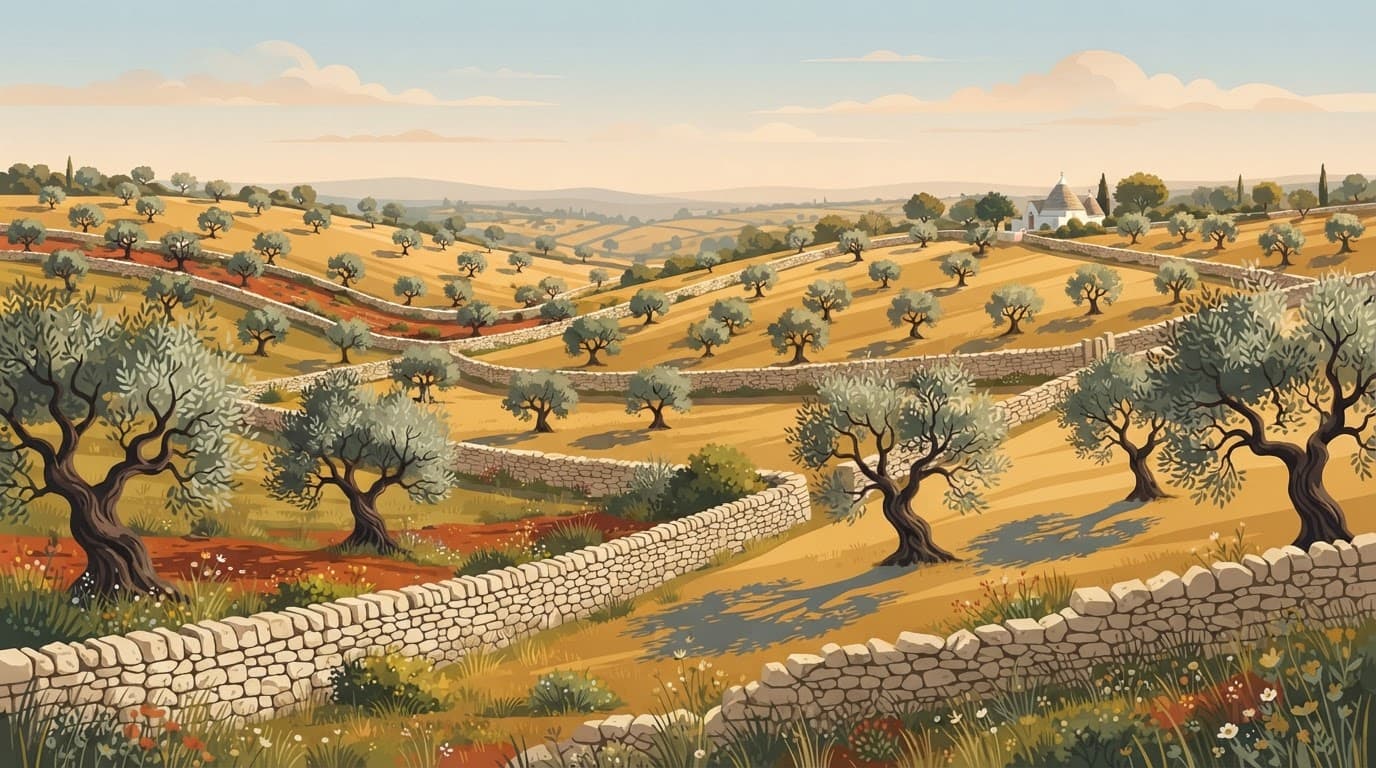
Puglia travel photography becomes more interesting when you show how a tree sits in the country. Include a dry-stone wall, a distant trullo, or an empty lane when it adds direction. Keep the road in frame if it leads toward the trunk.
A low camera position can make the roots feel imposing. However, don’t lie directly beneath dense branches if the canopy becomes a dark mass. Step around the tree until a gap in the foliage reveals pale sky or a distant white building.
Late light works beautifully on bark. Side light catches the folds and turns the silver-green leaves into small flashes. Backlight can also work, but shield the lens with your hand or lens hood to control flare.
Ask before entering a grove. Much of the countryside is private farmland, even when a gate is open or a path looks well worn. Don’t climb old trees, shift stones, or move branches for a cleaner composition.
A short visual record of Puglia’s ancient olive trees captures the appeal of these monumental forms and their stone boundaries. Your photographs will be stronger when you give the tree room to breathe rather than filling every corner with it.
The tree is the subject, but the route into the frame tells viewers where it stands.
Pack Light, Then Set Up With Intention
A versatile camera kit keeps you mobile in steep lanes and uneven fields. Carry what you can use without rushing.
| Item | What it helps you photograph | Practical use |
|---|---|---|
| 24-70mm zoom | Streets, hill views, and trulli | Use it when changing distance is impossible. |
| 35mm or 50mm prime | Alleys and environmental portraits | Shoot wide open only when the background supports the subject. |
| 70-200mm lens | Distant rooftops and compressed olive rows | Isolate patterns without crossing private land. |
| Circular polarizer | Leaves, pale walls, and water | Rotate it slowly while watching the effect. |
| Compact tripod | Blue hour and carefully layered scenes | Set it up only where pedestrians can pass safely. |
A microfiber cloth matters more than it seems. Olive dust, sea spray, and fingerprints show up quickly when you photograph bright skies and white buildings.
Set your camera to record RAW files. Also, use a low ISO whenever possible, because shadow recovery in narrow streets is easier when the file starts clean. At twilight, a tripod lets you lower ISO without forcing an exaggerated shutter speed.
Don’t photograph every scene at eye level. Kneel near a stone wall, shoot through an arch, or climb to a public viewpoint. Yet avoid blocking a doorway or standing in the road for one more frame.
Add People, Food, and the Adriatic With Permission
Puglia’s towns are lived-in places. A clean architectural frame has value, but local life adds timing and scale when you handle it with care.
Bari Vecchia’s Strada Arco Basso is known for women making orecchiette outside their homes. If you want a close photograph, say hello first and ask, “Posso fare una foto?” Buying a small bag of pasta doesn’t replace consent, but it can begin a friendly exchange.
Markets, cafe terraces, and fishermen near the coast offer more natural moments than posed street portraits. Stay back with a longer lens when someone is part of the setting. Move closer only after permission.
Polignano a Mare gives the route a burst of blue after so much limestone and olive bark. At Lama Monachile, arrive early, look for a stable viewpoint, and use the old town’s pale facades to frame the water.

Photo by K
Clouds change the plan. On a bright day, use a faster shutter speed to hold detail in the waves. When the light softens, try a slower exposure only if the composition still has a firm anchor in the cliffs or town.
A Slower Way to Photograph Puglia
The most memorable frames here come from attention, not volume. White facades need careful exposure, while ancient olive trees need time and a respectful distance.
Let each place set the pace. Puglia travel photography improves when you return to the same corner after the light shifts, rather than collecting the same view as everyone else.
Leave space on the memory card for a dry-stone wall, a gnarled trunk, and one silver olive leaf held in the last light.
