
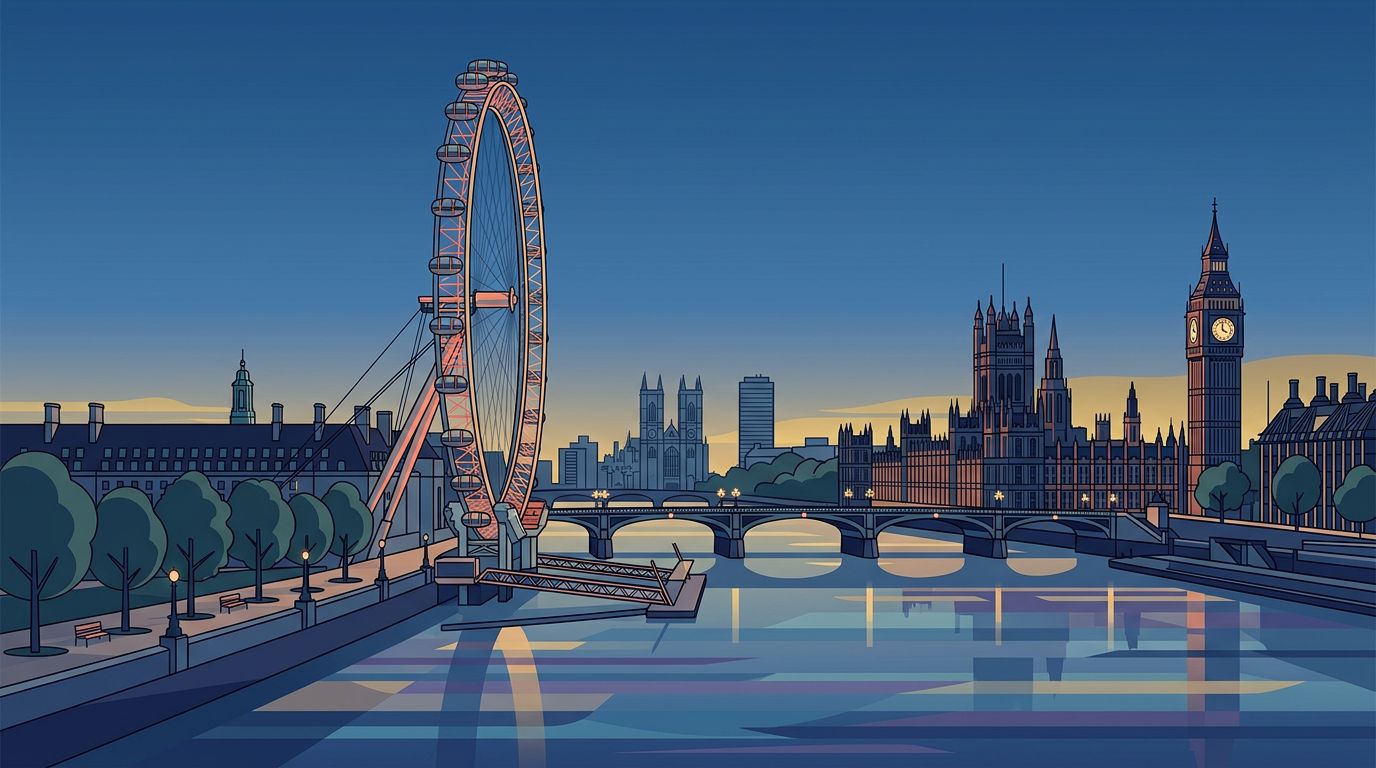
London is at its most photogenic before commuter buses fill the bridges and the Thames still holds the sky’s color. Westminster offers grand angles, while the riverbank brings reflections, concrete textures, and views that shift every few steps.
This London photography guide follows a walkable route through Westminster and South Bank. You can photograph Big Ben, Westminster Abbey, the London Eye, St Paul’s Cathedral, and the river without spending the day on the Underground. The light changes quickly, however, and a tripod can turn a simple personal shoot into a permissions issue.
Start before the buses. The river will reward you.
Key Takeaways
- Start 45 to 60 minutes before sunrise for quieter streets, blue-hour light, and cleaner views of Westminster Bridge, Big Ben, and the London Eye.
- Follow the Thames eastward from Westminster through South Bank, using the Golden Jubilee Bridges, Waterloo Bridge, Millennium Bridge, and Tate Modern as changing viewpoints.
- Keep your camera kit light: a 24-70mm equivalent zoom, a 35mm or 50mm prime, spare batteries, and a microfiber cloth cover most situations.
- Check permissions before using a tripod, especially around Westminster, the Queen’s Walk, County Hall, and other managed or privately owned spaces.
- Let the weather and passing movement shape the images; rain, reflections, buses, trains, and changing blue-hour light often create the strongest frames.
A route before the crowds
Westminster and the South Bank work best as an early start followed by a slow eastward walk. Arrive 45 to 60 minutes before sunrise to catch the blue hour around Westminster Bridge and the London Eye.
The South Bank is rarely empty, but dawn changes its pace. Runners, delivery staff, and a handful of photographers replace the daytime stream of visitors. As the light lifts, you can move toward the Golden Jubilee Bridges, Waterloo Bridge, and Bankside without retracing your steps.
The South Bank location guide from Amateur Photographer treats this riverside corridor as a long photographic route, and that is the right mindset. Don’t regard it as one stop. Treat each bridge, underpass, and bend in the river as a new viewpoint.
| Season | Light and atmosphere | Crowd reality | Practical note |
|---|---|---|---|
| February to March | Low sun, cooler color, occasional mist | Often quieter outside school holidays | Bring gloves and spare batteries. |
| Late April to May | Fresh park foliage and longer evenings | Busy after mid-morning | Sunrise is early during British Summer Time. |
| September to October | Softer evening light and darker skies sooner | A good balance for many visitors | Blue hour arrives at a workable time. |
| November to January | Wet pavements and short daylight | Tourist hotspots can still be busy | Christmas crowds affect the riverfront. |
Summer offers long days and a generous evening golden hour, yet it also brings the most people and the latest sunsets. By contrast, late autumn can give you a dark blue sky before dinner, though rain becomes a regular part of the plan.
Check sunrise, sunset, weather, and blue hour timings on the evening before your walk. Also check for demonstrations around Parliament Square, major events, and transport disruptions, because each can change access around Westminster within hours.
Westminster photography: frame the architecture without flattening it
The Palace of Westminster is easy to photograph badly. A wide angle lens can make Elizabeth Tower look thin and distant, while a crowded foreground can turn the river into visual clutter.
Begin on the South Bank near the Westminster Bridge approach. A 24mm to 35mm focal length gives you the river curve, the bridge, and Elizabeth Tower without bending every vertical line. Keep the tower away from the extreme edge of the frame, where wide-angle distortion becomes obvious.
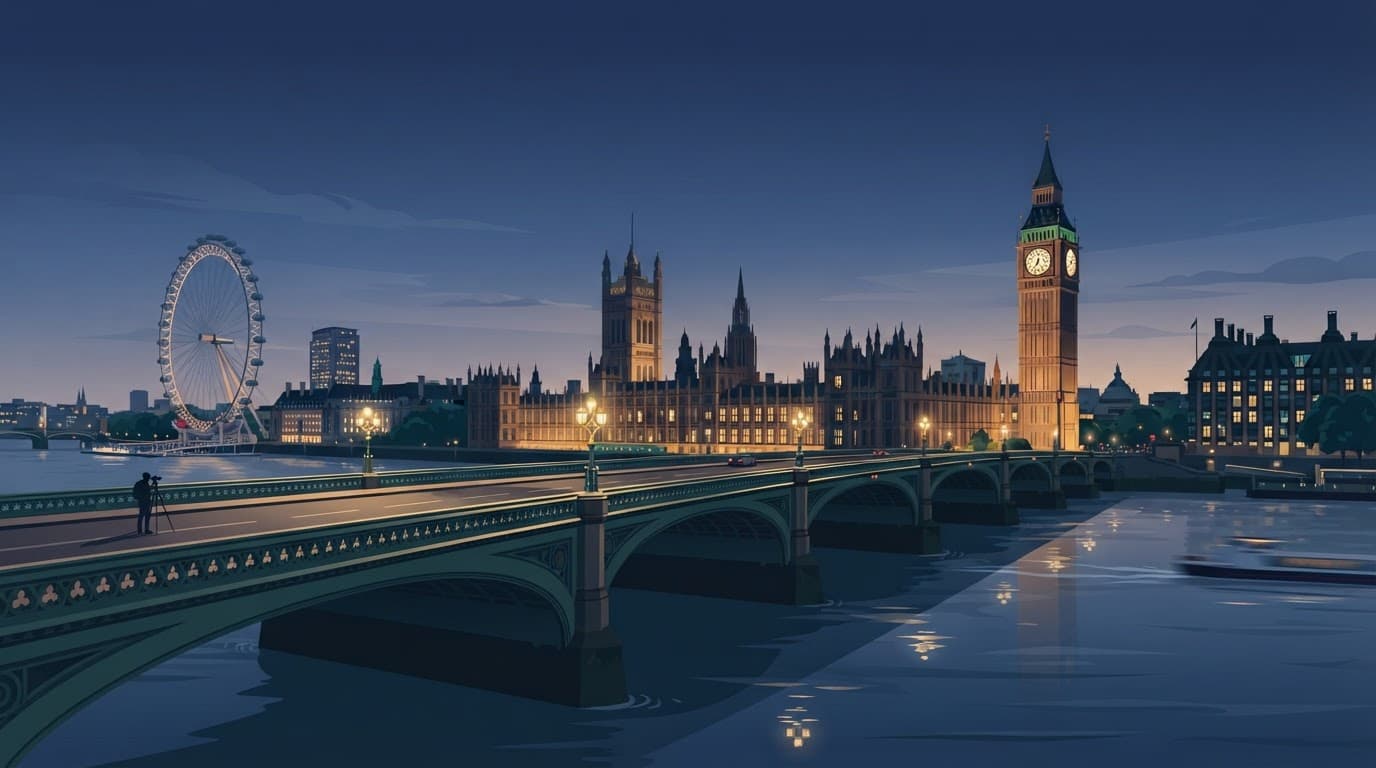
Big Ben, Westminster Bridge, and the Thames
Big Ben is the bell, not the tower. In photographs, the name usually refers to the full Elizabeth Tower, and the riverfront gives it the room it needs.
For the classic composition, shoot across the Thames with Westminster Bridge entering from a corner. Wait until a red bus travels through the frame, but don’t make it the main subject. At blue hour, use a shutter speed of around 1/125 second to keep the bus sharp. Raise your ISO rather than risking camera shake.
The bridge itself has useful repeating lamps and green ironwork. A low position can make those lines pull the eye toward the tower. Keep clear of pedestrians, and never block narrow sections of pavement. Westminster rewards patience more than a frantic burst of frames.
For a different view, walk around Parliament Square with a 50mm or 70mm lens. At blue hour, time an exposure as buses pass. The longer focal length can compress the clock tower against the traffic and gothic facade. The Elizabeth Tower viewpoints collected by Trevor Sherwin are a useful prompt to move beyond the first angle you see from the bridge.
Victoria Tower Gardens is another good handheld option for the Palace of Westminster’s riverside facade. Aim upward slightly, use the dark tree trunks as a border, and leave enough space above the roofline for the tower’s shape.
Westminster Abbey and quieter streets
Westminster Abbey needs a different approach. Its western facade is strongest in soft overcast light, when the stone details are visible without harsh shadows cutting across the towers.
Storey’s Gate and the streets around the Abbey give you tighter architectural views than Parliament Square. Use a 35mm lens and step back until street furniture falls outside the frame. Early morning also limits the chance of people walking directly through your shot.
Inside the Abbey, personal photography is permitted in many areas, but the rules are strict. No flash, tripod, selfie stick, video recording, or extra lighting is allowed. Photography also stops during services and remains prohibited in named spaces, including the Shrine of St Edward the Confessor.
Don’t treat sacred spaces as a studio. Keep your camera quiet and your visit considerate.
Optional westward detour
If you have extra time, a westward detour to Buckingham Palace offers a change of scale. Treat it as separate from the core riverside walk, since it adds distance and shifts the focus from the Thames.
South Bank photography beyond the London Eye
The South Bank can feel over-photographed, but its details change with your direction of travel. The London Eye dominates near County Hall, then the concrete geometry of the National Theatre takes over, followed by bridges, river traffic, and the distant dome of St Paul’s Cathedral.
Start with the London Eye from the Queen’s Walk. A vertical frame at 35mm can include the wheel, the County Hall facade, and a narrow slice of the river. For a more graphic result, isolate the spokes against a pale sky with a longer lens.
The river path has many distractions, including food stalls, barriers, and temporary signs. Move a few metres instead of trying to remove everything in editing. Often, a change in height or a tighter crop is enough.
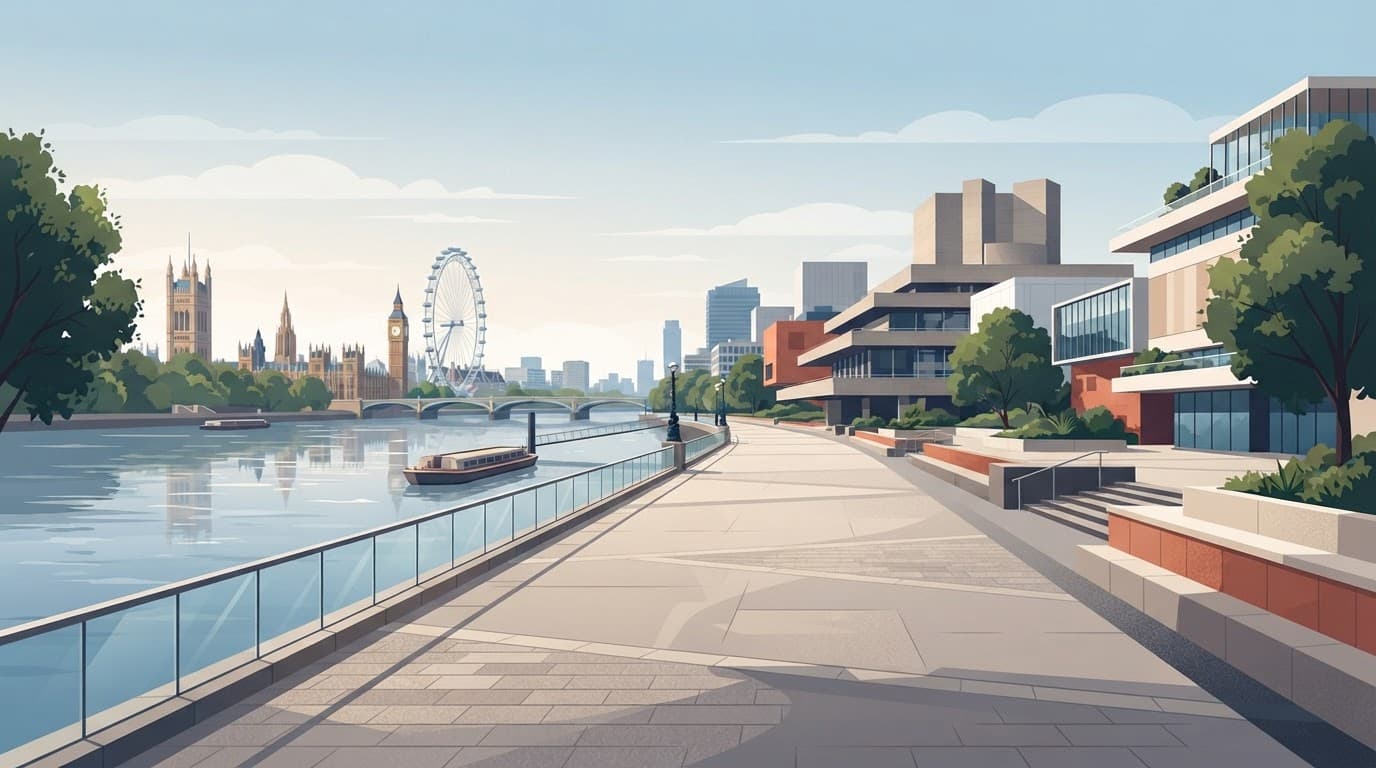
Golden Jubilee Bridges, Waterloo Bridge, and Tate Modern
The Golden Jubilee Bridges give you elevated river views without a rooftop reservation. At blue hour, face east for the City skyline and St Paul’s Cathedral. The darkening sky adds contrast as office lights begin to glow. Turn west for the London Eye and Westminster, but watch the rhythm of trains on Hungerford Bridge before settling on a composition.
On a February weekday, I reached the Golden Jubilee Bridge at 6:15 a.m. and waited through three passing trains before the view toward St Paul’s opened. One constraint remains: a fleeting opening between trains. The empty gap lasted seconds, but it was long enough for a clean frame of the river, bridges, and cathedral dome.
Waterloo Bridge sits higher and feels broader. Its eastern view works especially well at blue hour, when the City lights pick up in the water. Use the balustrade as a foreground line, but don’t rest your camera on it if vibration from traffic affects your exposure.
Continue east toward the Tate Modern and Millennium Bridge. At blue hour, stand on the south side of the bridge and point a 50mm lens toward St Paul’s. The fading light keeps the cathedral silhouette distinct against the river. Then turn around and use the bridge’s steel structure as a leading line toward the Tate.
The London travel photography route from Chasing Hippoz is helpful for seeing how South Bank and Bankside link naturally into a longer day. The river makes the route intuitive, even when the streets behind it become confusing.
Leake Street Tunnel, beneath Waterloo station, is one of the route’s hidden gems. Its graffiti changes often, the light is uneven, and the damp floor can give you colored reflections. A small fast lens, such as a 35mm f/1.8 or 50mm f/1.8, works better there than a bulky zoom.
For an optional London Bridge and Bankside extension, combine the textures of Borough Market with the scale of The Shard. If time allows, continue east to Tower Bridge, with Canary Wharf visible in the distance on a clear day. For an architectural alternative beyond the river walk, detour inland to Leadenhall Market.
Free views without depending on a rooftop booking
London’s popular high viewpoints can be free, but many still use advance bookings or capacity controls. The Sky Garden, Horizon 22, and Garden at 120 may change their entry systems, so don’t build a one-day shoot around a walk-in assumption.
For an unbooked elevated view, use Waterloo Bridge or the Golden Jubilee Bridges. They are open, central, and wide enough to offer several angles. One New Change’s roof terrace has also offered free views toward the dome, although its access depends on shopping-centre hours and on-site security.
For more landmark ideas around the river, this collection of iconic London photography locations may help you add a second location after your riverside walk.
Camera gear that stays practical in central London
Keep the kit light. Central London involves steps, bridges, crowded pavements, and sudden showers.
A camera with good high-ISO performance helps at blue hour, but you don’t need a specialist setup. A modern phone can make strong daylight frames if you watch reflections and keep verticals straight. For interchangeable-lens cameras, one zoom and one small prime lens cover most of this route.
- A 24-70mm equivalent zoom handles river scenes, landmarks, and tighter street details without frequent lens changes.
- A 16-35mm equivalent is useful for wide views and close architectural work, although it can distort towers near the edges.
- A 35mm or 50mm prime works well for street photography, underpasses, and low-light scenes by the river.
- Carry a microfiber cloth, two batteries, and a compact rain cover. River spray and drizzle leave marks on a front element fast.
For architecture photography, turn on your camera’s electronic level and leave room around the building. Correcting tilted verticals later trims the frame, so a little extra space saves a composition.
For practical camera settings at blue hour, begin handheld at f/4, 1/125 second, and ISO 800. Treat these as starting points, then adjust for the scene. Lower the shutter speed for still buildings, but keep it high enough to avoid blurred pedestrians if they matter to the image.
Street photography needs awareness as much as settings. Wear the camera cross-body or on a wrist strap, avoid leaving a bag by your feet, and keep gear packed away when entering busy stations. If someone appears uncomfortable in a close portrait, move on.
Tripod rules, permissions, and the difference a pavement can make
A tripod is not automatically allowed just because you can stand somewhere with a camera. Westminster and the South Bank combine public highways, Royal Parks land, venue property, and privately owned spaces that look public.
Westminster City Council allows small, handheld shoots of five people or fewer without an application when they don’t obstruct the pavement. Its no-application route does not allow tripods, lights on stands, drones, or equipment stored on the pavement, and you must keep at least two metres clear for pedestrians.
For a planned shoot using a tripod in Westminster, Film London says a Notice of No Objection is required, with small-crew applications needing at least three working days. That matters around Parliament Square, Westminster Bridge approaches, and other busy central locations.
A pavement that looks public can sit on private land, so permission follows the ground under your feet, not the view in front of you.
The South Bank needs the same care. The Queen’s Walk, the London Eye area, Royal Festival Hall surroundings, and the spaces around County Hall have different managers. Commercial or editorial work may need permission from the relevant landowner, even when passers-by use the route freely.
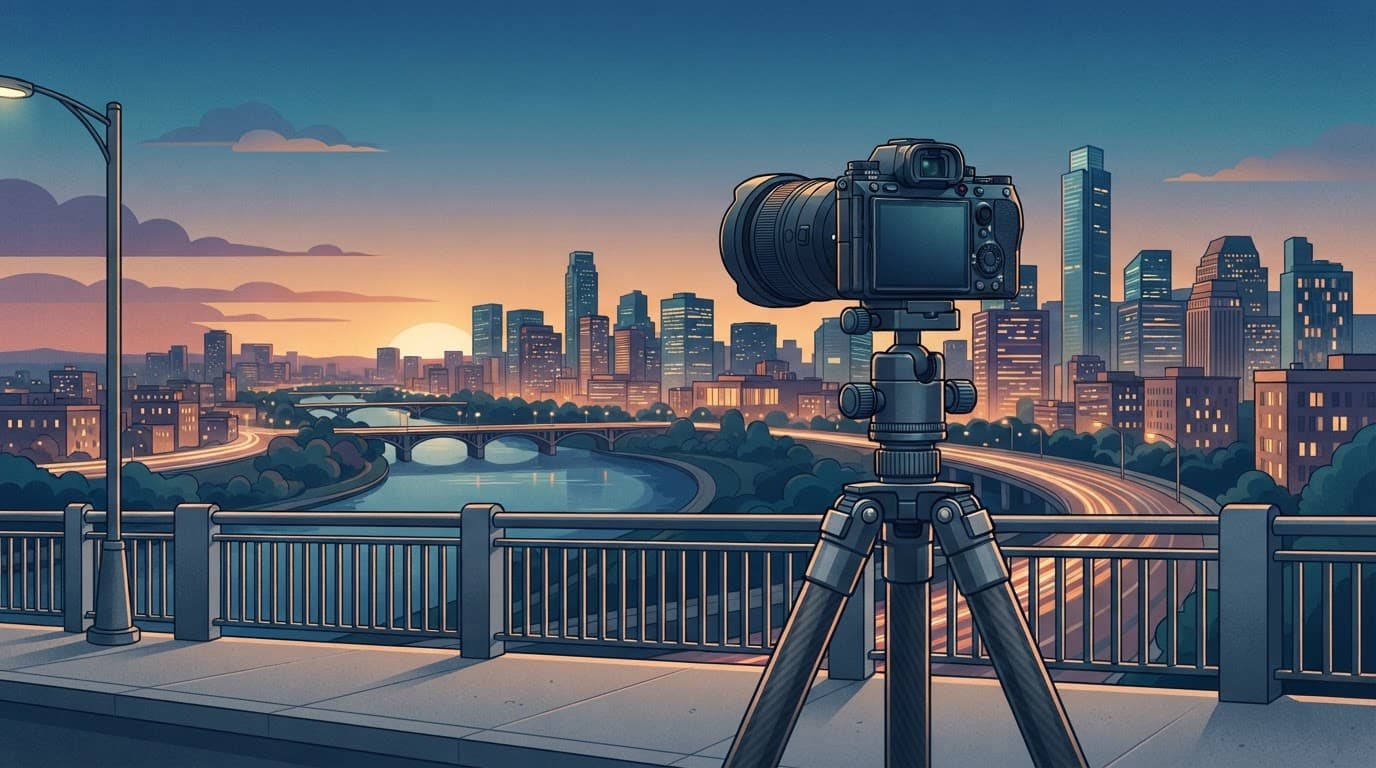
For personal photography, a handheld camera is the simplest choice. If security staff ask you to move or pack away a tripod, do it politely and ask where you may work instead. Don’t argue over a view when another angle is a short walk away.
Avoid placing legs where people could trip, even in areas where tripods are permitted. When a tripod is unsuitable, a compact camera braced against a wall, railing, or your own body can produce sharp photographs during blue hour.
Rain, cloud, and low light on the river
Rain can be useful. Westminster’s pale stone gains contrast when wet, and South Bank’s paving reflects buses, bridge lights, and the London Eye during blue hour.
Overcast weather suits Westminster Abbey and the Palace of Westminster because it softens shadows in the carved stone. On brighter days, look for side light that catches the bridge railings and wheel spokes. After rain, try a short long exposure on wet paving, but stay away from the river edge and slippery surfaces.
Carry a lens cloth in a pocket, not buried in your bag. Wipe the front element often, because a single drop can soften a night frame more than you notice on the camera screen. When moving indoors, leave the camera in its bag for a few minutes to reduce condensation.
For a rainy-day break, the Turbine Hall at Tate Modern offers huge scale and changing interior light. Around blue hour, watch how that changing light falls across the foyers around the Southbank Centre, creating layers of stairs, windows, and silhouettes. Leake Street Tunnel remains an option when the weather closes in, although its wet surfaces can be slippery.
A one-day Westminster and South Bank photography walk
A one-day London photography guide should leave room for missed light and closed areas. Use this order, then adjust it around the weather.
- Begin on the riverside of Westminster Bridge before sunrise, and photograph Elizabeth Tower across the river.
- Walk through Westminster for Parliament Square, Westminster Abbey’s exterior, and quieter side streets before the coach groups arrive.
- Return to the Queen’s Walk for the London Eye, then continue through the Southbank Centre toward the Golden Jubilee Bridges.
- Photograph the river from Waterloo Bridge at blue hour, or continue to Tate Modern and Millennium Bridge for the St Paul’s view after dark.
This route puts the strongest west-facing landmark views early, then shifts you east as the light and crowds change. The eastward leg is timed for blue hour, when the city lights begin to balance with the sky. If the morning is rainy, begin with Westminster’s stonework and save the river reflections for late afternoon.
Treat Buckingham Palace as an optional westward detour near Westminster, not part of the core sequence. With extra time, continue beyond Tate Modern and Millennium Bridge to Borough Market and Tower Bridge. These are separate stops, so the main walk still works without them.
Second-day extension: Use public transport to reach Canary Wharf or Greenwich. Neither is a walkable addition to this one-day route.
Give each stop a purpose. A wide river frame at Westminster, a compressed street scene near the Abbey, or a symmetrical bridge view toward St Paul’s is enough for one location.
Frequently Asked Questions
What is the best time to photograph Westminster and South Bank?
Arrive 45 to 60 minutes before sunrise to photograph Westminster during blue hour with fewer visitors and vehicles. Evening blue hour also works well from Waterloo Bridge, the Golden Jubilee Bridges, and Millennium Bridge.
Can I use a tripod on this London photography route?
Tripod use is restricted in several areas, even where the pavement appears public. Westminster generally requires additional permission for planned tripod shoots, while South Bank locations may have their own landowners and rules, so a handheld camera is the simplest option.
What camera lens is best for photographing London landmarks?
A 24-70mm equivalent zoom is versatile for river views, architecture, and street details. A small 35mm or 50mm prime is useful for low-light scenes, Leake Street Tunnel, and tighter compositions around Westminster Abbey.
Is this Westminster and South Bank photography walk manageable in one day?
Yes, the core route can be completed in one day by starting at Westminster Bridge and walking east toward Tate Modern and Millennium Bridge. Buckingham Palace, Borough Market, Tower Bridge, Canary Wharf, and Greenwich are best treated as separate detours or extensions.
How should I photograph London in rain or overcast weather?
Rain can add reflections to the South Bank paving and contrast to Westminster’s pale stone, while overcast light suits detailed architectural images. Carry a lens cloth and rain cover, and take care around slippery surfaces near the river.
Leave Space for the Unplanned Frame
The memorable London photograph often comes after the landmark shot, when rain starts, the light shifts into blue hour, a riverboat crosses the reflection, or a train clears the bridge. These hidden gems reward photographers who work with the conditions instead of waiting for a flawless postcard scene.
Westminster supplies the structure. South Bank supplies movement. Tower Bridge, Leadenhall Market, Canary Wharf, and Greenwich belong to separate eastward skyline and architecture routes, rather than this core walk.
For a second day, choose Shoreditch or Notting Hill street scenes, Hyde Park landscapes, Covent Garden market architecture, or Natural History Museum interiors.
Wait for the red double-decker bus to enter the Westminster Bridge curve, then take the frame.
