
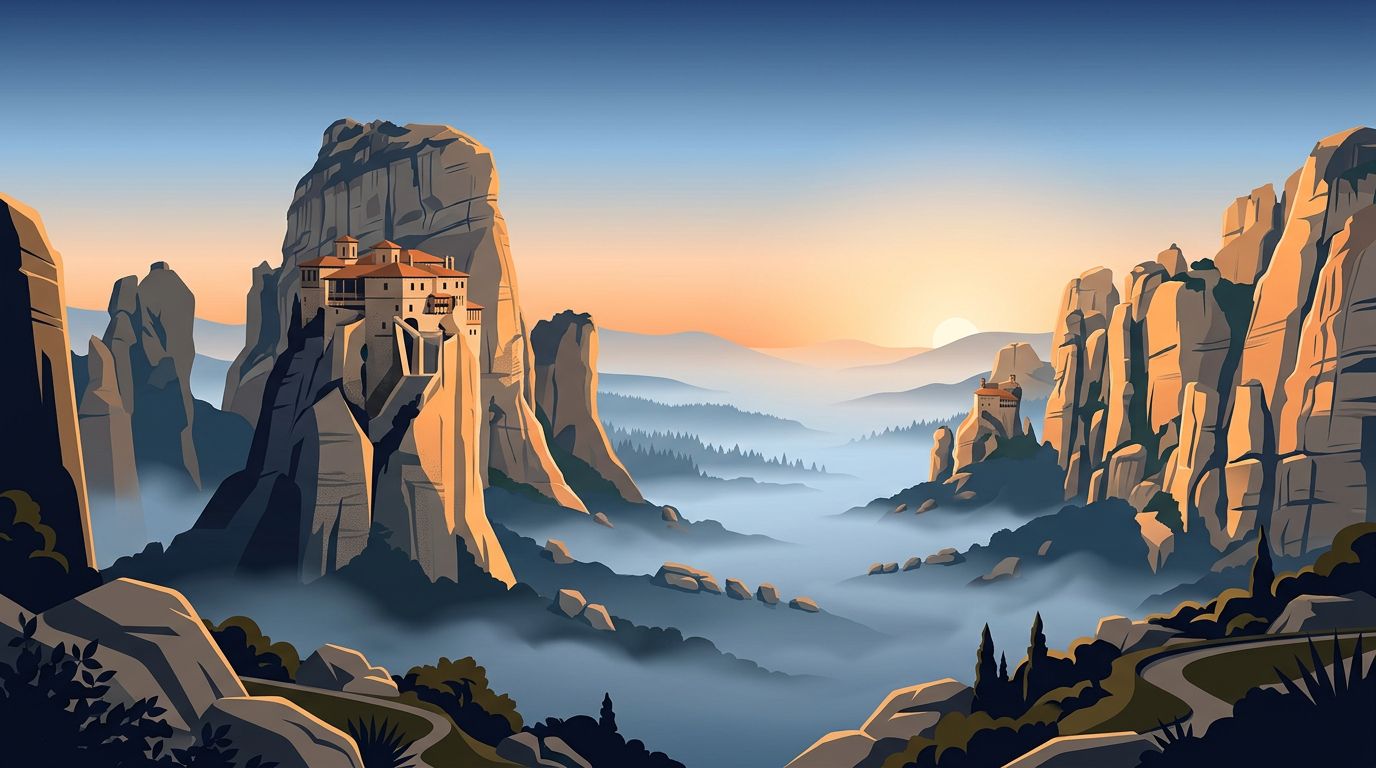
Before sunrise, Meteora can look almost unreal. Rock formations rise from a blue valley, while the Meteora monasteries catch the first narrow bands of warm light.
This Meteora photography guide helps you find the best photo spots without spending half your trip searching for the right pull-off. For travel photography, the strongest images come from preparation, patience, and a willingness to return when the weather changes.
Arrive before the color arrives.
Key Takeaways
- Plan each sunrise and sunset around the direction of light, weather, and the monastery or rock formation you want to feature.
- Arrive early, scout viewpoints in daylight, and allow extra time for limited parking, uneven paths, and changing conditions.
- Use both wide and telephoto lenses: wide angles show the valley and foreground, while longer lenses compress layers and isolate monasteries.
- Stay in Kastraki for the quickest access to early viewpoints, or choose Kalambaka for more restaurants and transport connections.
- Respect Meteora’s religious sites by following dress and photography rules, avoiding restricted interiors, and confirming drone permissions before flying.
Plan your light before driving into the hills
Meteora’s six active religious sites, known as the Meteora monasteries, sit high above Kalambaka and Kastraki, near Kalambaka Greece, on sandstone pillars shaped by water, wind, and time. Great Meteoron monastery and Varlaam monastery each face the light differently.
Because the cliffs face several directions and the monasteries sit at different heights, match each dawn or dusk to one composition. Great Meteoron monastery may suit one light direction, while Varlaam monastery often needs another. Roussanou monastery and Holy Trinity monastery also reward separate timing, rather than a hurried drive around the road while the best light disappears.
Start by checking sunrise, sunset, cloud cover, and wind the day before. Apps such as PhotoPills, The Photographer’s Ephemeris, and Windy help you see where the sun will rise or set in relation to a particular rock. Still, use them as a guide rather than a promise. A low bank of cloud can erase a planned sunrise, while broken cloud can turn an ordinary sunset into something far more textured.
A practical Meteora travel guide helps identify the best photo spots, but scout them in daylight. Check the approach to Great Meteoron monastery and Varlaam monastery before dawn. Roadside parking areas are small, and an evening pull-off such as sunset rock may involve uneven rock or faint paths that are hard to read in darkness.
The most productive photo session often begins before the sun reaches the horizon. During blue hour, shadows separate the monasteries from the cliffs before golden hour warms and flattens the scene.
Summer gives long daylight and late sunsets, often after 20:30. However, haze and crowds build fast. Winter offers cleaner air, quieter viewpoints, and occasional snow, but roads can be wet or icy. Spring and autumn are usually the easiest seasons for combining mist, manageable temperatures, and workable sunrise times.
Weather changes the script.
Meteora Photography Guide: Sunrise locations that reward an early start
Sunrise is Meteora’s quieter side. Tour buses haven’t arrived, road noise is low, and soft sidelight reveals folds and fissures in the rock formations. These conditions make Meteora one of the best photo spots for sunrise photography.
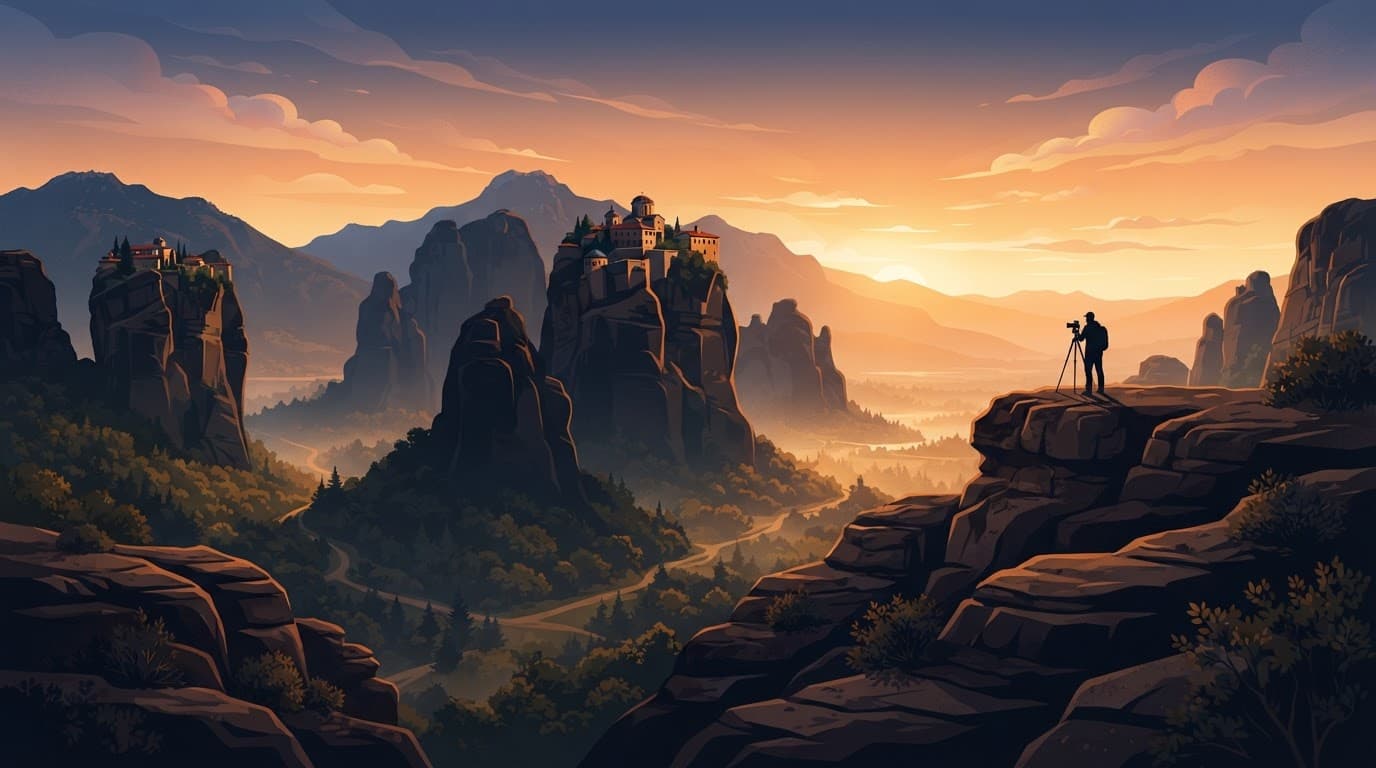
A wide valley view from the main observation deck
The main observation deck is known for sunset, yet it can be stronger at dawn. The view opens over pillars and distant monasteries, with the valley below adding depth through layered ridges. That suits landscape photography, while Varlaam monastery, Holy Trinity monastery, or Great Meteoron monastery can balance the sandstone scale. A guide to Meteora’s photo locations also recommends the Observation Deck for morning light.
Sunset rock is known for evening light, but it can offer a quieter dawn alternative.
Use a wide lens around 16mm to 24mm if you want the road and foreground rocks to lead toward the monasteries. Then switch to 70mm or longer when the sun starts to strike individual buildings. The telephoto frame removes visual clutter and makes the monastery feel embedded in the stone.
Avoid centering every building. Leave space around a dominant pillar, then use smaller monasteries to balance the frame. If the sky is pale and uninteresting, compose lower and allow the layered ridges to do the work. From this broad view, the best photo spots become more specific at the Roussanou and Kastraki viewpoints.
Roussanou monastery from the sunrise side
Roussanou monastery is one of the most photogenic buildings in Meteora because it appears to grow from its narrow pillar. Dawn works well when light grazes the valley, bringing out pale stone walls against darker cliffs.
Look for viewpoints that show Roussanou monastery with a second monastery in the distance. The image gains scale when the eye can travel through several ridges. A 70-200mm lens is especially effective here because it compresses the layers and keeps the monastery large in the frame.
One specific field story repeats often at Meteora. A photographer arrives at a famous overlook in dim light, sees the obvious wide view, then misses the stronger frame a few steps away where Roussanou monastery aligns with a distant pillar. That tighter composition lets Roussanou monastery relate to the surrounding cliffs. Walk slowly before setting the tripod. The useful foreground: a thin strip of gravel, a hardy shrub, or the edge of weathered limestone.
Kastraki for mist and low-angle views
Sunset rock gives an open view, while Kastraki village sits closer to the bases of the cliffs than Kalambaka. Its narrow lanes and nearby paths give you a lower perspective, which makes the formations feel taller and less familiar.
After rain or on cool autumn mornings, mist can settle in the valley beneath the monasteries. On a still morning after overnight rain, low cloud can drift through the valley beneath Roussanou monastery while the higher monastery catches first sun, so don’t abandon the photo shoot when the forecast says cloud.
Bring a headlamp. The short walk toward a Kastraki viewpoint is easy in daylight but uneven before dawn. Stay on marked paths and avoid climbing on fragile rock for a slightly higher angle.
Sunset Rock and other evening compositions
Sunset brings the largest crowds, especially from June through September. Most visitors head to sunset rock, one of the area’s best photo spots, for dramatic views across the cliffs and distant monastery silhouettes.
The light can be excellent, but the pull-off is tight. Aim to arrive at sunset rock 45 to 60 minutes early, when golden hour begins to shape the cliffs. Park safely at sunset rock, then carry your kit to the chosen spot before traffic builds. A Meteora sunset photography guide recommends using the period around sunset rather than photographing only the final moment.
Psaropetra viewpoint for layered monasteries
At sunset rock, place Roussanou monastery in the foreground, with other buildings stepping back through the scene. Start with 35mm to 70mm, then use a longer lens to isolate Roussanou monastery, cliff, and sky.
As the sun drops at sunset rock, watch the separation between Roussanou monastery’s walls and shadowed rock. Expose for the brighter stone, because a clipped white facade looks harsher than a slightly dark valley. If the dynamic range is extreme, bracket three exposures on a stable tripod.
At sunset rock, wait through blue hour after direct sunlight disappears. The sky often keeps color after the direct sun fades, while monastery lights begin to register against the blue cliffs.
Holy Trinity and the quieter northern road
Holy Trinity monastery has a more isolated profile than the clustered central monasteries. Late light outlines the profile of Holy Trinity monastery, while a long lens turns the surrounding ravines into darker shapes.
North of the busiest stops, roads around Great Meteoron monastery and Varlaam monastery offer quieter views for single-monastery compositions. You won’t always see a complete postcard panorama. Instead, look for Varlaam monastery framed by a tall pillar, or a road curve that adds direction without taking over the image.
A full sunset from sunset rock isn’t always necessary. If haze softens the sun, shift your attention to backlit grasses, red rock edges, or the shadow line moving across a monastery wall.
Use lenses and settings that suit Meteora’s scale
A wide angle lens is useful, but it isn’t the only lens for Meteora landscape photography. Wide frames can make monasteries appear small and distant. A telephoto lens changes that relationship, stacking cliffs and bringing Varlaam monastery’s architectural detail closer.
For a two-lens setup, carry this camera gear:
- A 16-35mm or 14-24mm lens for broad viewpoints, foreground-led frames, and interiors where photography is allowed.
- A 70-200mm lens for compressed layers, isolated monasteries, and distant ridgelines.
- A sturdy tripod, remote release, spare battery, lens cloth, and small microfiber towel for cold or damp mornings.
A 24-105mm lens can cover much of the trip if you travel light. Add a compact 100-400mm only if you enjoy distant details and can carry it safely on rocky paths.
Start with a clean technical baseline
At sunrise and sunset, begin near ISO 100, f/8 to f/11, and adjust shutter speed to protect highlights. Use aperture priority if the light changes quickly. Switch to manual exposure when working a fixed composition through a series of brackets.
Turn on the histogram. Meteora’s bright monastery walls can fool the camera meter when most of the frame is dark stone. Keep highlights from pressing hard against the right edge, then lift shadows later from a RAW file.
Focus carefully at longer focal lengths. Autofocus can grab a nearby branch or a ridge edge instead of the monastery. Magnify live view, focus on the building, and take a second frame after checking the result.
Wind is common on exposed overlooks such as sunset rock, so a stable tripod matters. Hang nothing from the tripod center column if it swings, widen the legs, and keep one hand close to the camera without touching it during the exposure.
Build compositions around distance
Meteora photographs gain power when they show the gap between the human-built monastery and the giant stone beneath it. Use layers. A foreground boulder, middle-distance monastery, and fading ridge can create a sense of depth without relying on a dramatic sky.
Vertical framing works well for a single pillar. Horizontal framing suits groups of monasteries and the valley. Try both before the light peaks.
Don’t overlook the frame after the sun has set. A 10-second exposure at blue hour can reveal texture in the sandstone while keeping the sky smooth. Check for artificial light color casts, especially near road pull-offs.
Where to stay and how to reach the viewpoints
For photographers, two nights is the minimum. Three nights give you two sunrises and two sunsets, plus a weather backup. Four nights make sense in winter or during unsettled spring conditions. Flexible accommodation options also help travel photography, leaving room for a midday rest before another session.
Stay in Kastraki village for early access, quiet evenings, close cliff views, and possible dawn walks without driving. Central roads save time reaching the best photo spots and Meteora monasteries. Northern routes to Great Meteoron monastery and Varlaam monastery are easy to plan, with evening access to sunset rock also convenient.
Choose Kalambaka Greece if you want more restaurants, stores, and transport connections. It lies slightly farther from the viewpoints, but the drive remains manageable if you leave well before first light.
Athens, Thessaloniki, and local transport
Public transport can bring you to Kalambaka, but rarely puts you where you need to be at dawn. Travelers from Athens or Thessaloniki can use intercity rail or coach connections toward Kalambaka. Check the live timetable before booking, since rail work and replacement buses can change routes.
Photographers who rent a car have the most control for pre-dawn departures, midday rests, and quick viewpoint changes. At sunset rock, park fully off the road. Use low gears on descents, drive slowly around blind bends, and don’t stop in the road for a photo.
Local buses and a photography tour work well for visitors seeking monastery access without driving. A local guide can clarify access rules, but fixed schedules rarely suit pre-dawn access or a long blue-hour finish. An e-bike is enjoyable in mild weather, but the climbs are serious and descending in darkness is a poor choice.
For quieter early sessions, sunrise is widely recommended over sunset because sunrise photography usually means fewer visitors at the viewpoints.
Monastery rules, drone limits, and respectful access
The monasteries are living religious sites, not outdoor sets. Dress modestly, cover shoulders and knees, and carry a wrap or long skirt if an entrance requires one. Follow staff directions without debate.
Hours and weekly closures change with the season and by monastery. Great Meteoron monastery, Varlaam monastery, and Holy Trinity monastery may not open on the same days. Check the current schedule locally, then visit during midday, when contrast is harsh, and save prime light for exterior work.
Photography inside churches and sacred interiors is often prohibited. Don’t use flash, don’t set up a tripod in a passageway, and never photograph worshippers without clear permission. Exterior courtyards may have separate rules.
Drone photography needs more than a clear-looking sky. Greek and European aviation rules apply, while protected cultural areas, people, roads, and monastery property create extra restrictions. Don’t plan a flight near the monasteries unless you’ve confirmed current requirements and secured written permission from the relevant site authorities.
Respectful restraint often improves the work. A long lens from a public viewpoint can produce a stronger image than a close approach that disturbs a quiet place.
Frequently Asked Questions
What is the best time for Meteora photography?
Sunrise is usually the quietest time, with softer light, fewer visitors, and clearer views of the rock formations. Sunset offers warmer light and dramatic skies but attracts larger crowds, especially from June through September.
Where are the best sunrise viewpoints in Meteora?
The main observation deck, the Roussanou monastery viewpoints, and Kastraki are strong options for sunrise. Kastraki is especially useful after rain, when mist may settle beneath the monasteries.
What camera lenses should I bring to Meteora?
A wide-angle lens around 16–35mm works well for broad valley scenes and foreground-led compositions. A 70–200mm lens is valuable for compressing the cliffs, isolating monasteries, and capturing distant architectural details.
Is it better to stay in Kastraki or Kalambaka?
Kastraki is the most convenient choice for photographers who want quick access to viewpoints and pre-dawn walks. Kalambaka offers more restaurants, shops, and transport connections while remaining within manageable driving distance of the sites.
Can I use a drone near the Meteora monasteries?
Do not assume drone photography is allowed simply because the area appears open. Greek and European aviation rules, protected cultural areas, monastery property, and nearby people or roads may require additional permissions, so confirm the current requirements before flying.
Final Light at Meteora
Meteora rewards photographers who give the light time to change. That patience suits travel photography, whether you plan an evening at sunset rock or choose a quieter dawn.
The memorable frames rarely come from rushing between every viewpoint. They come from staying put as light shifts at sunset rock, or as first sun reaches Roussanou monastery.
