
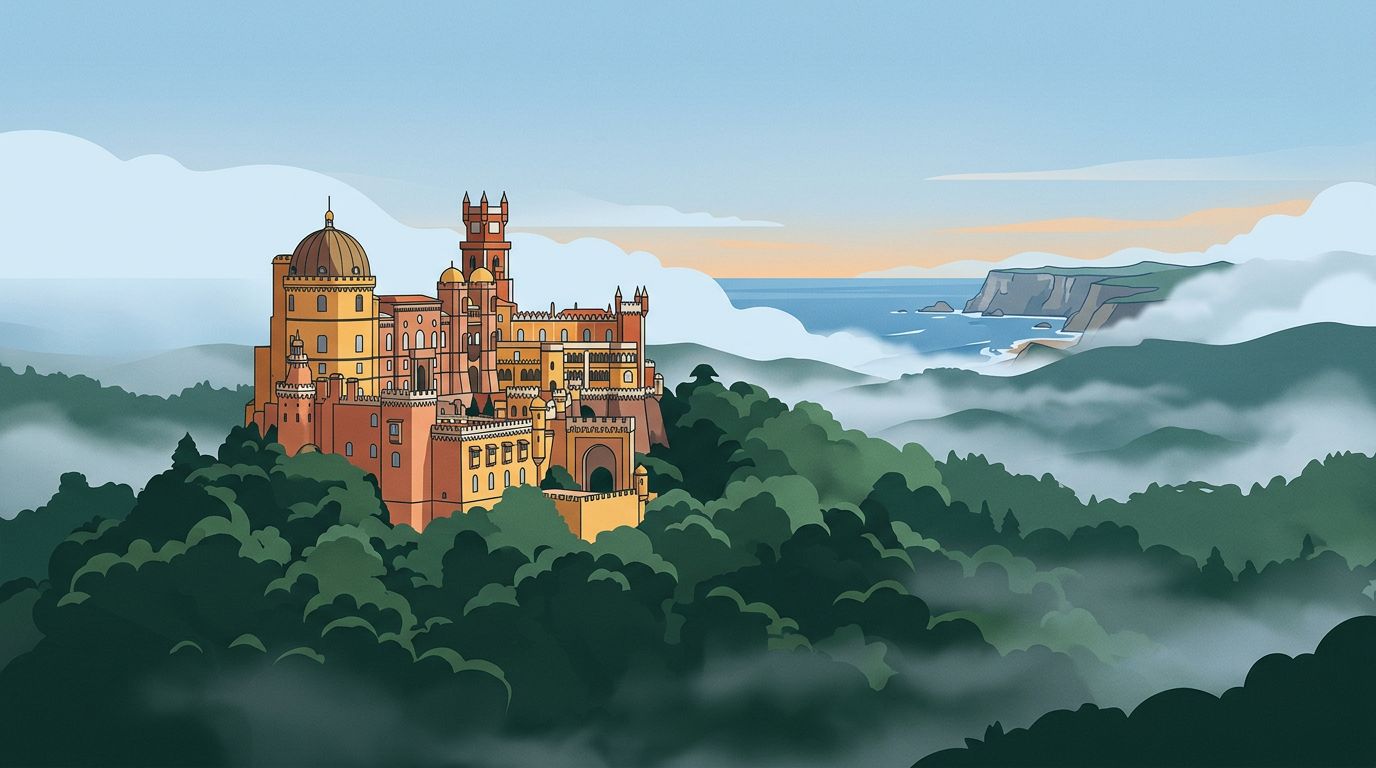
Sintra can give you a sunlit palace tower, a forest full of mist, and an Atlantic headland in one day, but only if you let the weather set the order. Sintra photography rewards flexible timing more than a packed route, because light shifts faster across these hills than most day-trip plans allow.
Morning fog is normal. It can flatten Pena Palace, soften mossy stone at Quinta da Regaleira, or disappear completely by the coast.
Bring a camera, a weatherproof layer, and patience. Those three things matter more than rushing between every landmark.
Let the Weather Choose Your First Location
Sintra sits high enough above the coast to create its own conditions. A clear Lisbon morning can turn into dense cloud around the palace hills, while Cabo da Roca catches hard sun and wind.
Because Sintra’s hills can sit beneath a low Atlantic cloud layer while Cabo da Roca is clear and windy, a flexible plan gives you better light than a rigid list of sights ever will.
Check the forecast before leaving Lisbon, then look up when you arrive. If Pena Palace vanishes into cloud, don’t force a wide palace view. Head for gardens, stone walls, or the forest instead.
Use mist as a visual tool
Low cloud works well around Quinta da Regaleira, the Moorish Castle walls, and the paths below Pena. It hides distracting backgrounds and gives dark foliage a softer separation.
Expose carefully, because mist can fool your meter into making the scene too dark. Add a little exposure compensation, then protect highlights in pale sky.
When fog hides Pena Palace, shift toward close details, garden paths, and stone textures. The same weather can make wide views weak and intimate frames stronger.
Wait for the cloud breaks
The most dramatic palace images often come after a fog bank starts to lift. Watch the towers, not only the sky. A narrow gap can put sunlight on yellow walls while the forest stays dark.
Crowds swell quickly. If the light begins to change, stay with your position for several minutes rather than chasing a new viewpoint.
For location ideas beyond the standard postcard angles, Parques de Sintra has an official photography itinerary built around the area’s color, contrast, and viewpoints.
Build a Day Around Timed Access
A day in Sintra is partly a photography trip and partly an exercise in timing. Palace interiors, shuttle queues, walking distances, and August crowds can take longer than expected.
Pena Palace requires a selected date and time for the interior. Book through the official Pena ticket page before you leave, then give yourself breathing room around that slot.
These August 2026 timings are useful when shaping a photo route.
| Site | Hours to plan around | Photography planning point |
|---|---|---|
| Park of Pena | 9:00 a.m. to 7:00 p.m. | The park stays open later than the palace interior. |
| Pena Palace interior | 9:30 a.m. to 6:30 p.m. | Entry is tied to a booked time slot. |
| Quinta da Regaleira gardens, Aug. 10 to Sept. 30 | 9:00 a.m. to 7:30 p.m. | Garden light lasts longer than interior access. |
| Quinta da Regaleira palace and chapel | 10:00 a.m. to 7:00 p.m. | Last admission is 5:30 p.m. during this period. |
The useful pattern is simple: photograph broad exteriors early, use gardens during harsh midday light, then save the Atlantic coast for late afternoon.
Give Pena Palace a fixed window
The palace interior has the strictest schedule, so make it the anchor point if you have an entry time. Arrive at the park gate early enough to account for the uphill route and queues.
Parks of Sintra also answers common access questions in its Pena visit FAQ. Read it before carrying a large bag or committing to a tight connection.
Keep one location optional
If weather or crowds disrupt your plan, drop a location rather than compressing every stop. One subject at a time; no frantic collecting.
A photographer who spends 40 minutes waiting for clean foreground at one palace often comes home with more than someone who photographs six places in a hurry.
Sintra Photography at Pena Palace
Pena Palace is bright, busy, and hard to photograph well. Its saturated walls tempt you to push color too far, while people, railings, and narrow terraces can crowd every composition.
A historical detail gives the site extra texture. After his 1809 Portuguese journey, Lord Byron described the area as “Cintra’s glorious Eden” in Childe Harold’s Pilgrimage. The phrase feels less exaggerated when cloud rolls across the wooded hill below the palace.
Prioritize the exterior terraces
Start with a wide lens for the palace’s towers and courtyard geometry, but don’t keep every wall in the frame. Cropping out a competing color can make the yellow, red, and blue sections feel more deliberate.
Look for repetition in arches, tiles, balustrades, and staircases. A vertical frame often works better than a wide view when people fill the terraces.
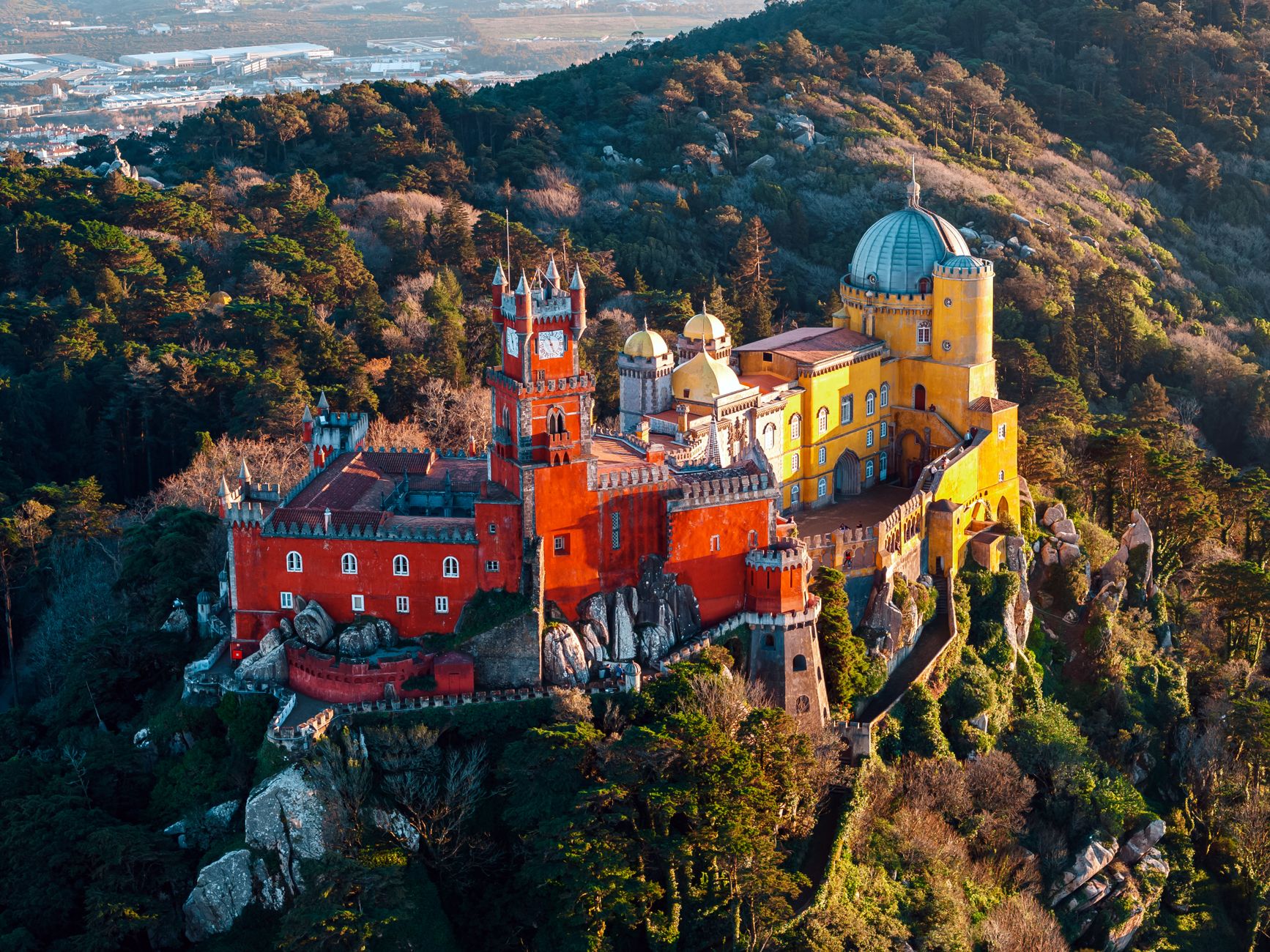
Photo by Matej Simko
Follow the interior rules
Pena’s current visitor guidance permits photography without flash, but staff direction and room-level restrictions should always decide what you shoot. Leave the tripod outside palace rooms and keep your bag compact.
Interior light is dim and mixed. Raise ISO before dropping shutter speed too far, especially when photographing patterns or chandeliers. A slightly noisy sharp image is better than a blurred clean file.
Find Quieter Angles Around Pena and the Hills
The famous terraces are only part of the story. Pena Park offers winding paths, distant palace views, and trees that frame rather than compete with the architecture.
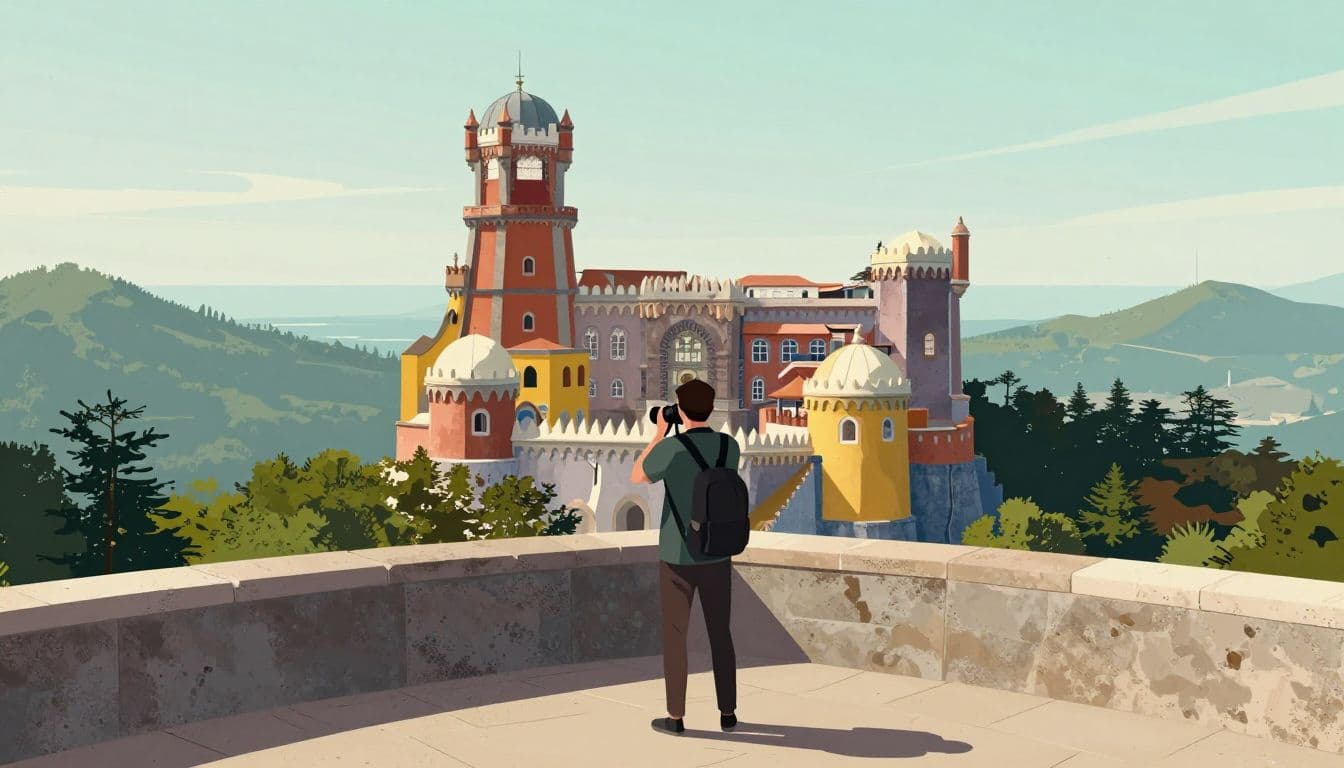
A longer lens helps when you want the palace to rise above the trees without showing every tourist on the terrace. At 85mm or 135mm, look for a single tower cutting through layers of green.
The weathered stone walls at Castelo dos Mouros also give you strong leading lines. Use the curves of the ramparts to guide the eye toward the hills, but keep people away from edges and narrow paths.
Let the forest do some work
Fern-framed architecture feels more like Sintra than a flat frontal palace record. Search for a branch, arch, or worn wall that can hold the foreground.
Bring a lens cloth. The damp air often leaves a fine film on front elements, particularly after fog or drizzle.
If you have a timed palace visit, the main gate entry instructions can help you avoid wasting the best part of the morning at the wrong entrance.
Photograph Quinta da Regaleira Without Forcing the Shot
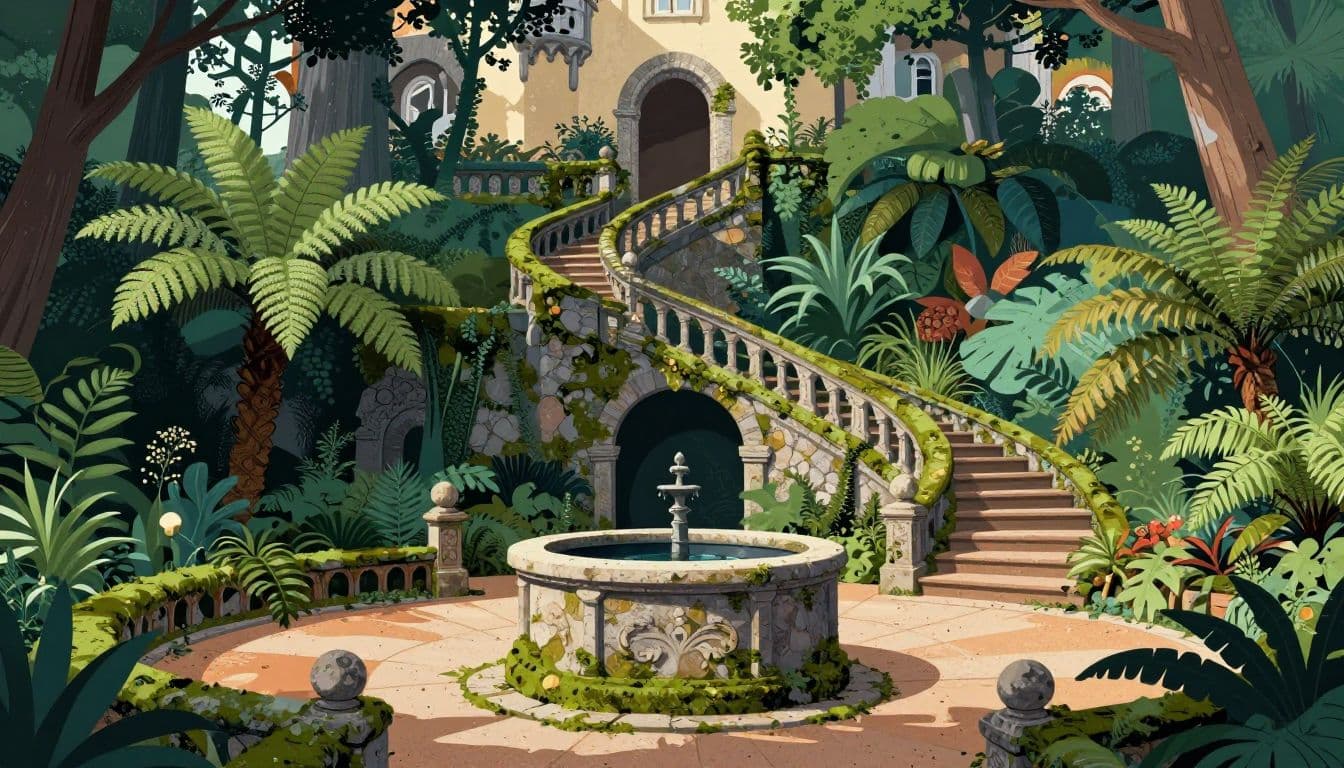
Quinta da Regaleira is darker, tighter, and more textural than Pena. Its stonework, wells, tunnels, and dense planting reward slower framing.
The Initiation Well draws huge interest, so a wide top-down shot may include many heads and phones. Instead, use the spiral walls as a graphic pattern, crop closer, or wait until a gap opens between groups.
Work with the low light
The gardens can be several stops darker than open terraces at Pena. A fast prime lens helps, although image stabilization and a steady stance also go a long way.
Shoot stone in overcast light when possible. Direct sun creates harsh white patches on damp walls and turns the green foliage into a busy background.
The official rules prohibit tripods and drones across Quinta da Regaleira, indoors and outdoors. Flash is also prohibited inside the palace and chapel, so prepare to work handheld.
Find the smaller scenes
The best Regaleira frames are often not the well. Look for iron gates half-covered by leaves, a passage opening into soft daylight, or water catching a fragment of sky.
Keep footsteps and gear quiet in enclosed spaces. People are sharing the same narrow routes, and a tripod-free setup makes it easier to move aside.
Use the Moorish Castle for Scale and Texture
Castelo dos Mouros gives Sintra a different visual language. Pena is theatrical. The castle is rougher, with exposed stone, uneven walls, and long views across wooded ridges.
Use a wide lens only when a wall, stair, or rocky surface gives the foreground weight. Otherwise, switch to a short telephoto and isolate battlements against soft hills.
Photograph paths before viewpoints
Many visitors walk quickly toward the panorama. Pause on the approach. A curving trail, worn steps, or the edge of a wall can make a stronger frame than the widest overlook.
Wind can be stronger on the ramparts than below. Keep straps secure and avoid changing lenses near exposed edges.
Keep the stone realistic
Gray walls can turn blue or orange under automatic white balance. Check your files before leaving the site, especially if cloud cover changes quickly.
A moderate contrast edit usually suits this location. Heavy clarity can make old stone look brittle and artificial.
Cabo da Roca for Atlantic Coast Views
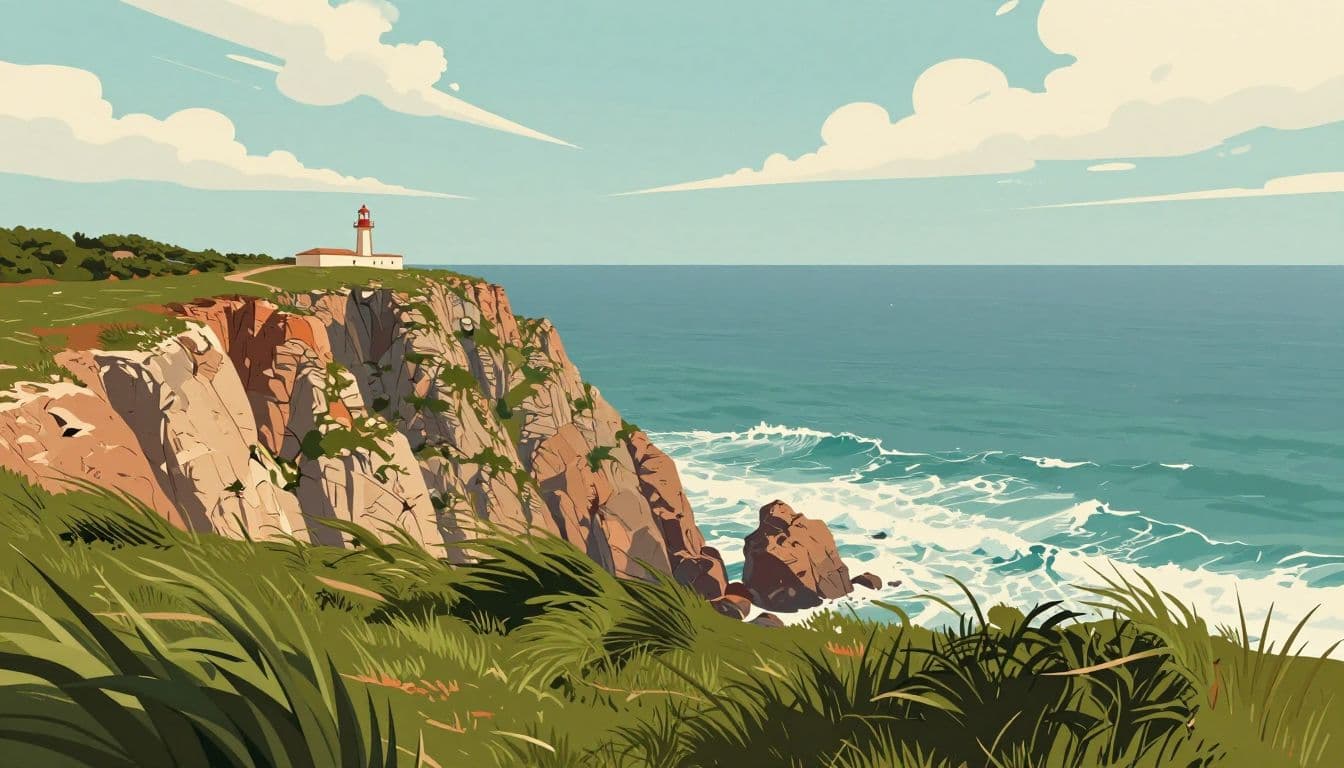
Cabo da Roca changes the pace of the day. The palace hills feel enclosed, while the coast opens into long horizons, wind-bent grass, and steep cliffs above the Atlantic.
The headland is widely known as mainland Europe’s westernmost point, and this Cabo da Roca visitor guide has helpful orientation details if you are combining Sintra with Cascais.
Use the wind in the frame
At the west-facing coast, a long lens can compress successive headlands and bands of surf, whereas a wide lens only works when foreground grass, a path, or weathered stone has enough weight to hold the frame.
Late afternoon often gives the cliffs more shape. Yet bright sun can still create extreme contrast between shadowed rock and reflective water, so bracket exposures when the scene needs it.
Wind changes everything. Keep filters, lens caps, and spare batteries secured.
Stay behind barriers
The cliffs are not a place for a dramatic selfie or a closer angle. Use the marked paths and railings, even when another spot looks tempting.
A 70mm to 200mm lens can produce a powerful compressed view without moving closer to an unstable edge. For route ideas that include the coast, compare your plan with these Cabo da Roca day-trip notes.
Pack for Fast Changes in Light
A practical Sintra kit is smaller than many photographers expect. You will walk uphill, queue, squeeze through gardens, and work in damp air.
A weather-sealed camera body is helpful, but a simple rain cover and microfiber cloth can protect any camera. Carry one wide lens and one short telephoto rather than filling your bag with options.
Choose lenses by subject
A 16mm to 35mm lens suits palace courtyards, coastal foregrounds, and the scale of Regaleira’s well. A 70mm to 200mm lens isolates Pena’s towers, compresses distant hills, and brings Atlantic headlands closer.
A 35mm or 50mm prime is useful inside darker spaces where permitted. It also makes more intimate garden compositions without the exaggerated edges of a wide lens.
Set exposure before the moment arrives
For people moving through palace terraces, start near 1/250 second. Raise shutter speed further when wind shakes branches or tall grass.
At Cabo da Roca, a polarizer can reduce glare, although it may darken part of a wide blue sky unevenly. Test it before committing to a whole sequence.
Shoot RAW if you plan to edit. Sintra’s pale mist and colored walls often need careful highlight recovery and restrained color correction.
Edit for Mood Without Inventing a Different Place
Sintra already has atmosphere. Heavy presets can bury the details that make each site distinct.
Keep greens natural at Regaleira, preserve the painted color separation at Pena, and allow the Atlantic water to stay cool without turning electric blue. Selective edits work better than pushing every slider globally.
Keep mixed light believable
Palace interiors may include warm lamps beside daylight from windows. Correcting everything to one temperature can strip away the feeling of the room.
For exterior shots, compare adjacent files before editing. If one image has much stronger saturation than the rest, the difference may come from a passing sun break rather than your camera settings.
Respect people and places
Wait for a clean frame instead of treating other visitors as obstacles. If someone becomes a clear subject, ask before sharing their portrait.
Drones are prohibited across the Sintra Cultural Landscape, and commercial shoots may need prior approval at individual sites. Check Parques de Sintra visitor information before planning anything beyond personal travel photography.
A Route That Leaves Space to Wait
Start with Pena if the hill is clear and your booked time makes sense. If cloud settles in, begin with Regaleira or the Moorish Castle, then return to exterior palace views when light improves.
Save the coast for the later part of the day, when you can give Cabo da Roca enough time for changing light. Don’t schedule a palace interior and the cliffside sunset too close together.
A satisfying day of Sintra photography comes from committing to a few strong scenes, not collecting proof that you stood at every attraction. Watch the forecast, respect the access rules, and give each location time.
The Frame That Stays With You
Sintra rewards photographers who react to what the day offers. Fog can turn a missed palace panorama into a quiet study of stone, while a break in cloud can transform a crowded terrace in seconds.
The most lasting image may not be the obvious one. Will your final frame be Pena’s yellow tower against a cloud break, or Atlantic grass bending above the cliffs at Cabo da Roca?
