
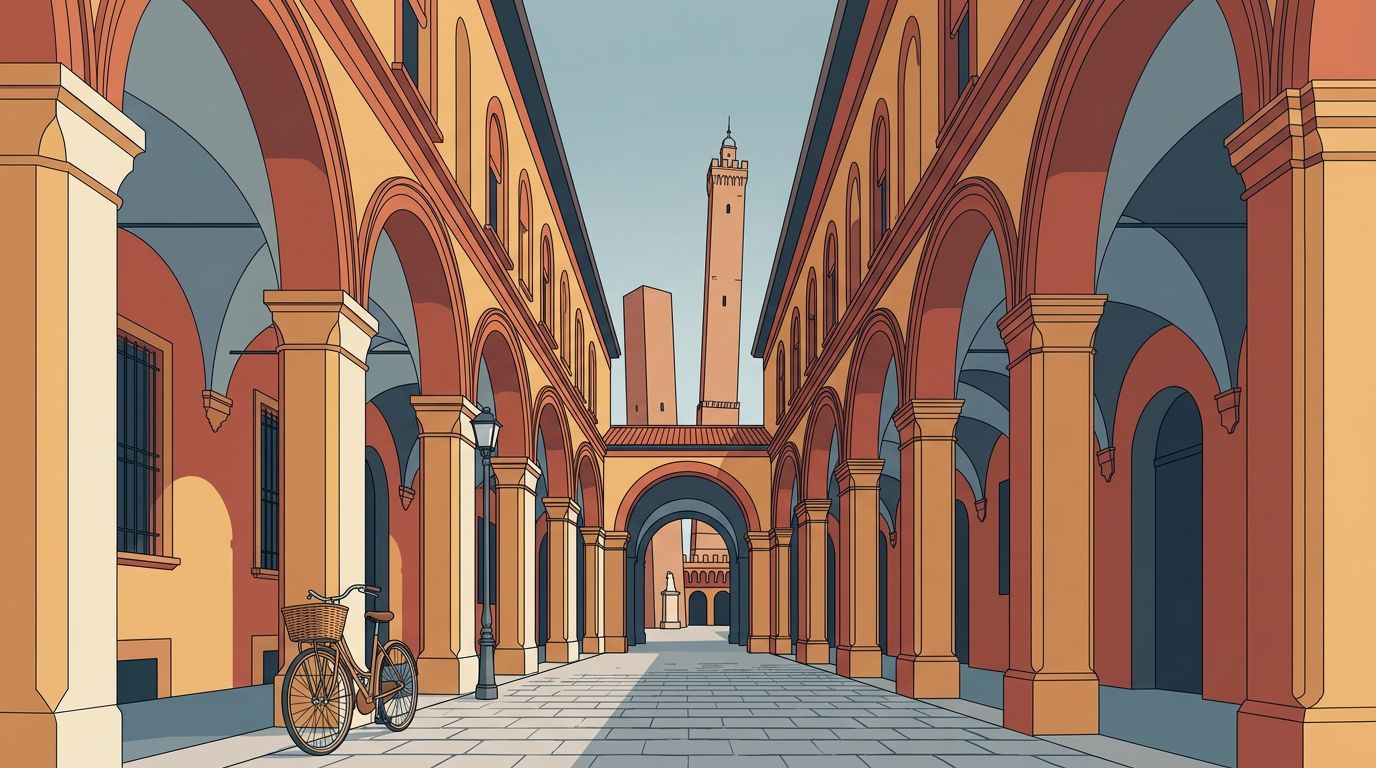
Bologna rewards patience more than speed. Bologna photography becomes stronger when you stop chasing landmarks and wait for one person, one bicycle, or a strip of side light to complete the frame.
The city’s covered streets soften rain and midday glare, yet their shade can hide detail while the leaning medieval towers resist a neat, obvious composition. Arrive with a light plan, a modest kit, and time to walk slowly.
Bologna photography starts with the portico rhythm
Bologna’s porticoes are not one long backdrop. They change in height, material, width, and mood as you move through the city, so each street asks for a different approach.
The UNESCO World Heritage entry identifies 12 portico ensembles across a total stretch of 62 kilometres. That scale matters for photographers because the grand San Luca arcade, the busy Pavaglione, and the quieter residential sections each produce a different kind of picture.
Follow repetition, then interrupt it
Start by watching the visual beat of the columns. A centred frame can show symmetry, but a shifted viewpoint often gives the arches depth and lets one column overlap another.
Look for interruptions in the rhythm. A red scooter at the curb, a doorway left open, or a pedestrian carrying an umbrella can keep an architectural image from feeling empty.
Arrive before the shutters rise. The early hours give you cleaner pavements and fewer delivery vehicles.
Choose light before you choose a street
Terracotta walls often look best when low sun brushes across them. However, a portico’s deep shade can trick your camera into overexposing the street beyond the arches.
For Bologna photography at street level, check the direction of sunlight before walking across town. A location that feels dull at noon may become vivid when late afternoon light touches its outer columns but leaves the interior in shadow.
Use side light to show texture
Stand near the edge of an arcade rather than deep inside it. Side light catches chipped plaster, brick joints, stone bases, and iron fixtures without flattening the wall.
Expose for the sunlit opening if you want a graphic silhouette. Instead, lift shadows carefully when the scene depends on detail inside the portico.
Treat blue hour as a separate shoot
Blue hour works well around Piazza Maggiore and streets near Via Farini, where warm lamps sit against a cool sky. Bring a stable handhold or a compact tripod if local conditions allow it.
Avoid making every frame bright. A slightly darker exposure usually keeps the lamps from turning into featureless white circles.
Portico locations worth a longer stop
A route works best when each stop gives you a fresh visual problem. Bologna Welcome’s guide to the 12 UNESCO portico stretches can help you pair locations with the type of architecture you want to photograph.
| Location | What to look for | Best approach |
|---|---|---|
| Pavaglione and Piazza Maggiore | Monumental arches, shopfronts, changing foot traffic | Work early, then return after dark |
| Santo Stefano and Mercanzia | Dense medieval streets and warm brick | Use a 35mm lens near the square |
| Strada Maggiore and Portico dei Servi | Long colonnades with formal perspective | Walk the outer pavement for side views |
| San Luca | Repeating arches climbing toward the sanctuary | Plan a separate half-day session |
The Portico di San Luca is 3,796 metres long and includes 666 arches, according to Italia.it’s official portico guide. Its length gives you room to make both broad views and close studies of worn steps, directional signs, and changing light.
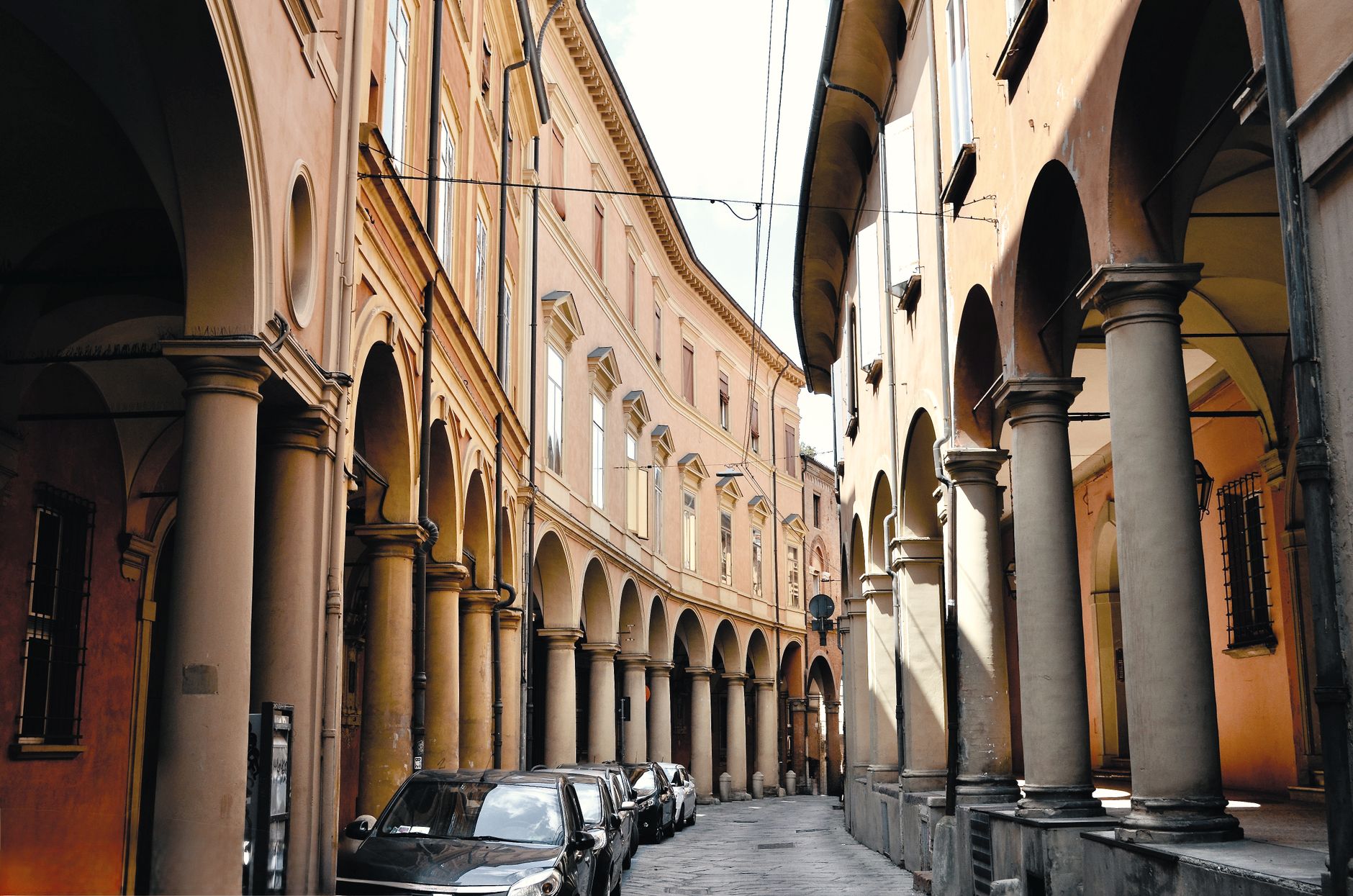
Photo by Hub JACQU
Compose arches without flattening them
Porticoes naturally pull your eye forward. The risk is making every image look like a tunnel with a bright rectangle at the end.
Change your distance from the column line. A small move toward the street can reveal layers of arches, while a position close to a wall can turn a single column into a strong foreground anchor.
Begin at the outer edge
Use the portico as a frame for activity outside it. A tram, a cyclist, or people crossing a piazza can fill the brighter area beyond the shade.
Keep an eye on verticals. Tilting the camera upward may work for an expressive frame, but it can make columns appear to fall inward unless that distortion is deliberate.
Let one person set the scale
People give the structures proportion. Wait until a passerby reaches an arch opening rather than photographing someone halfway between columns.
A lone figure often works better than a crowd. In busier streets, a slower shutter speed can soften the moving bodies while the columns stay crisp.
A perfectly symmetrical portico frame can feel static. A slight offset usually gives the arches more depth and a clearer path through the image.
Photograph Bologna’s medieval towers from the street
The Asinelli and Garisenda towers dominate Piazza di Porta Ravegnana, yet the most familiar viewpoint is also the most crowded. At ground level, a wide lens often creates more trouble than drama, because nearby facades squeeze the towers into a cluttered sky and bend every vertical near the edge.
Walk several blocks away before choosing your angle. Narrow streets can use the towers as distant punctuation, while an open piazza gives them breathing room.
Work around the current tower closure
As of August 2026, the official Asinelli Tower booking page says the tower is closed for area maintenance. Check it again before travelling because access dates can change.
The exterior view remains the practical option. Respect barriers, avoid setting up in pedestrian pinch points, and use the changing street scene rather than treating the closure as a lost photograph.
Use the Garisenda’s lean with restraint
Dante mentioned the leaning Garisenda in Inferno XXXI, comparing its apparent inclination to the giant Antaeus bending when clouds pass overhead. That old observation still makes a good visual prompt: the tower looks different depending on where you stand.
A 50mm or short telephoto lens can isolate its angle against a pale sky. Keep nearby rooflines in the frame when you need a reference for the lean.
Viewpoints and rooftops need advance checks
A high viewpoint can reveal Bologna’s red roofs and tower silhouettes, but it also removes the close, human scale that makes the porticoes compelling. Treat elevated shots as a complement to your street work.
Torre Prendiparte is one possible historic alternative. Bologna Welcome’s Torre Prendiparte access details state that all 12 floors are accessible, although visits and availability should be checked before you build a schedule around it.
Keep San Michele in Bosco flexible
San Michele in Bosco is often considered for wider views over the city. However, verify current access and opening arrangements directly before heading up, especially if you are working near sunset.
Don’t depend on one viewpoint. Bologna’s skyline also appears in gaps between roofs, at the end of long streets, and through portico openings where a tower becomes part of the city rather than an isolated subject.
A compact kit for Bologna photography
Bologna rewards light equipment. You will walk on uneven pavement, pause in busy arcades, and often change direction when the sun moves.
A practical setup includes:
- A 24-70mm zoom for piazzas, streets, and wider portico scenes.
- A 35mm prime for lower-light street photography.
- A short telephoto lens for compressing roofs or isolating tower details.
- A microfiber cloth, because rain and spray collect quickly under arcades.
Set exposure for the bright opening
Porticoes create high-contrast scenes. Shoot RAW, use highlight warnings, and check your histogram when the sky or bright pavement sits beyond a dark foreground.
Image stabilisation helps, but it does not freeze people. When you want walkers sharp in shade, raise ISO before letting shutter speed drop too far.
Bologna photography benefits more from reliable exposure than a large bag of lenses.
Street photography needs patience and courtesy
The porticoes are part of daily life. People use them to get to work, carry groceries, meet friends, and escape a sudden shower.
Give people space. If a shopkeeper is opening a door or a resident is carrying bags through a narrow section, step aside before you take the frame.
Keep entrances clear
Never block an arcade entrance with a tripod, camera bag, or posed subject. The covered walkways can narrow fast when rain begins or a tour group passes through.
For close portraits, ask. A brief conversation can lead to a better image and removes uncertainty about whether your camera feels intrusive.
Also photograph traces of life without faces: stacked crates, bicycles against old plaster, handwritten menus, or wet footprints on stone. Those details can carry the atmosphere of a street without interrupting anyone’s day.
Rain, twilight, and hard weather
Rain changes everything. The pavement becomes a dark mirror, and the porticoes give you cover while the street outside catches reflections from lamps and shop windows.
After rain. Watch for shallow puddles near column bases, then lower the camera until a tower or arch appears in the reflection.
Protect highlights after dark
Bright LED signs and warm lamps can exceed the range of one exposure. Underexpose slightly, then recover shadow detail later instead of clipping the lamps.
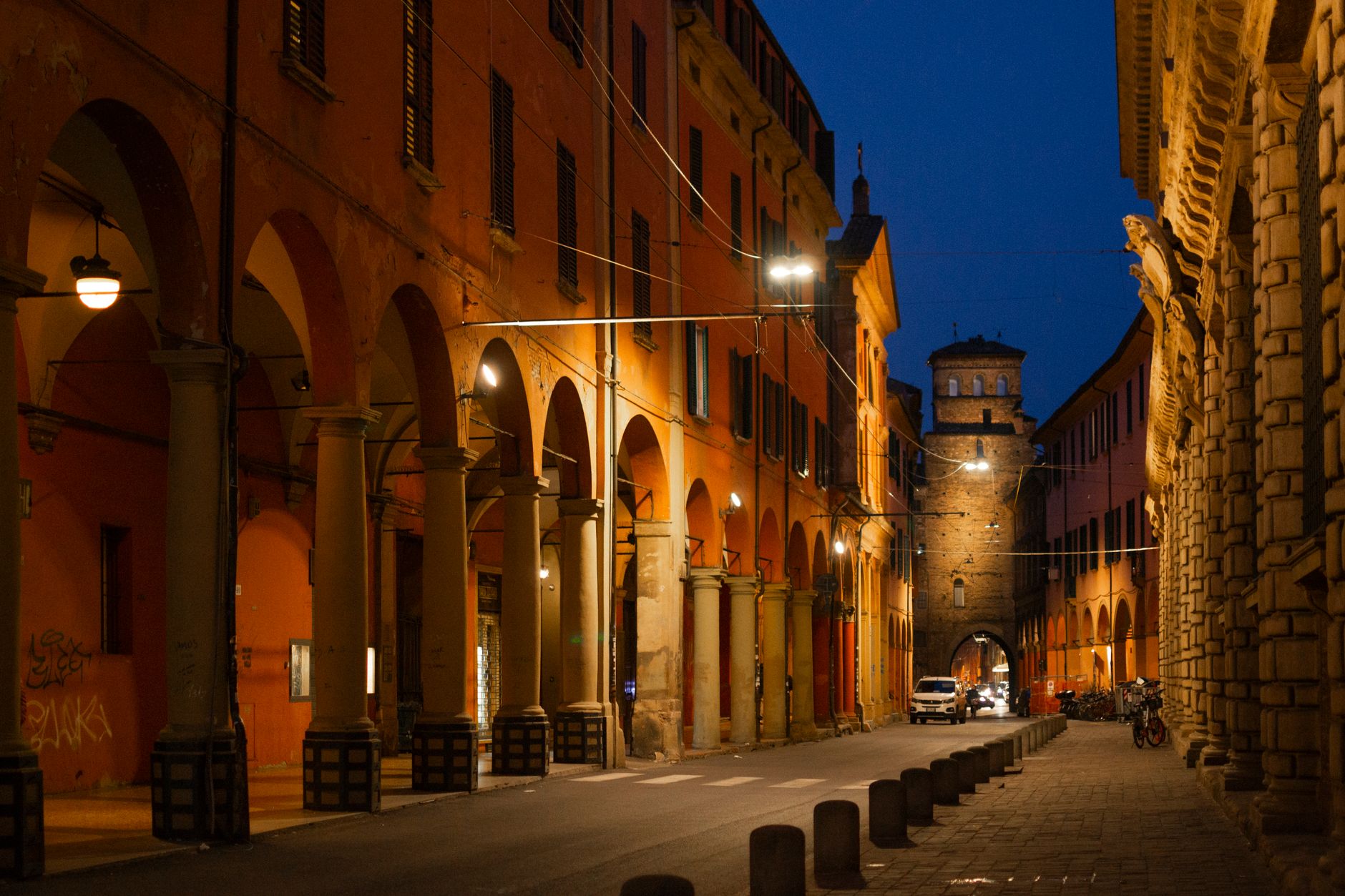
Photo by Julia Krasnoperova
Bring a lens hood if rain is light. It shields the front element better than repeatedly wiping it with a damp cloth.
Build a walkable photo route for one day
Begin at Piazza Maggiore before the busiest hours. Photograph the Pavaglione and Banchi porticoes while shopfronts are still closed, then continue through the lanes toward Santo Stefano and Mercanzia.
Later, walk along Strada Maggiore to the Portico dei Servi. Its rhythm is more formal, so try a longer focal length and frame columns against the street rather than standing dead centre.
Let the light decide the final stop
Reach Piazza di Porta Ravegnana when the sky still has detail. Take your tower frames early, then circle back after blue hour if the lamps and traffic suit your work.
Save San Luca for a dedicated morning or late-afternoon session. The climb and the length of the arcade deserve time, and rushing through 666 arches leaves little room to notice how the city slowly disappears behind you.
Let the city slow your shutter finger
The strongest images often arrive after you have walked past a location once. Return when the light shifts or the street has emptied.
Keep the towers in context and let the porticoes hold the frame. At San Luca, wait for a walker to enter a single arch before pressing the shutter.
