
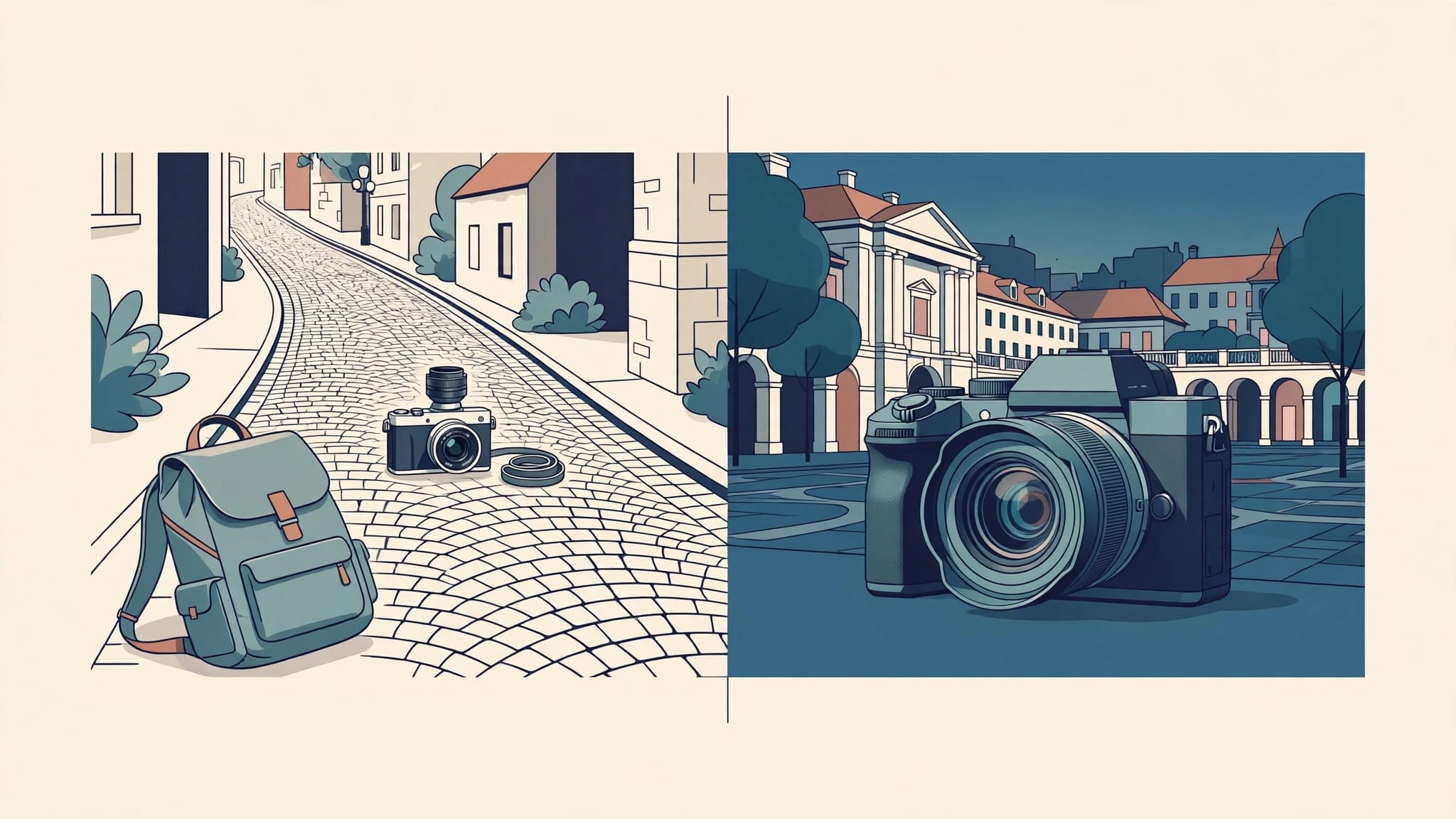
A great European photo often appears when you have already walked all day. Your feet notice every gram. That makes APS-C vs full frame less about bragging rights and more about the camera you will happily take out after dinner.
Both formats can produce beautiful travel images. The better fit depends on how you travel, what you shoot after sunset, and how much gear you want beside your rain jacket.
Choose the system that invites you to keep photographing when the light turns good.
APS-C vs full frame: What actually changes
A full-frame sensor measures roughly 36 x 24mm, the same frame size as 35mm film. APS-C sensors are smaller, though dimensions vary by brand. Canon APS-C bodies use a 1.6x crop factor, while Fujifilm, Nikon, and Sony APS-C cameras generally use 1.5x.
Field of view changes, not focal length
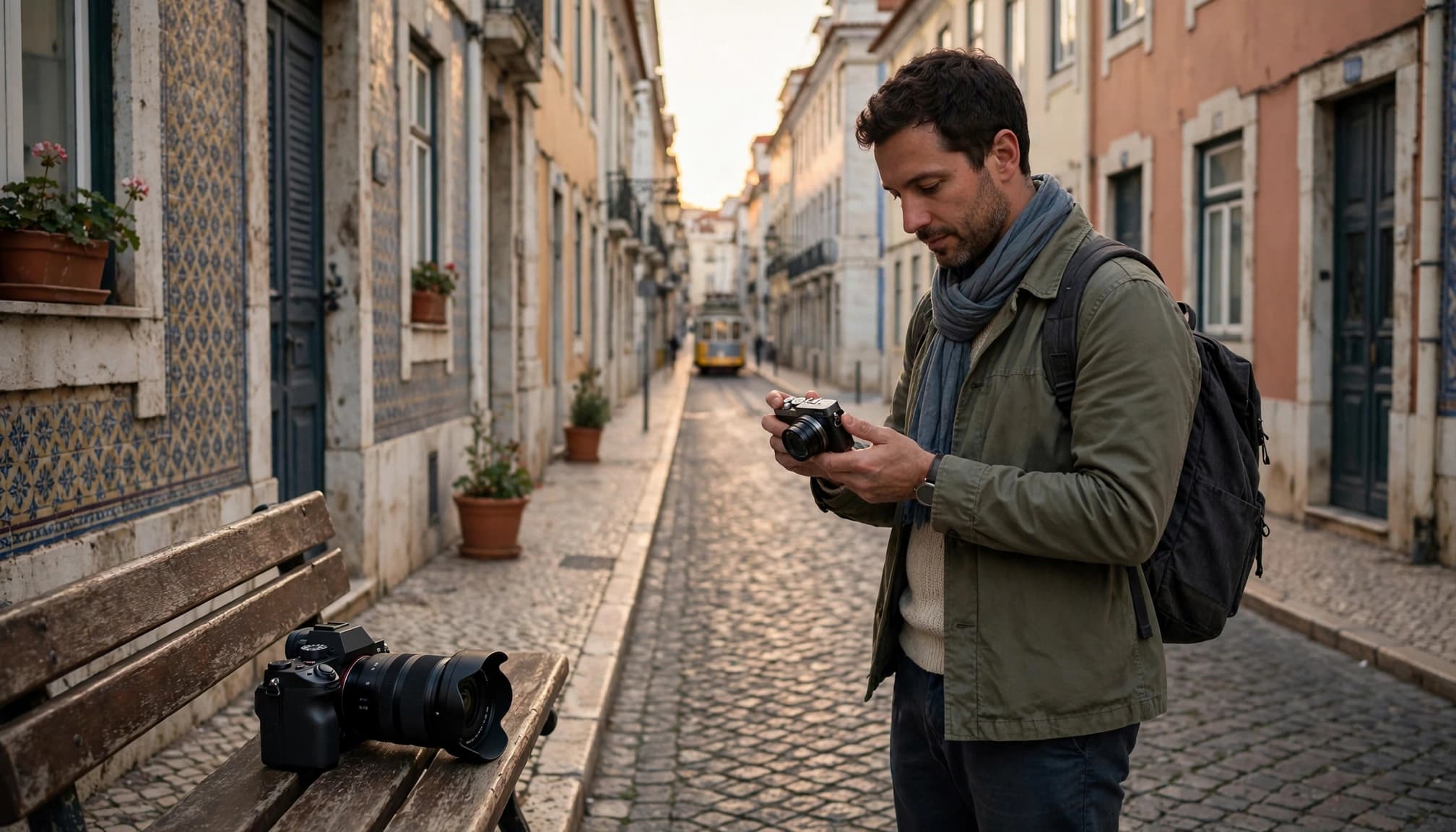
Mount a 23mm lens on a 1.5x APS-C body and it frames like a 35mm lens on full frame. A 16mm APS-C lens gives a view close to a 24mm full-frame lens. This matters when you photograph narrow Venetian canals or the inside of a small Paris cafe.
The lens still has its stated focal length. The smaller sensor simply records a tighter portion of its image circle. Canon’s APS-C and full-frame comparison explains why that crop can give distant subjects more apparent reach.
A 50mm lens becomes roughly a 75mm equivalent on a 1.5x APS-C body. That is useful for a detail on a cathedral facade, but it can feel too tight on a crowded Roman street.
Sensor size affects low-light headroom
With similar sensor technology, full frame usually produces cleaner files at high ISO. It also creates shallower depth of field at the same angle of view and aperture. Those advantages help with dim churches, evening portraits, and blue-hour city scenes.
However, sensor size doesn’t rescue an unfocused image or a rushed composition. Modern APS-C cameras handle daylight, overcast weather, and well-lit interiors extremely well. A sharp APS-C file can print beautifully.
A wider aperture and a steady shooting position often improve a night photo more than moving to a larger sensor.
Carrying comfort matters after the first day
European travel often includes steep metro stairs, uneven pavement, museum queues, and long train platforms. Your camera kit stays on your shoulder through all of it.
The best kit gets carried. A camera left in a hotel safe cannot photograph anything.
Body weight tells only half the story
A Sony a6700 weighs about 493g with battery and card. Fujifilm’s X-S20 weighs about 491g. By comparison, a Sony a7C II weighs about 514g, while Canon’s EOS R8 weighs about 461g.
Those numbers reveal an important point: full-frame bodies can be compact. The real difference appears when you add lenses. Full-frame f/2.8 zooms tend to be larger and heavier because they must cover a larger sensor. Compact full-frame primes can narrow the gap.
A small APS-C body with a 16-50mm lens can fit in a modest sling bag. A full-frame body with a 24-70mm f/2.8 often needs more space and changes how you pack for the day.
Test your bag before departure
Travel writer Rick Steves offers a useful packing-light test: pack fully, then walk around your block or hometown before you fly. That small anecdote works for camera gear, too.
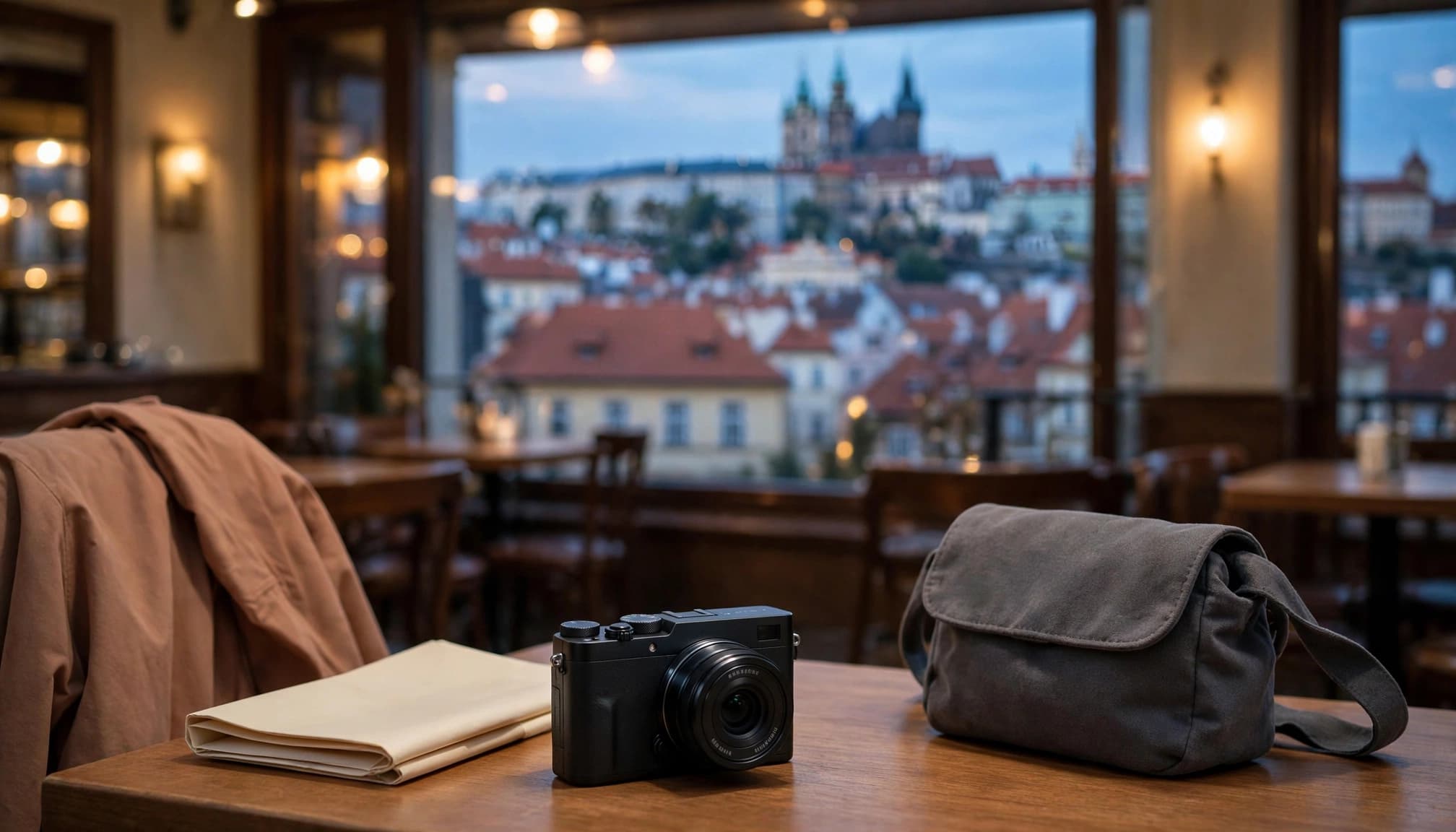
Load the body, lenses, battery, charger, water, and jacket you expect to carry. Walk for an hour. If the strap digs into your shoulder, reduce the kit now.
The payoff is plain: less strain after lunch.
Match the camera format to European scenes
Europe isn’t one type of destination. Icelandic coastlines, London street markets, Alpine villages, and underground museums ask different things from a camera.
Wide architecture favors lens choice
For travel architecture, a sufficiently wide lens matters more than the sensor label. On APS-C, a 10-20mm or 11-20mm zoom gives you room for a Gothic nave or a tight alley. On full frame, a 16-35mm or 17-28mm lens is a familiar option.
Full frame makes ultra-wide lenses easier to find, particularly for photographers who want 14mm or wider views. Yet APS-C systems have strong choices. Fujifilm’s 10-24mm f/4 and Sony’s 10-20mm f/4 PZ cover most travel architecture without filling your bag.
Keep vertical lines straight by holding the camera level when possible. Correct modest perspective later rather than tilting dramatically upward.
Photo by NaNa Photography
Full frame earns its place after dark
Rain changes the plan. You may spend the afternoon inside a low-lit Porto wine bar, then find a wet street reflecting lamps outside.
On a damp evening under Bologna’s arcades, a full-frame body paired with a fast 35mm lens can hold a faster shutter speed at ISO 6400, while an APS-C camera may need more ISO or a slower shutter, depending on its lens and stabilization.
That advantage is meaningful if you photograph people moving in dim light. It matters less for buildings, because image stabilization lets you use slower shutter speeds when your subject stays still.
Build a lens kit before choosing a body
The APS-C vs full frame decision becomes clearer when you write down the lenses you actually want. A body is only the mount for the glass you carry.
APS-C kits can stay small and flexible
For a beginner or intermediate traveler, an APS-C standard zoom often covers almost everything. A 16-50mm lens on a 1.5x system frames like 24-75mm, which suits street scenes, food, portraits, and city views.
Add one small prime if you enjoy low-light photography. A 23mm f/2 behaves like a 35mm equivalent, while a 35mm f/2 feels closer to a 50mm normal lens. Either can turn an evening walk into a lighter, simpler outing.
Fujifilm’s X-mount system is especially appealing for compact primes. Sony E-mount offers a large lens selection, including options from Sigma and Tamron.
Full-frame lenses reward deliberate packing
A full-frame 24-70mm f/4 zoom and a 35mm f/1.8 prime create a capable two-lens travel kit. You gain strong low-light ability without hauling a large f/2.8 zoom all day.
Some travelers prefer a single 28mm or 40mm prime. That limitation can make composition faster because you stop changing lenses in busy spaces. Canon shooters comparing compact normal lenses can use this Canon 50mm lens comparison to see how size, aperture, and price shift between options.
Avoid buying a full-frame body only to pair it with one large zoom you dislike carrying. You will notice the lens more than the sensor.
Consider cost beyond the first purchase
Full-frame bodies have become more accessible, but building a full system still often costs more. The body price is only the first receipt.
Put your budget where photos improve
Spend first on a dependable camera, a lens that suits your usual subjects, and enough batteries for long days. A spare battery becomes more useful than an expensive lens upgrade when you are away from power for twelve hours.
APS-C often gives beginners more room to buy a good lens, a weather-resistant bag, and travel insurance. Those purchases affect your trip every day.
Full frame makes sense when you know you need its strengths. Large prints, extensive cropping, or frequent night work can justify the extra cost. Although a larger sensor gives more editing latitude when exposure is imperfect, a modest kit with a better lens usually produces stronger travel photos than an expensive body with poor glass.
Check the system’s future, not only one camera
Look at the lenses you may want in two years. Check their weights, used prices, and availability in your region. A system that has the focal lengths you enjoy will stay useful longer.
Also consider charging. USB-C charging can make travel easier, but bring the manufacturer’s charger if you depend on fast charging or need to refresh several batteries overnight.
Use your itinerary to make the final choice
Your travel style should settle the question faster than online arguments. Choose APS-C if you want a small shoulder bag, plan long walking days, or prefer telephoto reach for wildlife and distant details.
Full frame fits photographers who make low-light images a priority and accept larger lenses when needed. It also suits people who already own full-frame glass and want to keep using it.
This quick comparison keeps the decision practical:
| Travel priority | APS-C fit | Full-frame fit |
|---|---|---|
| Long walking days | Usually lighter with small lenses | Works with compact primes |
| Dark interiors and evenings | Strong with fast lenses and stabilization | More high-ISO flexibility |
| Distant details | Extra reach from crop factor | Requires longer focal lengths |
| Tight budget | More room for lenses and accessories | Higher system cost is common |
For many first-time European trips, APS-C is the easier recommendation. It gives you capable image quality while keeping the camera approachable. A light setup also makes it easier to photograph without drawing attention in busy areas.
Choose the Camera You Will Use
A full-frame camera offers real benefits, especially in dim light. Yet APS-C vs full frame is not a contest with one correct winner. It is a packing decision shaped by your subjects and your stamina.
Carry the kit that makes you pause at a side street rather than hurry past it. Will you still want to lift that camera after 18,000 steps and a late train to your hotel?
