
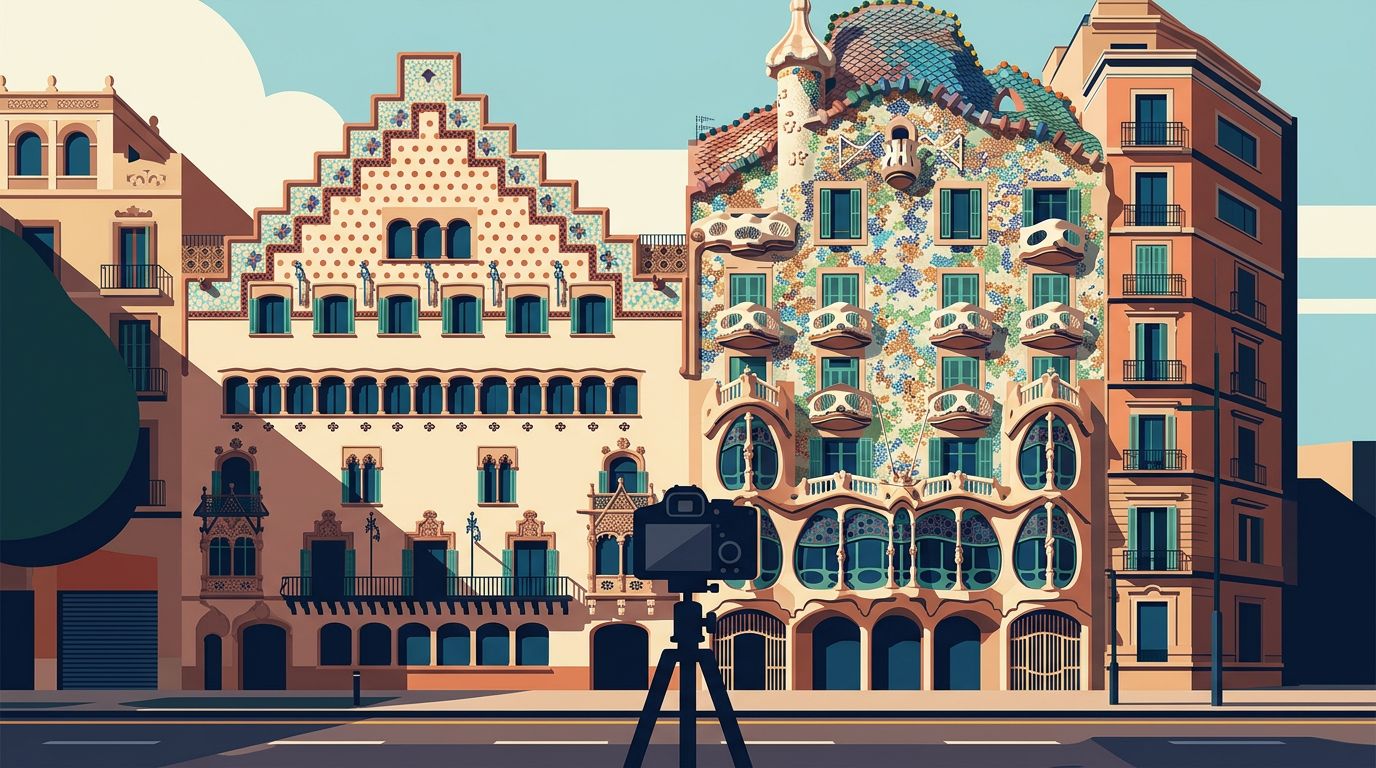
Barcelona’s Gaudi buildings punish rushed photography. A facade can look flat at noon, while a few minutes later its ceramic skin throws color across the street.
For Barcelona architecture photography, timing and position matter more than a long lens. You need room to look up, patience around tour groups, and a plan for the city’s sharp Mediterranean light.
Start with the buildings that offer the strongest mix of public viewpoints and rooftop access.
Key Takeaways
- Arrive early for quieter streets and softer light on the Sagrada Familia and Passeig de Gracia.
- Use Plaça de Gaudí for water reflections, then move along Carrer de la Marina for compressed facade details.
- Photograph Casa Batlló from across the avenue, but reserve a visit if you want rooftop angles.
- La Pedrera’s roof rewards a wide lens, while a short telephoto isolates its sculptural chimneys.
- Keep people small and purposeful in the frame. Gaudí’s architecture needs scale.
Barcelona Architecture Photography Locations That Reward Patience
The best locations are close together, yet they demand different approaches. Sagrada Familia needs space and careful perspective control. Casa Batlló works through layers of street life, glass, balconies, and traffic. La Pedrera becomes far more interesting once you reach its roof.
A useful overview of Gaudí’s Barcelona buildings can help you group visits by neighborhood. Casa Batlló and Casa Milà sit on Passeig de Gràcia, so photograph them on the same morning before the pavement fills.
Arrive before the coaches.
At Sagrada Familia, begin on the east side near Plaça de Gaudí. The pond offers the familiar reflection, but don’t stop there. Walk toward Carrer de la Marina and work with the vertical lines of the Nativity Facade. Morning light falls more gently on this side, so stone carvings retain detail instead of turning into hard shadows.
For a tighter view, stand farther back than feels necessary and use a 50mm or 85mm equivalent. This reduces the exaggerated lean caused by a wide lens pointed upward. The Sagrada Familia photography location guide identifies the plaza, Marina side, and surrounding streets as distinct viewpoints, which is useful when one side becomes crowded.
A specific morning plan can prevent wasted time. On a clear Tuesday in April, reach Plaça de Gaudí at 7:30 a.m., photograph the reflection while the water is still, then cross to Carrer de la Marina before 9:00 a.m. for cleaner details in the facade. By then, the first groups often change the rhythm of the scene.
At Sagrada Familia, a wider lens rarely makes the building feel taller. It usually makes the lower stonework look oversized and pulls the towers apart.
Photographing Casa Batllo and Passeig de Gracia
Casa Batlló is a study in surface. Its bone-like balconies, wavy windows, and scaled roof can look chaotic when you include too much street. Build the image around one repeated pattern, then let a small section of the facade break that order.
Stand on the opposite side of Passeig de Gràcia for a straight-on frame. Wait for a gap in traffic, then shoot across the road with a medium focal length. Cars can also help when their blurred lights form a low band beneath the building after sunset.
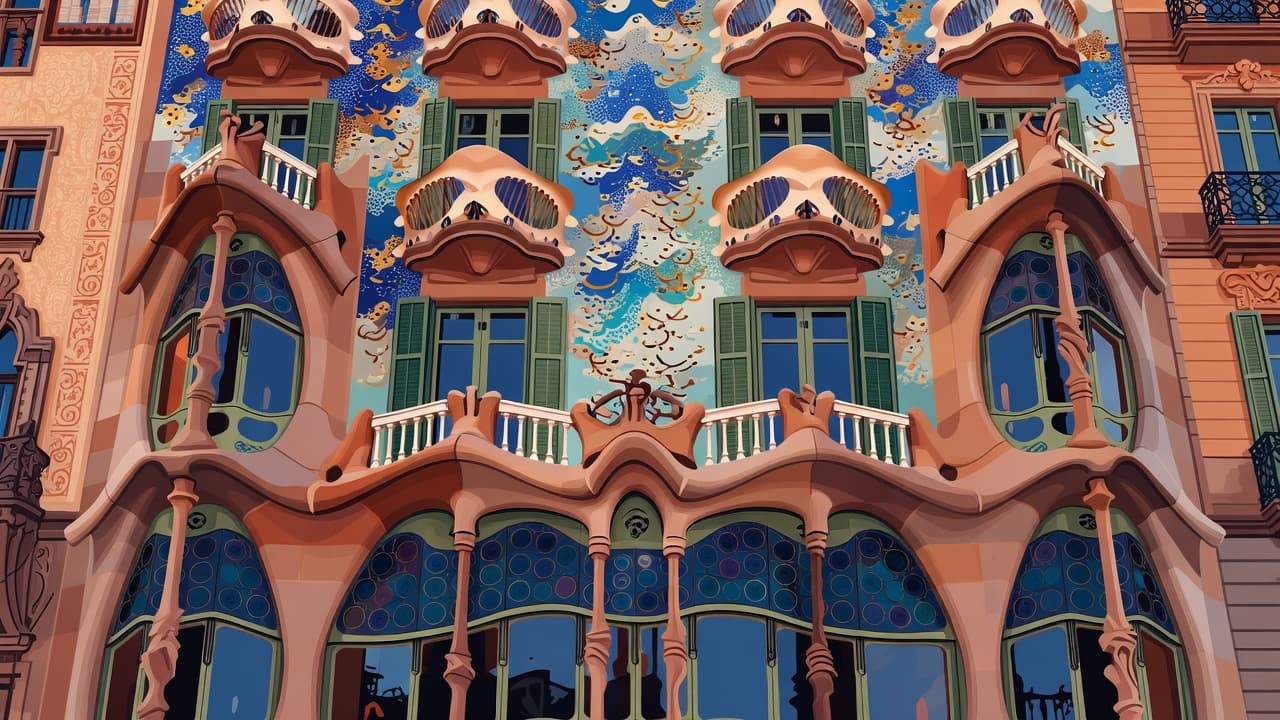
Late afternoon suits the facade because the light reaches it at an angle and adds definition to its curved surfaces. However, direct sun can create bright hotspots in the glass mosaics. Underexpose slightly, check the histogram, and protect the highlights. The right file: a low-contrast RAW with recoverable color.
For Barcelona architecture photography at Casa Batlló, make two kinds of frames. First, create a full facade image that shows the building’s strange silhouette within the Eixample streetscape. Then, isolate the mask-like balconies, fractured blue glass, or roofline. These close studies often carry more character than the standard postcard view.
Although the facade draws most photographers, the rooftop gives you a closer view of the dragon-back roof and its tiled spine, where curved forms overlap against the neighboring blocks and narrow slices of Barcelona sky. Access depends on the entry type and time slot, so book before you build your day around it. The Gaudí buildings visitor guide is a helpful starting point for comparing the major sites.
La Pedrera’s Rooftop Chimneys Need a Different Lens
Casa Milà, better known as La Pedrera, has one of Barcelona’s most photogenic roofs. Its chimney stacks aren’t background details. They are the subject. Gaudí shaped them as helmeted figures, ventilation towers, and stairwell volumes that shift with every step.
Go early or reserve a quieter timed visit when available. The roof can feel crowded because paths funnel visitors through narrow areas. Rather than fight the crowds, use them carefully. A single person walking between chimneys gives the architecture scale and a sense of direction.
Patience beats a wider lens.
A 24mm equivalent captures the roof’s sculptural layout, but it can distort the nearest chimney. A 35mm or 50mm equivalent often produces a more natural frame. Keep your camera level, then crop a little later if needed. Vertical shots work especially well where stair towers overlap with the city behind them.
In strong sun, place a chimney between the lens and the light to block flare. Conversely, when clouds soften the sky, look for tonal separation between pale stone, dark openings, and the blue-grey city beyond. Don’t force a skyline photo. The strongest image may contain only two chimneys and a strip of rooftop pavement.
Rain changes the color. Wet stone and tile can become more saturated, though the roof may close or become unsafe. Check access conditions on the day rather than assuming your ticket guarantees rooftop photography.
Working With Light on Gaudi Facades
Barcelona’s sun is generous, but it can be unforgiving. Midday light works for deep relief carving at Sagrada Familia’s south-facing areas, yet it usually flattens Casa Batlló’s color and makes pedestrians squint. Early morning and late afternoon give you gentler contrast.
Blue hour is useful around Plaça de Gaudí because the pond can hold the illuminated basilica. Bring a compact tripod only if the site rules and crowd conditions allow it. Otherwise, stabilize the camera against a railing or bench and use image stabilization with a sensible shutter speed.
For a longer city view, the Bunkers del Carmel place Sagrada Familia within Barcelona’s dense grid. It isn’t a Gaudí site, but the distant temple becomes a visual anchor among apartment blocks and hills. Pair that broad frame with close rooftop studies later in the day.
A few decisions make difficult light manageable:
- Shoot RAW and expose for bright mosaics or pale stone, not the deepest shadows.
- Use a circular polarizer with care, since it can darken blue patches unevenly on ultra-wide lenses.
- Bracket a static facade when sun and shade fall across the same frame.
- Return after rain if reflective pavement fits the scene you want.
The Barcelona photography spots guide also suggests looking beyond Gaudí for complementary city frames, including parks and older civic architecture.
Composition, Access, and Respectful Shooting
Gaudí’s buildings invite dramatic angles, but restraint usually produces stronger photographs. Start by finding the building’s visual rhythm: the repeated balconies at Casa Batlló, the tower clusters at Sagrada Familia, or La Pedrera’s chimney silhouettes. Then decide what must stay straight.
Correct verticals in-camera when possible. If you use perspective correction later, leave extra room around the edges because the software will crop the frame. For interiors, a 16mm to 35mm equivalent lens helps, but avoid placing important details near the corners.
Bring one camera body if you can. A small kit moves faster through entry lines and crowded roofs. A wide zoom, a normal prime, spare battery, microfiber cloth, and compact rain cover handle most situations without turning the visit into a burden.
Respect staff directions, barriers, and other visitors. Tripods, drones, flashes, and commercial shoots can face restrictions at major attractions. Also, don’t block a narrow rooftop path while waiting for a clean frame. Shoot quickly, step aside, and return when the light improves.
Barcelona rewards the photographer who notices what changes: a reflection disturbed by wind, a patch of sun crossing mosaic, a lone visitor passing beneath a chimney.
A Final Frame Worth Waiting For
The most memorable Gaudí photographs often come after the obvious view. Let the crowds move through, watch the facade for changing light, and give yourself time to find one deliberate composition.
At Plaça de Gaudí, wait until the basilica’s towers settle into the pond’s dark blue reflection.
