
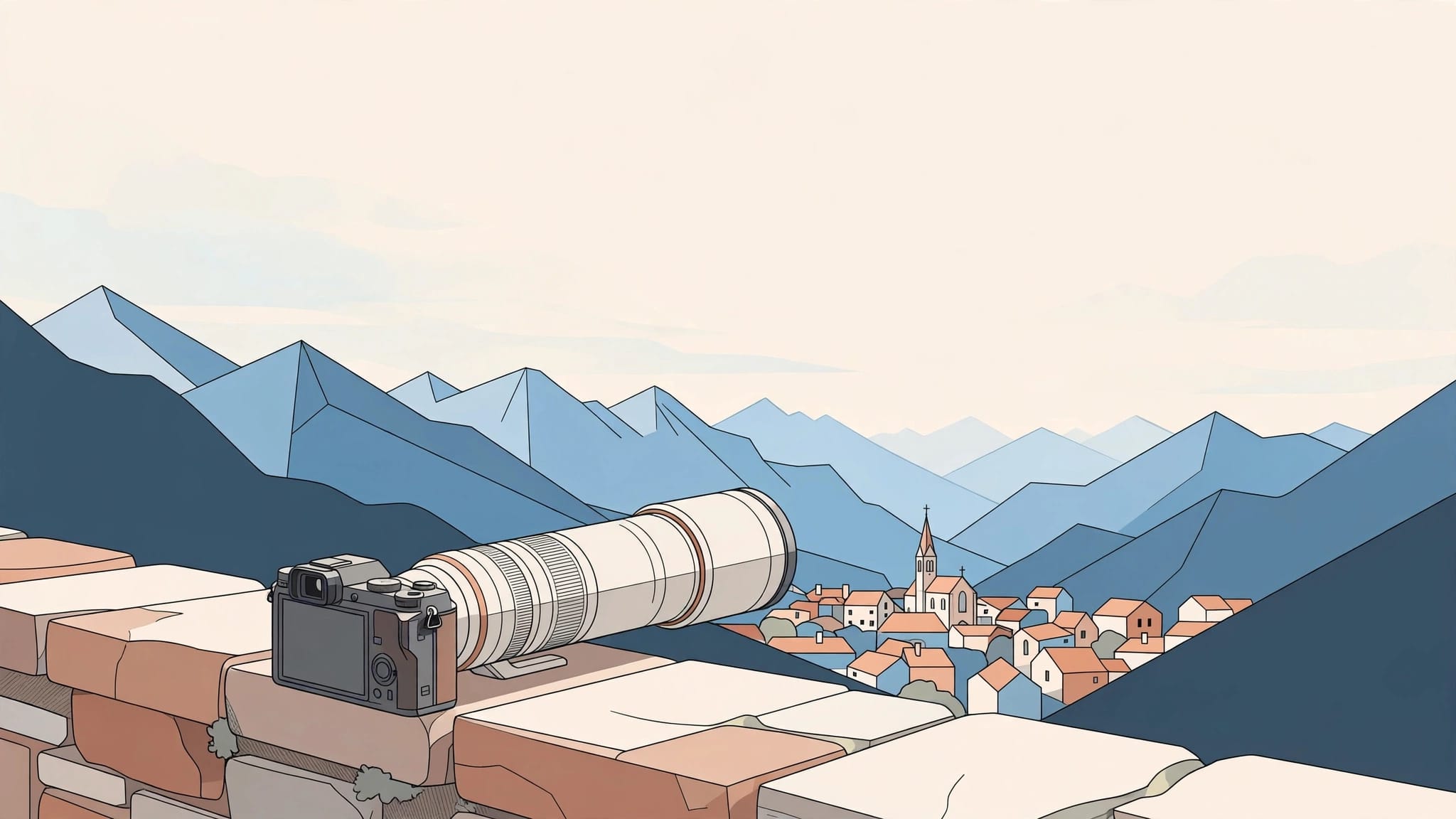
A telephoto lens can turn a distant bell tower, Alpine ridge, or balcony into a photograph with real shape and scale. Yet the best telephoto lenses for European travel are the ones you will still carry after an eight-hour day of trains, cobblestones, museums, and stairs.
Most city-heavy itineraries do not need a huge f/2.8 zoom. A compact telephoto gives you selective reach without making every walk feel like a gear haul.
Start with your itinerary. A week in Florence and Copenhagen needs different focal lengths than a rail trip through the Alps or a coastal drive along the Amalfi Coast.
What a Telephoto Lens Adds to European Photos
A telephoto lens does more than make distant subjects larger. It lets you simplify busy scenes, compress layers of architecture, and pick details from places you cannot approach.
Telephoto work is selective. That is its appeal.
Isolate details without entering the scene
At 100mm or longer, you can frame gargoyles on a cathedral, laundry lines across a Venetian canal, or a lone figure on a distant bridge. The lens removes visual clutter that a wider view might include.
This matters in crowded destinations. You may not be able to move closer to the Trevi Fountain, a lookout railing, or a protected landscape. A longer focal length gives you another composition without needing more access.
Use it for patterns. Repeating windows, roof tiles, stairways, and mountain villages all look more graphic when photographed from a distance.
Compress landscapes and city layers
Telephoto compression makes distant objects appear closer together. That effect suits Alpine valleys, Tuscan hills, coastal towns, and viewpoints above cities such as Prague or Lisbon.
A 70-200mm zoom is often enough for rooftop layers and distant ridges. However, 300mm to 400mm becomes useful when birds, far-off details, or mountain scenes are a major part of the trip.
A long lens earns its place when it solves a planned problem, not because it might be useful once.
Best Telephoto Lenses for European Travel
The best telephoto lenses depend on your camera mount, budget, and tolerance for weight. These options have clear roles, rather than one universal winner.
Sony E 70-350mm F4.5-6.3 G OSS
For Sony APS-C photographers, the Sony E 70-350mm F4.5-6.3 G OSS is a strong travel choice. It weighs 625g and includes Optical SteadyShot, while its 70-350mm range gives an APS-C camera substantial reach.
Its 67mm filter thread also keeps filter costs reasonable compared with many larger telephotos. At the long end, it works well for distant façade details, birds along a coastline, and layered mountains.
Sony lists it at $999.99. That price is substantial, so it makes most sense for travelers who regularly photograph distant subjects rather than occasional telephoto users.
Canon RF 100-400mm F5.6-8 IS USM
Canon RF users wanting maximum reach in a comparatively light package should consider the RF 100-400mm F5.6-8 IS USM. It weighs 635g, uses a 67mm filter, and reaches 400mm without moving into the size of Canon’s professional telephoto zooms.
The trade-off is its f/8 maximum aperture at 400mm. It is most comfortable in daylight, especially for coastlines, mountain viewpoints, city details, and wildlife in open areas.
At 200mm, its minimum focusing distance is 0.88m, and it reaches 1.05m at 400mm. Those close-focus abilities make room for tighter shots of flowers, food details, and museum-adjacent outdoor scenes when you do not need distant reach. Retail pricing varies, although recent Canon RF 100-400 price discussion has often placed it around $650.
Nikon NIKKOR Z 24-200mm f/4-6.3 VR
The NIKKOR Z 24-200mm f/4-6.3 VR is not a dedicated long telephoto, but it may be the smartest option for a one-lens Nikon Z trip. Its 24mm wide end handles narrow streets and interiors where permitted, while 200mm covers distant domes, compressed hillsides, and portraits across a square.
That breadth helps when you travel with one body and do not want lens changes in rain, dust, or a crowded platform. Nikon’s VR stabilization helps for static subjects, although it cannot stop a walking person or flying bird.
This lens suits travelers who value coverage first. It is less suited to people who know they want 300mm-plus reach for wildlife or distant Alpine scenes.
Match Focal Length to Your Route
Focal length is a planning decision. Your destinations should determine it more than online lens rankings.
Choose 70-200mm for flexible city and landscape work
A 70-200mm range is useful for hilltop overlooks, riverbank views, distant rooftops, and portraits with a quieter background. It also works on routes that combine cities with the Alps, the Dolomites, or coastal villages.
In central Vienna, Florence, or Copenhagen, however, you may use it less than expected. Streets are often tight, and city scenes happen close to you. A compact standard zoom will likely stay on the camera more often.
Still, a short telephoto can produce excellent framing from a bridge, tower, or hotel window. Give it a distinct job.
Pick 300-400mm for planned distant subjects
Longer reach matters when a trip includes bird reserves, mountain wildlife, sailing coasts, or viewpoints with distant layers. The Canon RF 100-400mm and Sony 70-350mm make sense because they reach subjects a 200mm lens may leave too small.
A 400mm frame asks more of your technique. Heat haze, low shutter speeds, and sloppy handholding become more obvious at long focal lengths.
For static subjects, stabilization helps. For movement, shutter speed still does the work.
Weight Matters More Than Spec Sheets Suggest
The best travel kit is the one you use after dinner, when the light improves and your shoulders are tired. No spare shoulder.
City travel rewards compact gear because the day includes stairs, transit, bag checks, and long walks before you even reach the evening location.
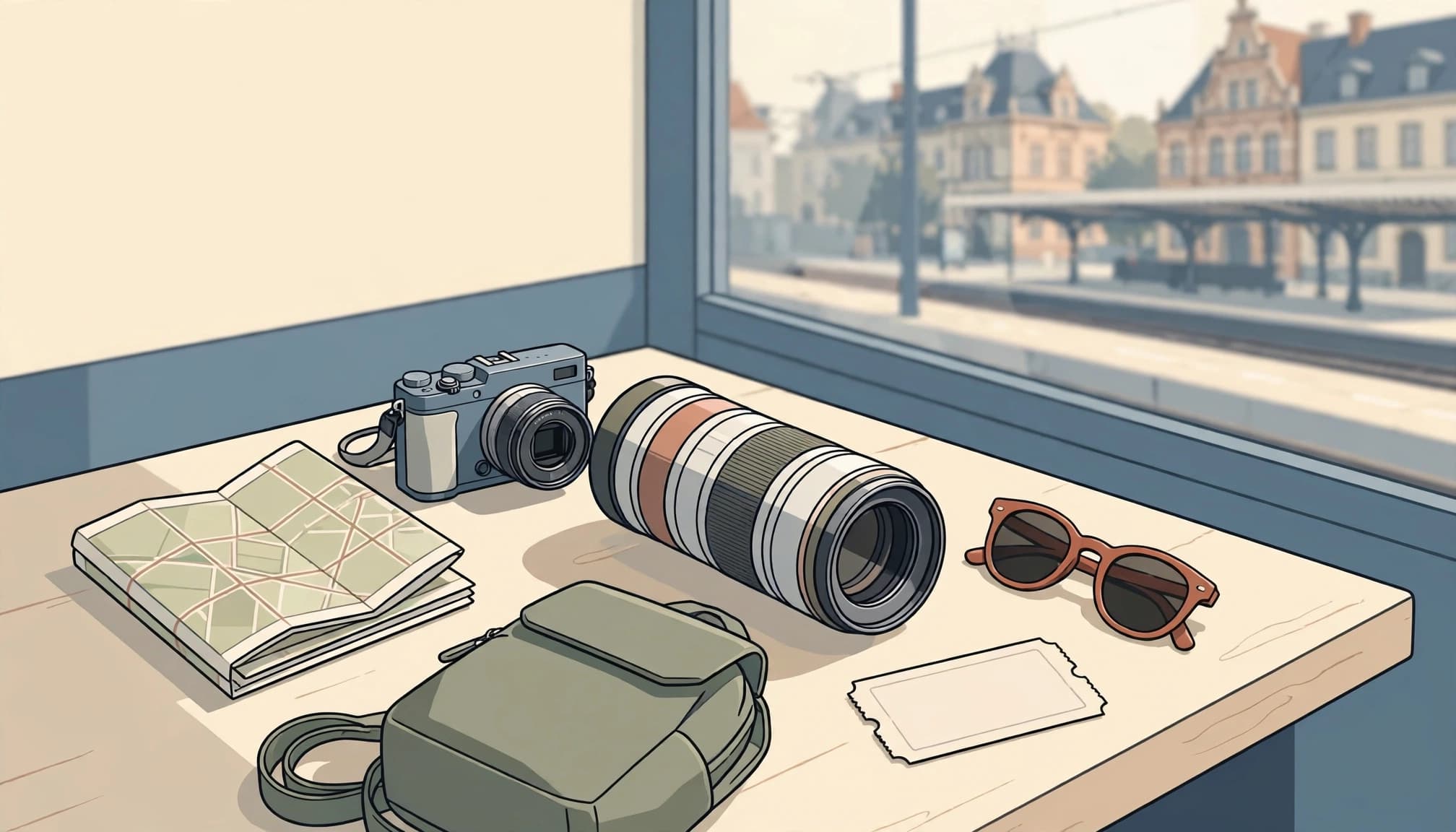
Avoid packing for hypothetical photos
A fast 70-200mm f/2.8 has clear advantages in poor light and for subject separation. However, it may stay in the hotel if your days focus on old town centers, cafés, museums, and train connections.
On Lisbon’s Alfama steps last spring, a traveler with a heavy full-frame kit stopped repeatedly to adjust the bag, while a companion with a lighter setup kept shooting and caught a yellow tram turning the corner in clean afternoon light. That small difference changes how often the camera comes out.
For many trips, one zoom plus a compact prime is enough. Use the telephoto when its perspective is worth the carry.
Build around the lens you use most
If a 24-105mm or 24-200mm stays on your camera all day, add the telephoto only for mountain days, a wildlife excursion, or a planned architectural viewpoint. This setup also reduces lens swaps in wind and rain.
A small 35mm or 50mm prime can be the better second lens for dim restaurants, evening streets, and church interiors where photography is allowed. It gives you more low-light flexibility than a slower long zoom, with little extra weight.
Stabilization, Aperture, and Shutter Speed
A stabilized telephoto makes travel shooting easier, but it does not replace exposure discipline. At longer focal lengths, small movements show quickly.
Use stabilization for still subjects
Optical stabilization or in-body stabilization can help you handhold a slower shutter speed for static façades, distant statues, and landscapes. It is especially welcome under overcast skies or late in the day.
Keep expectations realistic. Stabilization only counters camera movement. A cyclist, a bird, or a moving tram still needs a fast shutter speed.
Begin around 1/250 second for people and 1/500 second for more active subjects. At 300mm or 400mm, raise the speed when your subject moves or you cannot brace yourself.
Accept slower apertures in daylight
Travel-friendly telephotos often become f/6.3 or f/8 at the long end. That is manageable in daylight, particularly in southern Europe, coastal locations, and mountain settings.
Low light gets expensive fast. A slow long zoom may force high ISO settings in a dim cathedral or during blue hour. For a still building, lower the shutter speed with stabilization or a compact tripod. For people, switch to a faster prime or accept more noise instead of accepting blur.
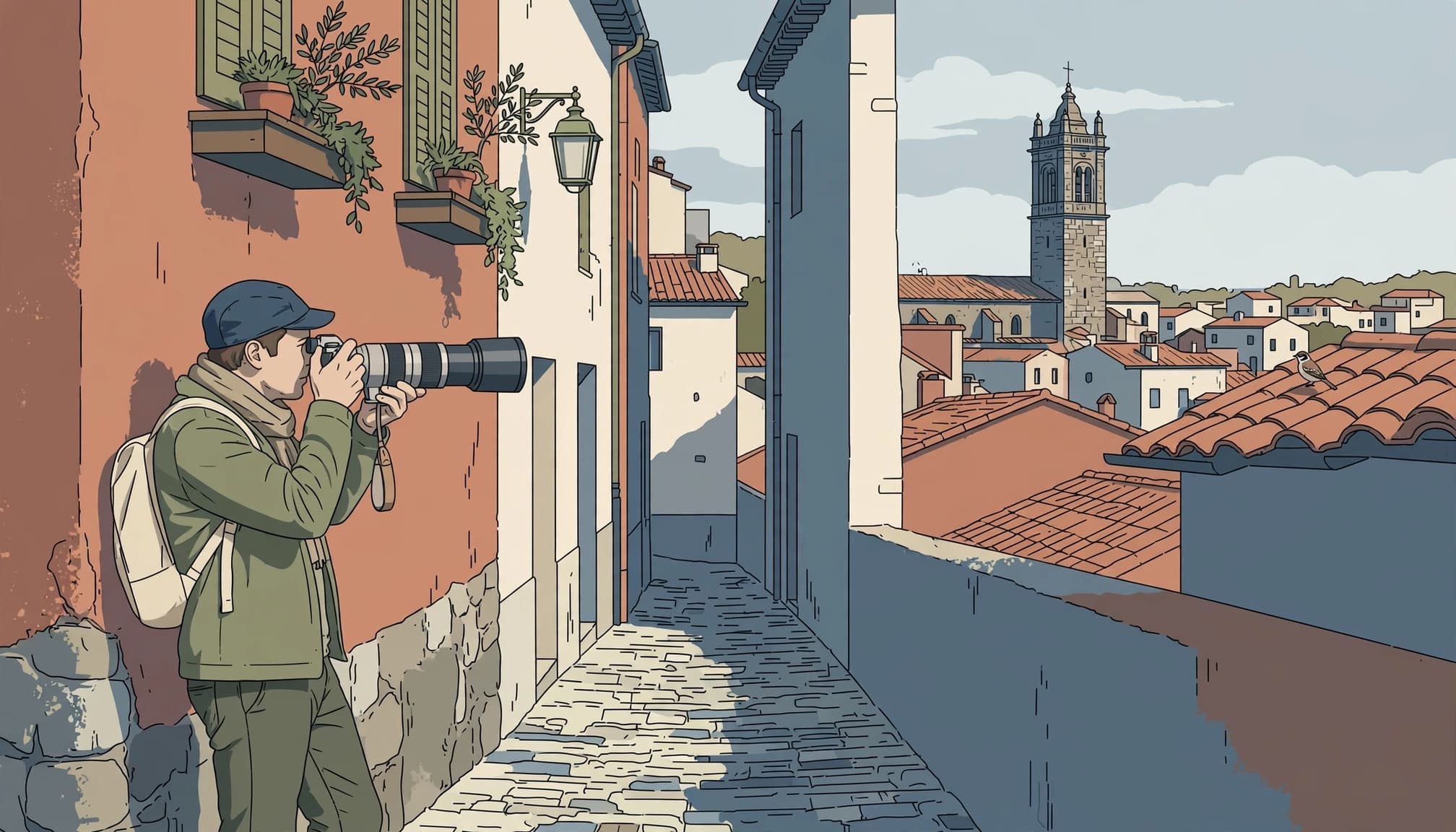
Use a Telephoto Lens Without Missing the Trip
Long lenses can slow you down if you constantly hunt for far-away subjects. Use them with purpose, then put them away.
Keep the camera ready, not exposed
Carry the camera cross-body or in a compact sling when you expect a telephoto shot. In crowded areas, pack it away between locations and avoid leaving a bag by your feet.
A microfiber cloth deserves a place in every kit. Sea spray, rain, dust, and fingerprints show up fast against bright European skies and pale stone walls.
Also bring a spare battery. Image stabilization, cold weather, and long days of reviewing frames can drain power faster than expected.
Shoot with room for correction
At long focal lengths, architecture can look cleaner because you are farther from the building. Still, leave a little space around towers and façades for later perspective correction or cropping.
Check highlights instead of trusting the rear screen. White limestone, sunlit stucco, and bright clouds can clip before the rest of the frame looks too bright.
For a static scene, use RAW files and keep ISO low when conditions allow. Detail in deep street shadows is easier to recover from a clean exposure.
Key Takeaways for a Lighter Travel Kit
- The Sony E 70-350mm G OSS gives APS-C Sony users serious reach at 625g.
- Canon RF travelers get 400mm reach in a 635g lens with the RF 100-400mm IS USM.
- Nikon’s Z 24-200mm VR makes more sense when one-lens coverage matters more than maximum reach.
- Bring a telephoto for distant architecture, mountain layers, coastal scenes, or wildlife, not every city walk.
- A compact prime often solves evening photography better than a heavy f/2.8 telephoto zoom.
- Keep a microfiber cloth, spare battery, and practical carrying strap close at hand.
Frequently Asked Questions
Is a 70-200mm lens enough for Europe?
For most travel photographers, yes. A 70-200mm lens handles city overlooks, distant rooftops, layered landscapes, and portraits well. It is most useful outside dense old town centers, where subjects may be farther away.
Choose 300mm to 400mm when birds, wildlife, or distant mountain details are a regular priority.
Should I bring a telephoto lens on a city break?
Bring one if you enjoy details and have a light model. A compact 70-200mm f/4 or a light 100-400mm can create frames that a phone or standard zoom cannot.
For a short, city-only break, a 24-105mm and small prime may be more practical. Museums, tight alleys, and evening restaurants rarely reward a large telephoto.
Can I use a slow telephoto lens in low light?
Yes, for static subjects with stabilization, support, or a tripod. Moving people and wildlife are harder because they need faster shutter speeds.
Aperture matters most when motion matters. For evening street scenes, a small f/1.8 prime often offers more usable light than a long zoom at f/6.3 or f/8.
Choose the Lens You Will Carry
A telephoto lens should expand your options without turning travel days into an equipment exercise. Pick one that matches your camera system, gives you reach for the scenes you care about, and fits the bag you will carry through a full day.
A 200mm zoom is enough for many routes. A 350mm or 400mm lens earns its weight when a distant church tower, a mountain ridge, or a bird over the Adriatic is the photograph you came to make.
