
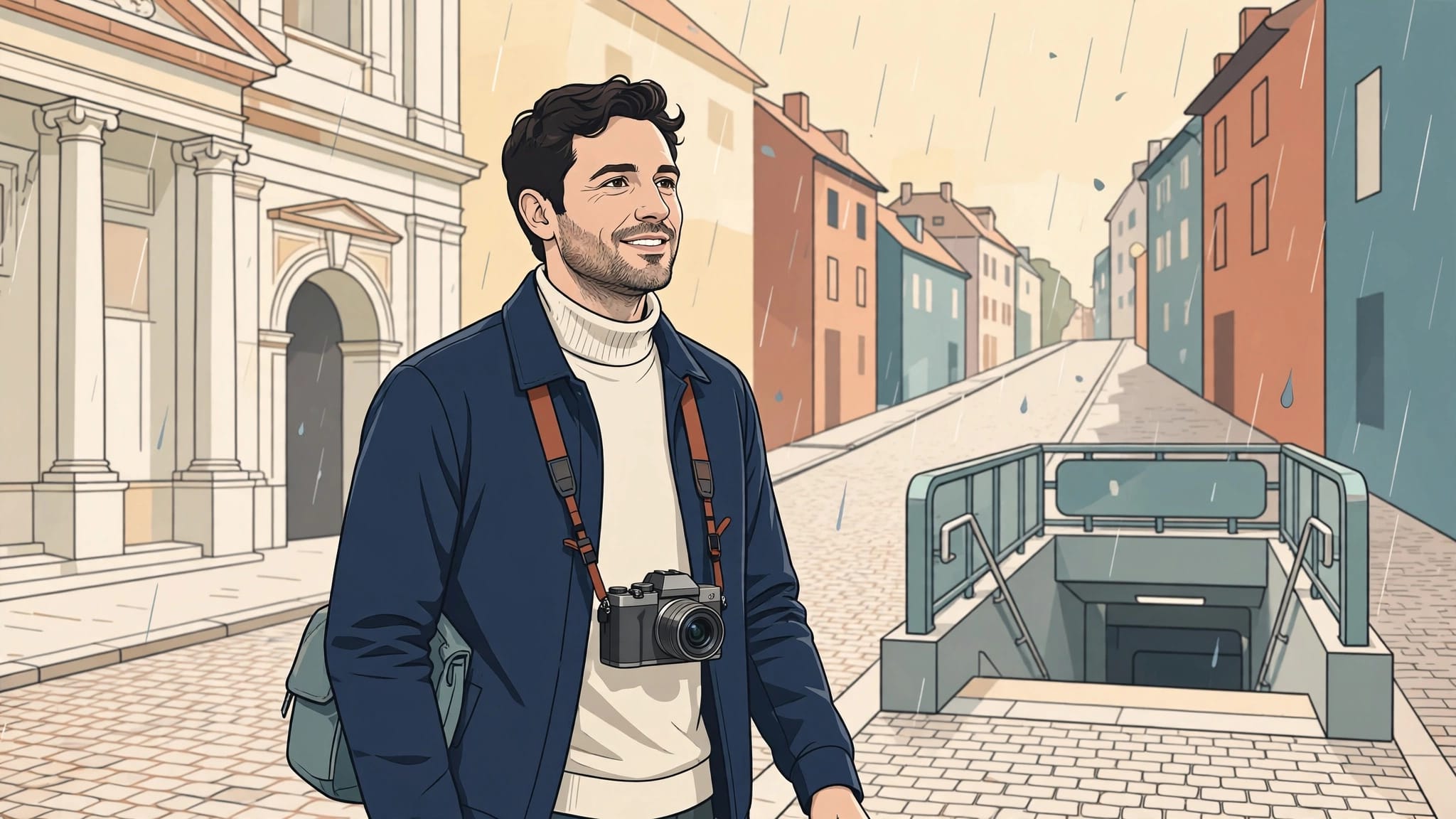
A compact camera can feel heavy by mid-afternoon when its strap rubs your neck, swings into your hip, or makes you look like you’re carrying expensive gear. The best compact camera straps keep a small camera close, accessible, and comfortable through museums, Metro platforms, steep streets, and sudden rain.
For travel photographers moving between city centers on foot, a narrow adjustable sling usually beats a thick neck strap, while a wrist strap works best when the camera spends more time in your hand than on your body. Comfort beats clever hardware.
The right strap also makes you more likely to bring the camera along when the light changes.
What Long European Walking Days Demand
A strap for a three-hour photo walk has an easier job than one used from hotel breakfast to blue hour. Weight compounds after lunch. So does friction.
For a compact camera, focus on four practical details:
- Width and padding should suit the camera’s actual weight. Wide neoprene pads help heavier bodies, but can feel oversized on a pocketable compact.
- Fast adjustment matters when you move from an open square to a crowded tram. You should be able to pull the camera close before boarding.
- Low-profile hardware draws less attention and catches less often on jackets, scarves, and backpack straps.
- Connection type affects how you use a tripod, cage, or quick-release plate.
A strap that stays close to your body also helps you move through crowds without the camera knocking against people or stone walls. That is more useful than a large comfort pad on a small camera.
A compact camera strap should disappear when you’re walking, then make the camera available in one motion when a scene appears.
On Lisbon’s Alfama steps last spring, a friend kept shifting a full-frame kit with a wide padded strap while I carried a small APS-C body on a thin sling. He left his camera in the hotel the next morning. Mine came along for the yellow tram turning into sunlight.
Compact Camera Straps Worth Packing
The best choice depends on whether you want a sling, a neck strap, or a wrist tether. This comparison keeps the focus on cameras such as the Fujifilm X100 series, Ricoh GR, Sony a6000-series bodies, Canon EOS R50, and small Micro Four Thirds cameras.
| Strap | Best for | Useful details | Watch for |
|---|---|---|---|
| Peak Design Leash | Most compact mirrorless kits | 86 g, 19 mm wide, adjusts from 83 to 145 cm | Thin webbing can feel sharp with heavier lenses |
| DSPTCH 1″ Quick Adjust Sling | Discreet city carry | Adjusts from 29 to 55.5 inches | Less cushioning on long days |
| Peak Design Cuff | Handheld street shooting | Quick Anchor system, wrist security | No hands-free carry |
| OP/TECH Pro Strap | Heavier compact kits | 2.5 by 15-inch neoprene pad | Too bulky for tiny cameras |
| Gordy’s tripod-mount wrist strap | Minimalist leather carry | Attaches to a 1/4-20 tripod socket | Occupies the tripod socket |
The Peak Design strap range is a useful starting point because it separates wrist, hand, neck, and sling options instead of treating every carry style as interchangeable.
Best Compact Camera Straps for Most Travelers
Peak Design Leash: Best Overall for Small Mirrorless Cameras
The Peak Design Leash is the strongest all-round choice for a compact mirrorless camera with a small prime or kit zoom. At 86 g, it adds little to a day bag. Its 19 mm seatbelt-style webbing lies flat under a jacket and doesn’t dominate a small camera body.
It adjusts from 83 to 145 cm, so you can wear it short across your torso through a station, then lengthen it for shooting. The Anchor system also makes it easy to remove the strap before mounting the camera on a tripod.
Peak Design lists the Leash at $49.95 in the US and €49.99 in its European store. The Leash product details confirm its weight, width, and adjustment range.
The trade-off is simple. A narrow strap stays compact, but it isn’t the right match for a large f/2.8 zoom.
DSPTCH 1″ Quick Adjust: Best for Discreet Cross-Body Carry
The DSPTCH 1″ Quick Adjust Camera Sling Strap suits photographers who want an understated strap without large pads or visible branding. Its herringbone and mil-spec webbing look more like a practical bag strap than camera gear.
It fits lengths from 29 to 55.5 inches and costs $46 at the time of writing. That range lets you wear a camera high and tight under a rain shell or lower at the hip over a T-shirt. The DSPTCH 1″ Quick Adjust Sling is built for mirrorless and light-to-medium camera setups.
No dangling ends. That small detail matters when you’re squeezing past café tables or getting into a train seat.
Choose the Carry Style Before the Brand
Wrist Straps for Cameras You Keep in Hand
A wrist strap is ideal for a Ricoh GR, Fujifilm X100, Sony RX100, or another camera you use constantly and can slip into a pocket or small bag between shots. It gives you drop protection without adding fabric around your neck or shoulder.
The Peak Design Cuff uses Anchor connectors rated by Peak Design at over 200 pounds, or 90 kg, per anchor. That rating speaks to the connector’s strength, but you should still check your camera’s strap lugs before every trip.
Gordy’s tripod-mount wrist strap is another appealing option for a minimalist camera. Its latigo leather design connects through a 1/4-20 tripod socket and costs $30 to $33, depending on the version. It feels simple and personal, although it isn’t the best choice if you regularly move the camera onto a tripod.
Slings and Neck Straps for All-Day Carry
A sling is the better answer when your camera needs to stay available while your hands handle tickets, coffee, or a map. Wear it diagonally, with the camera resting at your opposite hip, and shorten it before entering busy spaces.
The Peak Design Slide Lite is a more substantial option for a small mirrorless body and a modest lens. It has more surface area than the Leash without moving into heavy DSLR territory. Peak Design describes the Slide Lite as its smaller strap for mirrorless and light DSLR cameras.
For heavier setups, the OP/TECH Pro Strap has a 2.5 by 15-inch neoprene pad and adjusts from 37 to 43 inches. It can make a Canon EOS R10 with a larger zoom more pleasant to carry. However, that padding feels excessive on a GR III or RX100.
Keep the Camera Controlled in Crowds and Rain
Shorten the Strap Before Transport
Long European walking days often include escalators, crowded buses, ticket barriers, and tight restaurant tables. Before you enter any of them, pull the camera higher against your torso.
A short cross-body position reduces swing and gives you a clearer sense of where the camera is. Keep it on the side away from a shoulder bag. If you’re carrying a backpack, avoid routing both straps across the same shoulder because the webbing can bunch and rub.
BlackRapid’s Sport-X Right has a locking carabiner, safety tether, cam-locks, and an underarm stabilizer. Yet its 6.7-ounce weight and 66-inch maximum length make it a more substantial sling than most compact-camera travelers need.
Treat Straps as Comfort Gear, Not Weather Protection
No strap makes a camera safe in heavy rain. Nylon webbing dries faster than leather, while leather needs a wipe-down and air drying after a wet afternoon. Check buckles and connectors after sand, salt spray, or a rainstorm.
Carry a small rain cover or tuck the camera under your jacket during a shower. A microfiber cloth belongs in the same pocket. It takes seconds to dry a camera grip and strap hardware before moisture works into a bag.
Fit Your Strap Before You Board the Flight
Test it loaded. Attach the camera, lens, battery, and the jacket you expect to wear. Then walk for at least an hour around your neighborhood.
This test reveals problems that a desk setup hides, including a buckle that lands on your collarbone, a strap tail that catches on your coat, or a camera that hits your ribs with every step. Try it with your travel bag too, because backpack straps change where a sling sits.
Set the camera at hip height for relaxed walking. For crowded areas, tighten it until the body sits above the hip and under your elbow. If the strap can’t do both without a slow re-threading process, it will frustrate you on the road.
A compact tripod adds another complication. If you use one for blue-hour architecture or self-portraits, choose quick-release strap connectors or remove the strap before mounting the camera. Don’t let a tripod plate and strap hardware fight for the same socket.
Key Takeaways
- Choose a narrow adjustable sling for a compact mirrorless camera carried all day.
- Use a wrist strap when the camera stays in your hand or pocket.
- Test the strap with your real travel bag and outer layer before departure.
- Pull the camera close before entering packed transport or narrow walkways.
- Skip oversized padded straps unless your lens makes the kit genuinely heavy.
FAQ
Is a wrist strap enough for European city travel?
A wrist strap works well when you shoot frequently and can store the camera between stops. It is less convenient during long walks, meals, train journeys, or museum visits because one hand remains occupied. Pair it with a small padded bag if you need hands-free time.
Should I choose leather or nylon for a travel camera strap?
Leather has a classic look and can feel excellent on a small fixed-lens camera. Nylon usually wins for mixed weather and frequent adjustment because it dries faster and packs flatter. For a damp trip through Amsterdam, Dublin, or northern Italy, a nylon sling is the lower-maintenance choice.
The Strap You Will Keep Using
The best compact camera straps aren’t the most padded or complex. They suit your camera’s weight, let you control it in a crowd, and don’t make you resent carrying it after ten kilometers.
Pack the setup that stays on your shoulder through the last walk home, with your camera resting securely at your hip beside a rain-darkened tram stop.
