
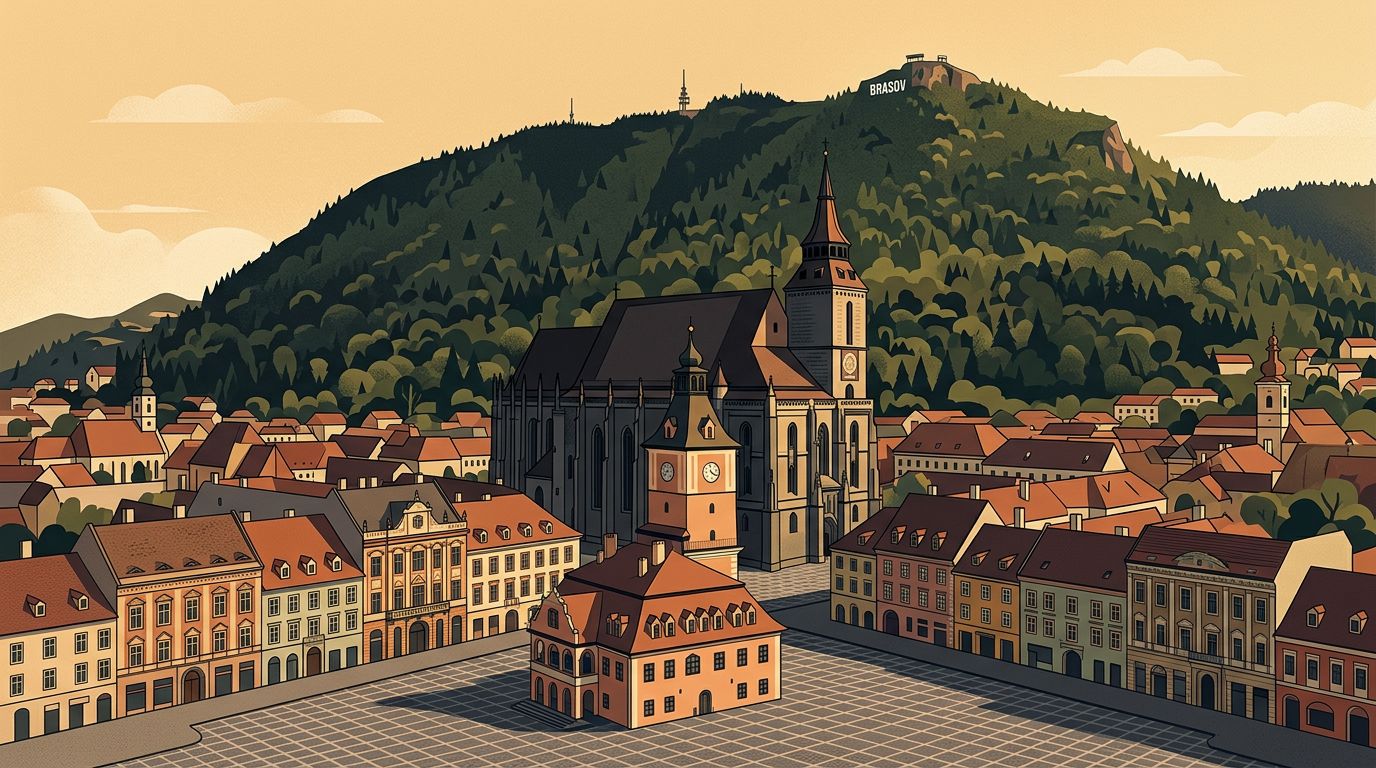
Brașov gives photographers a rare pairing: steep mountain slopes rise directly behind a medieval old town. The strongest Brasov photo spots put Gothic stonework, tiled roofs, and forested ridges into the same frame.
You can cover the central streets on foot, then climb above them before sunset. Light changes quickly between the narrow lanes and open viewpoints, so a loose plan makes a real difference.
Key Takeaways
- Piața Sfatului gives you the classic Black Church and Mount Tâmpa composition.
- Strada Sforii works best with a wide lens and minimal foot traffic.
- Turnul Alb offers a high angle over the medieval center without climbing Tâmpa.
- Mount Tâmpa is the place for red roofs, distant ridges, and broad city views.
- Early morning brings cleaner streets and softer light on Brașov’s old facades.
Brasov Photo Spots in the Medieval Core
Start in Piața Sfatului
Piața Sfatului, also called Council Square, is the easiest place to begin. Pastel facades form a low, colorful border around the paving, while the Black Church rises at the square’s western edge. Tâmpa fills the background when you face south.
Work the square in layers. Place a café table, fountain, or pedestrian in the foreground, then let the church and hillside create depth behind it. A 35mm lens often gives the most natural perspective here, because it holds enough of the square without stretching the church tower into an odd shape.
For a more intimate frame, move beneath the arcades on the square’s edges. Their shadow creates a natural border around sunlit buildings. Meanwhile, a longer lens can isolate the church spire against the green ridge.
A short visual look at Brașov’s historic center can help you recognize the square’s changing angles before you arrive. Still, your best frames will come from circling the space rather than shooting from its center.
The square looks busiest at midday, but its wide layout lets you photograph around crowds by using foreground details and a low camera position.
Blue hour lasts briefly. Return after dusk if you want warm lamps against the dark outline of Mount Tâmpa.
Frame the Black Church Without Flattening It
The Black Church, or Biserica Neagră, is one of the defining Gothic landmarks in Romania. Its buttresses, pointed windows, and imposing tower need room in the composition. Stand too close, and the building becomes a wall of stone.
Try the side streets around Curtea Johannes Honterus for a diagonal view. This approach makes the church recede into the image and leaves space for rooflines or street lamps. A 24mm lens can work well, although keep it level to avoid exaggerated verticals.
The church’s name has a dramatic origin. In 1689, a fire swept through Brașov and scorched the exterior, leaving the darkened appearance that inspired its familiar name. Include the weathered stone in close shots, especially when side light picks out the carved details.
Morning sun reaches parts of the facade more gently than the hard light of early afternoon. If clouds roll over Tâmpa, use them. The contrast between Gothic masonry and a heavy sky can make a stronger image than a clear blue backdrop.
Narrow Streets, Walls, and Rooftop Angles
Use Strada Sforii for Scale and Texture
Strada Sforii, or Rope Street, is Brașov’s celebrated narrow passage. Its walls close in tightly, so it works less as a grand cityscape and more as a study of texture, scale, and perspective.
Go early. The passage feels cramped once visitors stop to pose. A wide lens lets the converging walls pull the eye toward the brighter opening at the far end, but a phone’s ultra-wide setting can bend the buildings too much. Correct the distortion later, or step back and use the standard lens.
Rain improves the pavements. Especially after rain, the worn stone and plaster walls pick up soft reflections without the glare of direct sun.
An old traveler favorite, Strada Sforii often appears in discussions of historic Brașov photography locations. Don’t limit yourself to the street’s centerline, though. Photograph a door handle, drainpipe, or a single window, then use the walls as an abstract frame.
Climb to Turnul Alb and Walk Behind the Walls
For a higher view without the longer ascent to Tâmpa, follow the paths toward Turnul Alb, the White Tower. It overlooks the old town from the northwest and gives you a clean view across the dense roofscape toward the mountain.
The climb includes steps, and the reward is strongest when the sun sits low. Red and rust-colored roofs catch warm light, while the Black Church tower cuts through the center of the town. Use a medium telephoto lens if you want to compress the rooftops against Tâmpa.
Continue through the Graft Bastion area and along Strada După Ziduri. The old defensive walls add a rougher counterpoint to the polished center. Mossy stone, arrow-slit openings, and wooden roofs give you quieter frames than Council Square.
On Strada Republicii, look up. The pedestrian street is useful for vertical compositions, with ornate facades and signs leading toward the mountain. Wait for a gap between walkers, then shoot straight down the street with Tâmpa closing the view.

Photo by Mosquito
Mount Tâmpa for Brașov’s Wide Mountain Views
Hike or Take the Cable Car
Mount Tâmpa is the essential high viewpoint among Brasov photo spots. The summit area looks over the old town’s roofs, the newer districts beyond them, and the surrounding Carpathian ridges. The white “BRAȘOV” sign is an obvious landmark, but the best panorama sits behind and beyond it.
You can hike up through the forest or use the cable car when it operates. The walk commonly takes about an hour, although pace, trail conditions, and photo stops can turn the ascent into a much longer outing, especially after rain when roots and rock sections become slick.
Start before breakfast if you want fewer people at the overlook. In summer, the morning view also avoids the haze that can soften distant ridges later in the day.
After the upper cable station, allow time for the short walk to the exposed viewing area. Bring water and a light layer, since the summit can feel cooler than the square below. Check the cable car’s current schedule and fare locally before planning your last descent around it.
A community-shared Brașov and Carpathian panorama shows why the height matters: the city becomes a compact patchwork, and the mountain ridges gain definition beyond it.
Shoot Past the Sign
The sign itself can be fun, yet it usually makes a weaker photograph when it fills the frame. Step to the side and use it as a small foreground marker, with the town spreading below. A person near the edge can add scale, provided they stay well back from exposed drops.
Late afternoon works well when the sun warms the old town. However, sunset can place Tâmpa’s slopes in shadow before the rooftops do. Watch the light move across the square below, then shoot a sequence as the lamps start to appear.
A 70-200mm lens reveals patterns in the old town, including church spires, courtyards, and clusters of chimneys. A wider lens is better for keeping the ridgeline and sky. Bring both if weight allows.
A Practical Route for Better Photos
Begin in Piața Sfatului at first light, when delivery vehicles and tour groups are less likely to occupy your frame. Walk to the Black Church next, then use Strada Sforii before its narrow width becomes congested.
By late morning, move toward Turnul Alb and the old fortifications. The elevation gives you a fresh view of the streets you have already photographed, and the shaded path can be a useful break on hot days.
Save Tâmpa for late afternoon or sunset. That sequence gives you street-level Gothic details first, then the broad view that puts the old town in context. It also prevents a common mistake: climbing the mountain too early and photographing flat, hazy roofs for hours.
Keep your editing restrained. Brașov’s appeal comes from real contrasts, dark Gothic stone against pale facades, weathered tile against dense forest. Heavy saturation can make the town look less convincing than it felt in person.
Final Frames in Brașov
Brașov rewards patience more than speed. A quiet corner near the Black Church can be as memorable as the wide summit view, especially when the street is wet and the stone catches a little reflected light.
Return to the places that first caught your eye. The same facade can look completely different once evening settles over Piața Sfatului and the red roofs begin to glow beneath Tâmpa’s wooded slope.
