
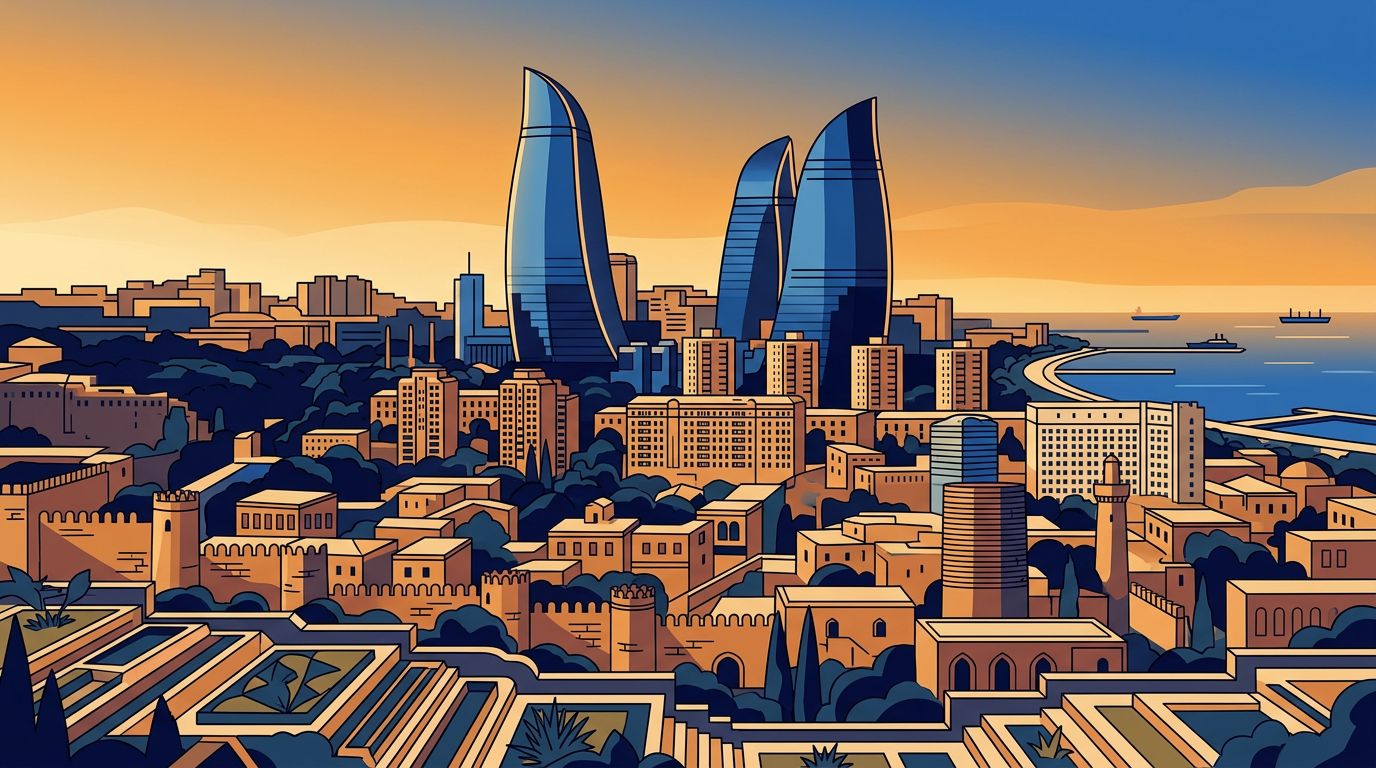
Baku rewards photographers who look upward. Ancient limestone lanes can end with the blue-glass curves of the Flame Towers filling the sky, and that tension gives the city its strongest images.
This Baku photography guide focuses on the light, viewpoints, and framing choices that turn familiar landmarks into personal photographs. You don’t need a huge kit. You do need patience.
Start with the city’s changing light.
Baku Photography Guide: Plan Around Light and Wind
The Flame Towers are three curved skyscrapers completed in 2012. Their glass surfaces change color quickly, especially when the Caspian sky shifts from pale morning blue to late-afternoon gold. A frontal view at midday often looks flat, while side light exposes the towers’ curved edges and makes their reflective surfaces feel more dimensional.
Dawn is forgiving. Streets stay calmer.
For wide city views, arrive at Highland Park before the sun drops behind the western hills. You can place the old city, Baku Boulevard, and the Caspian Sea beneath the towers in one frame. The blue hour that follows is equally useful, because the building lights appear before the sky loses all color.
Baku’s wind matters. It can be sharp on the elevated paths around Highland Park, so use a strap, stabilize your tripod, and avoid changing lenses in exposed spots. A microfiber cloth also earns its place in your bag, since wind-blown dust and sea haze can mark front elements.
If you want the towers’ LED displays, return after dark. The bright animations can overpower the rest of the scene, so expose for the highlights and let surrounding buildings fall into a deep silhouette. The Flame Towers night-view guide is useful for understanding the landmark’s position above the city before choosing a route.
The strongest tower photos usually keep some darkness in the frame. A perfectly bright foreground can make the illuminated towers look pasted onto the skyline.
Highland Park for Wide Flame Towers Compositions
Highland Park, also called Nagorny Park, gives you Baku’s broadest viewpoint. It works best for photographers who want context rather than a close architectural study. The three towers sit on the hill behind you or to one side, depending on your position, while the Old City, boulevard, port, and bay stretch below.
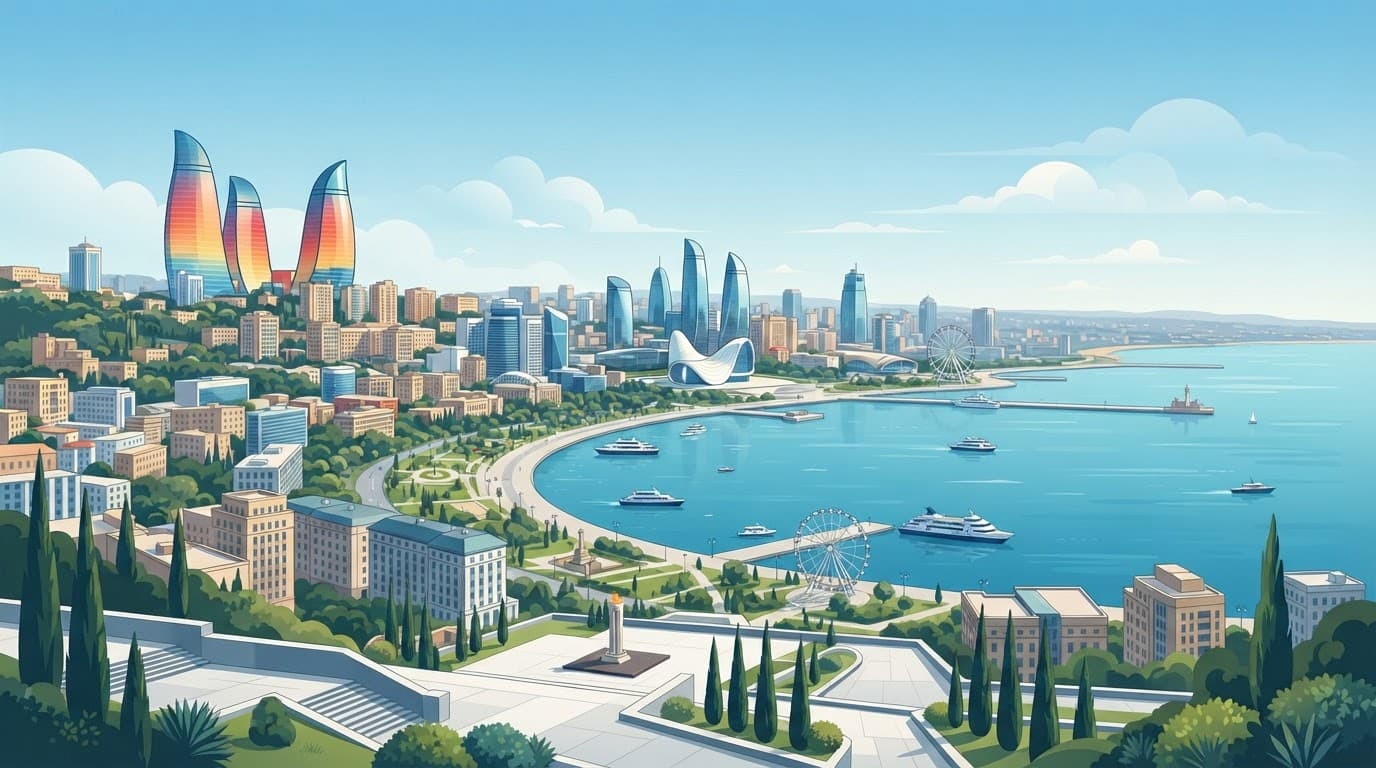
Walk the paths instead of setting up at the first overlook. A few meters can remove a distracting lamp post or give the towers space away from other high-rises. With a 24mm to 35mm lens, keep the horizon level and allow the bay to act as open visual space. A 70mm to 200mm lens compresses the city into layered blocks, with the Flame Towers rising behind the old stone core.
At sunset, try a vertical frame. Use the curve of the staircase, a line of lamps, or the slope of the hillside to lead the eye toward the towers. In contrast, a horizontal panorama suits the broad sweep of the waterfront.
One evening near the park’s upper terrace, I watched a photographer wait through fifteen minutes of dull cloud while visitors packed up around him. A thin break opened above the Caspian, warming only the towers’ western faces for less than two minutes. His final frame had a dark blue city below and three bright orange slashes above it.
Patience beats a crowded shooting schedule.
Photographing Icherisheher With the Towers Behind It
Icherisheher, Baku’s walled Old City, gives you the contrast that skyline viewpoints cannot. Its narrow streets limit your view, which is exactly the point. Let stone walls crop the scene, then reveal one Flame Tower or all three through an opening overhead.
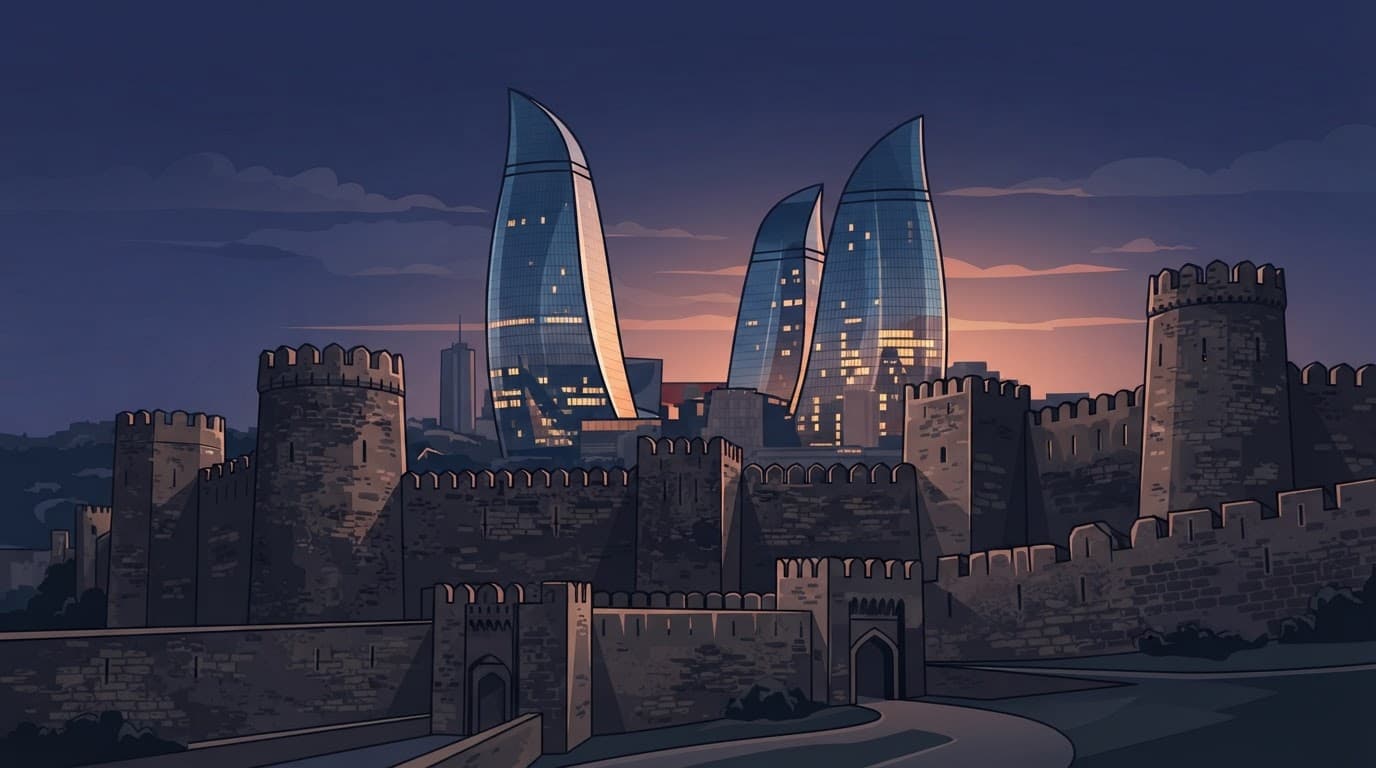
Start near Gosha Gala Gapisi, the Double Gate, then work through the lanes toward Kichik Gala Street. Keep looking behind you. The tower view often appears after you pass a doorway or turn toward a wall that catches indirect light.
A narrow stone passage, a sliver of sky, and three blue-glass curves above it.
That frame needs restraint. Don’t use an ultra-wide lens merely because the alley is tight. Extreme distortion can turn historic walls into bending lines and make the towers look remote. A 35mm or 50mm lens usually preserves the street’s scale while giving the skyscrapers enough presence. Step back when possible, then use an archway, carved door, or rough masonry as a natural border.
The Old City Flame Towers viewpoint shows why this pairing works so well. Centuries-old stone gives the reflective facades a clear visual counterweight. Frame the towers off-center, because a symmetrical shot can flatten the tension between the dense alley and open sky.
The Maiden Tower offers another useful elevation. Its 29.5-meter structure has views over Icherisheher and the boulevard, although access timing and visitor traffic can affect your shot. Go early, use a moderate wide lens, and photograph across rooftops rather than straight down. Repeating chimneys, domes, and terraces give the image depth.
For a quieter street image, wait until people naturally cross a patch of light. One person can add scale. Ten people can turn a careful composition into a travel snapshot.
Camera Settings for Stone, Glass, and Night Lights
The best Baku photography guide is less about fixed settings than reading contrast. Old City walls often sit in shade while the towers reflect a bright sky. Your camera may protect the sky and make the stone almost black, or lift the walls and burn out the glass.
Shoot RAW if your camera allows it. You will have more room to recover detail in shaded stone and bright windows. Turn on highlight warnings, then check the towers after each major exposure change. When the sky is bright, bracket three exposures one or two stops apart.
These starting points cover most situations:
| Scene | Suggested lens | Starting settings | Main concern |
|---|---|---|---|
| Highland Park near sunset | 24mm to 70mm | ISO 100, f/8, 1/125 sec | Keep the horizon level |
| Old City tower reveal | 35mm or 50mm | ISO 100 to 400, f/5.6 | Protect bright sky detail |
| Blue-hour skyline | 24mm to 70mm | ISO 100, f/8, 1 to 10 sec | Use a stable support |
| Night LED displays | 50mm to 135mm | ISO 100 to 400, f/8 | Avoid clipped highlights |
A circular polarizer helps during clear daylight, but rotate it carefully with wide lenses. Uneven polarization can make the sky look blotchy. At blue hour, remove it because it costs light when shutter speeds already lengthen.
Tripods attract attention. A compact travel tripod or a small beanbag is more practical in busy lanes. If you shoot handheld after sunset, brace against a wall and use burst mode at a safe shutter speed.
Build a Walkable Baku Photo Route
Begin at Little Venice or the boulevard in the morning. This lower angle can separate the three towers against the sky, and still water may offer a soft reflection when conditions are calm. Then take the funicular or walk uphill toward Highland Park for the wider city view.
Return to Icherisheher in late afternoon. The western-facing walls catch warmer light, while narrow lanes remain shaded enough to hold texture. This is a good time to move slowly, because doorways and walls shape the frame more than the towers themselves.
Respect the streets as lived-in spaces. Ask before making close portraits, don’t block entrances, and keep your tripod out of narrow walking paths. Religious sites may have rules about interior photography, so look for posted guidance and follow staff requests.
The Metro’s Icherisheher station sits near the Old City’s western edge, which makes it an easy starting point for a sunset walk. If your time is limited, shoot the Old City first, then finish at Highland Park after the lights switch on. That order gives you warm stone, a blue sky, and illuminated towers in one evening.
Leave Room for Baku’s Contrasts
Baku looks most convincing when your frame includes its contradictions. Let an old wall stay dark. Let a modern tower remain partly hidden. Leave empty sky when it gives the architecture room to breathe.
A careful photograph can hold both periods without forcing them together. Wait for the light on the stone walls near Gosha Gala Gapisi, then look up when the first Flame Tower lights begin to glow.
