
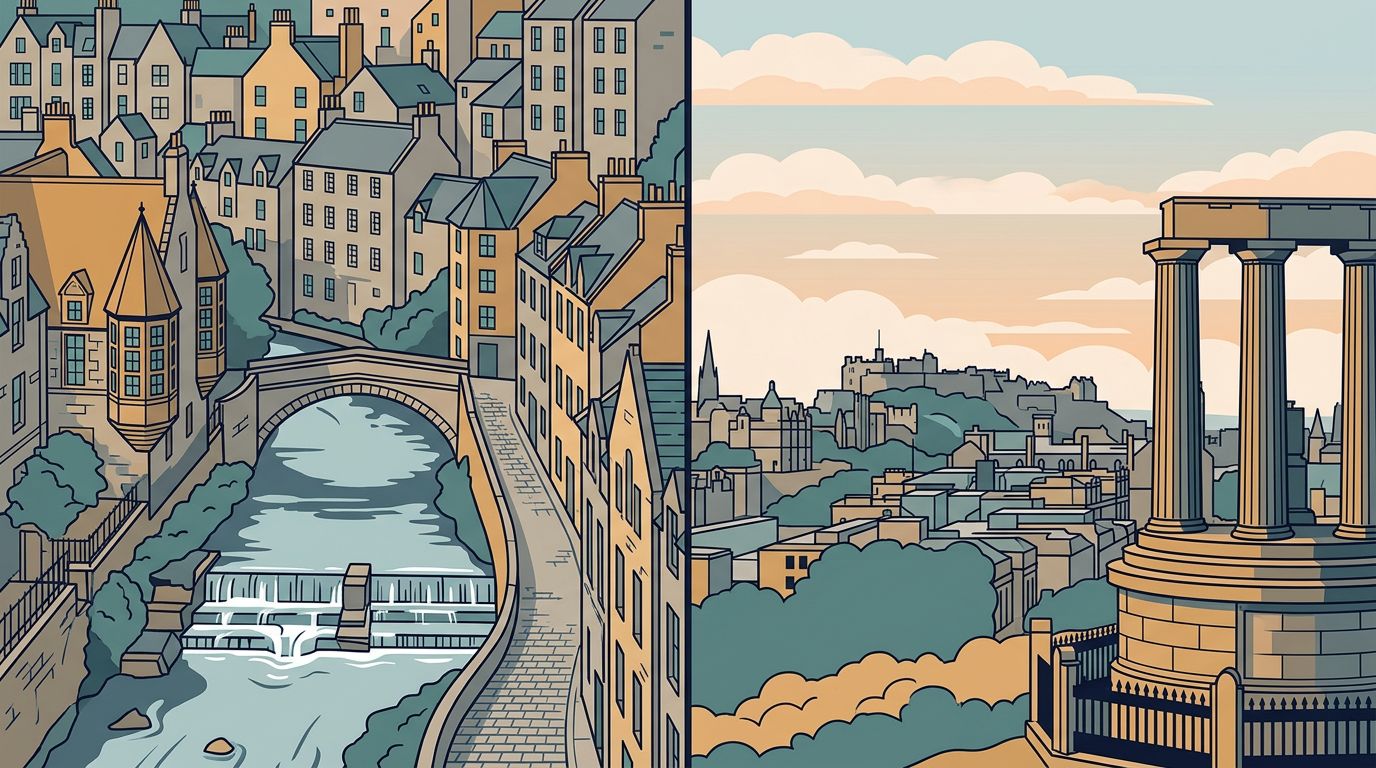
Edinburgh can make a wide lens feel cramped. This Edinburgh photography guide pairs Dean Village’s close river gorge with Calton Hill’s open skyline, so your shots feel planned rather than rushed.
At Dean Village, a weir, bridge, and jumble of windows can crowd the frame, while Calton Hill lets you use monuments as foreground anchors against the Old Town and Edinburgh Castle, even when you only have a few hours. Start with light, then choose your location.
An Edinburgh Photography Guide for Light and Route Planning
Dean Village and Calton Hill ask for opposite approaches. Dean Village is strongest when the streets and riverside path are quiet. Calton Hill needs room for sky, changing light, and a little patience with other photographers.
If you can give the route one full day, photograph Calton Hill at sunrise, visit Dean Village while afternoon light reaches the gorge, then return to Calton before sunset for a completely different skyline.
Use this quick plan to decide where your first frames should happen.
| Location | Best time | Strong first composition | Practical note |
|---|---|---|---|
| Dean Village | Before 8 a.m., weekday | Dean Bridge above the Water of Leith | Expect more walkers by mid-morning |
| Damside | Early morning or overcast afternoon | The weir leading toward stone cottages | Keep clear of homes and paths |
| Calton Hill | Sunrise or 45 minutes before sunset | Dugald Stewart Monument with Old Town beyond | Wind can be strong |
| National Monument | Golden hour and blue hour | Columns framing the city | A short telephoto lens helps |
The contrast is useful. Dean Village gives you texture and layers at close range. Calton Hill gives you distance and scale.
Before leaving Princes Street, browse this Edinburgh photo-spot roundup for ideas that can extend your walking route. Still, don’t try to collect every landmark in one morning. Two carefully worked locations will produce more convincing photographs than ten hurried stops.
Photographing Dean Village Without Flattening Its Character
Dean Village sits beside the Water of Leith, below the traffic crossing Dean Bridge. The houses are the draw, yet the scene works because of the river, the mature trees, and the steep walls around it. Treat it as a neighbourhood, not a backdrop.
Go early. The soft light reduces contrast on pale stone, and the narrow paths feel less congested. Cloud cover also helps because it holds detail in windows, water, and shaded corners.
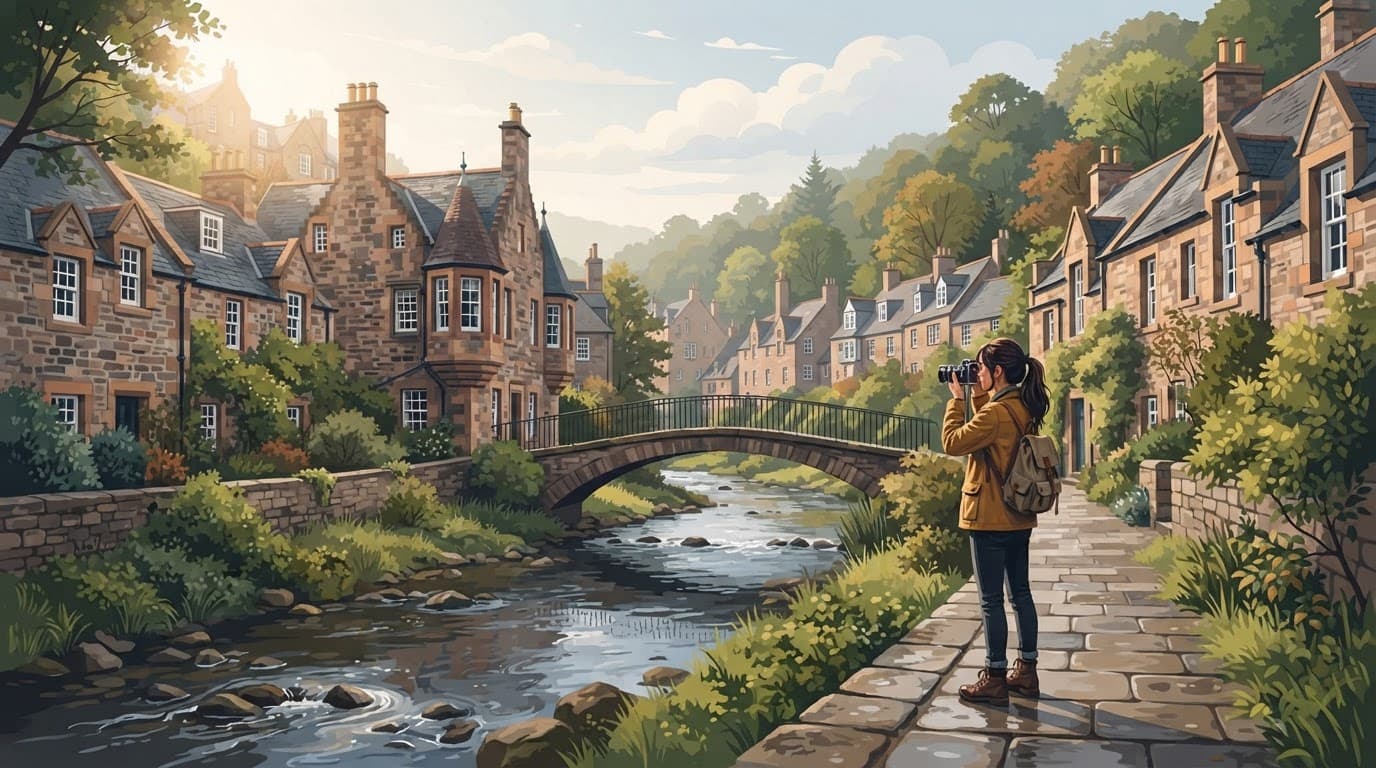
Start at the Dean Bridge overlook. A wider focal length lets you include the curve of the bridge and the gorge below, but don’t force every building into the shot. Crop with purpose. A 24mm to 35mm view often feels more natural than an ultra-wide frame that stretches the nearest cottage.
Then walk down toward Damside and the weir. Position the water as a leading line, but leave enough space around it for the buildings to breathe. Vertical frames work well when you want the river below and the tall facades above. Horizontal frames suit the wider sweep of the bend.
One damp weekday morning, the best frame at Damside often comes after waiting for a single pedestrian to cross the far path. That small figure can show the scale of the cottages without turning the photograph into a portrait. Keep the person near an edge rather than placing them in the centre.
Dean Village looks busiest when every roofline, window, and tree compete for attention. Choose one clear anchor, then let the rest support it.
Watch for bright sky through gaps in the trees. Meter for the highlights, then lift shadows later if needed. If your camera has a histogram display, check it after the first exposure. Stone walls can appear darker than they look to your eyes.
Respect the setting, too. Don’t set up on private steps, lean over garden walls, or block the narrow riverside route with a tripod. The strongest travel photographs rarely need a perfect empty scene.
Calton Hill Photography for Edinburgh’s Big Skyline
Calton Hill is a free public hill at the east end of Princes Street, with a short but exposed climb to the summit. It is the more recognizable viewpoint, yet the obvious panorama is only the starting point.

For the classic west-facing view, work around the Dugald Stewart Monument. Its circular temple shape gives the skyline a solid foreground, while the castle and Old Town rise behind it. Move a few steps at a time. The monument can hide the castle, or frame it, depending on your position.
A wide lens captures the National Monument, the hilltop, and the distant city in one scene. However, a 70-200mm lens produces a different result. It compresses the castle, spires, and rooftops behind the monuments, making Edinburgh appear denser and more layered.
Wind changes everything. Brace the tripod, hang no heavy bag from its centre column, and use a two-second timer or remote release. At sunset, even a small movement can soften the edges of columns or rooftops.
Arrive before the light peaks, because the best Calton Hill frame often depends on a foreground position that fills quickly.
The hill draws crowds during golden hour. Arriving about 45 minutes before sunset gives you time to find a clean angle and test several focal lengths. Sunrise is quieter, with softer colour and fewer tripods around the popular overlooks.
At 1 p.m., the time ball drops at Nelson Monument. Catch it as a brief moving detail during a daytime shoot, especially if the weather makes a long skyline session less appealing.
The wider Edinburgh photography locations guide is useful if you want to pair Calton Hill with a castle or Princes Street viewpoint. For the hill itself, don’t stay fixed at the first railing. Walk behind the monuments, shoot through the National Monument columns, and turn east for cleaner views with fewer familiar landmarks.
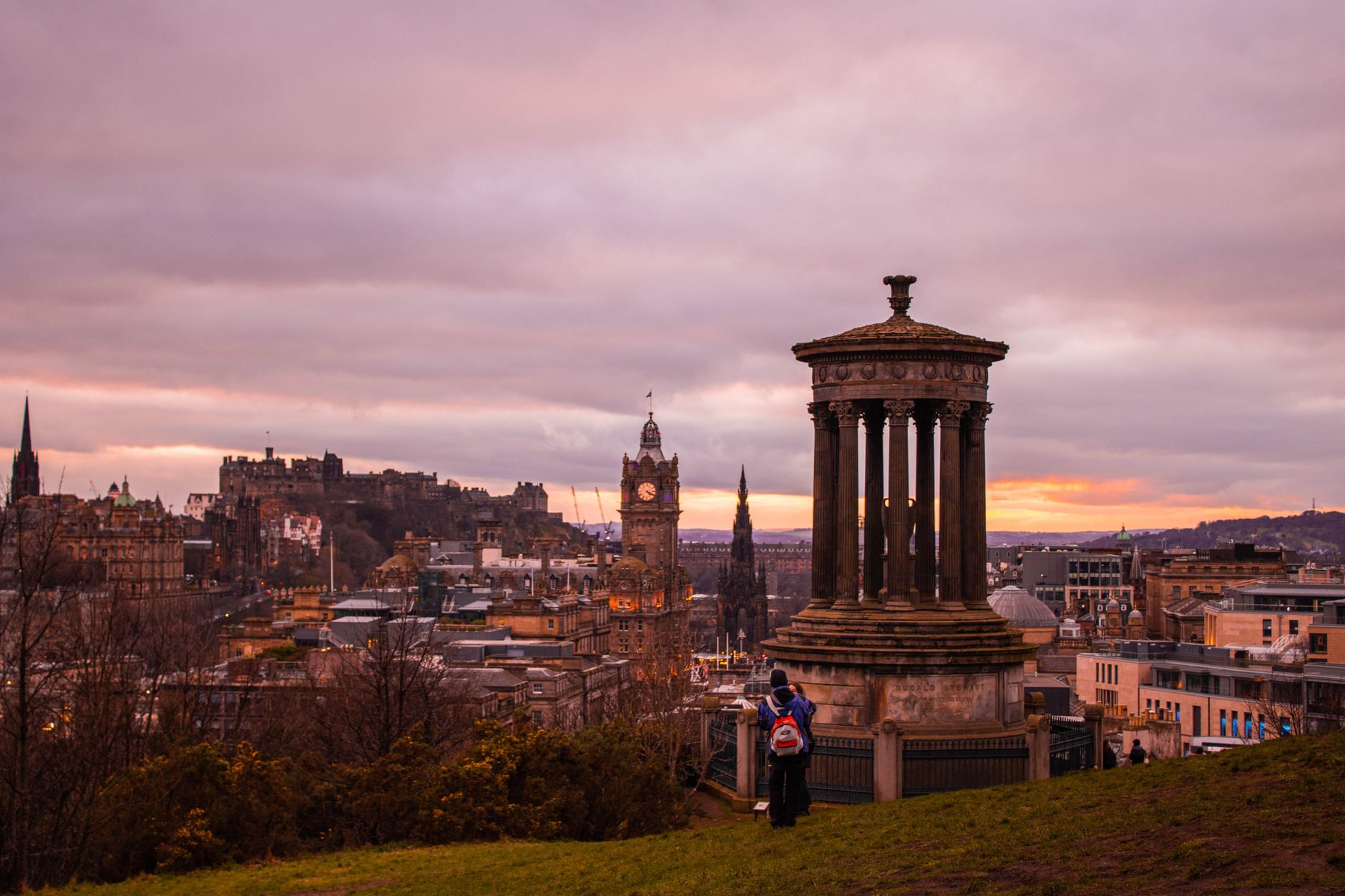
Photo by Hoàng Vũ
Camera Settings and Weather-Proof Habits
A compact kit is enough for both places. Carry only what supports the picture you want, because steep paths and rain-soaked pavements make extra weight tiresome.
- A 16-35mm or 24-70mm lens covers most Dean Village scenes and wider Calton Hill views.
- A 70-200mm lens helps separate the castle, monuments, and distant rooflines.
- A small tripod supports blue-hour exposures and keeps low-light ISO under control.
- A lens cloth matters more than another filter when mist or rain blows across the front element.
At Dean Village, use a moderate aperture such as f/5.6 to f/8 when you want detail across a wide scene. Faster apertures work when you isolate a window, a stone arch, or water moving through the weir. Keep the foreground simple.
On Calton Hill, f/8 to f/11 often gives enough depth for monuments and skyline detail. Start at ISO 100 when the tripod is stable. As the light fades, lengthen the shutter speed before raising ISO, unless wind moves the camera.
Don’t overcorrect Edinburgh’s weather in editing. Grey skies can add shape to pale stone, and damp pavements often give the city richer colour. Correct vertical lines in architecture, then compare the image with your memory of the scene. Heavy clarity can make old stone look brittle.
One More Pass in Better Light
Dean Village and Calton Hill reward return visits because weather changes both scenes faster than any preset can. A quiet riverside frame and a crowded hilltop can each work when you commit to a clear subject.
Bring the lens that suits the view, arrive before the light shifts, and give yourself time to move a few steps. Start at the Damside weir at 7:45 a.m., before direct sun touches the upper windows.
