
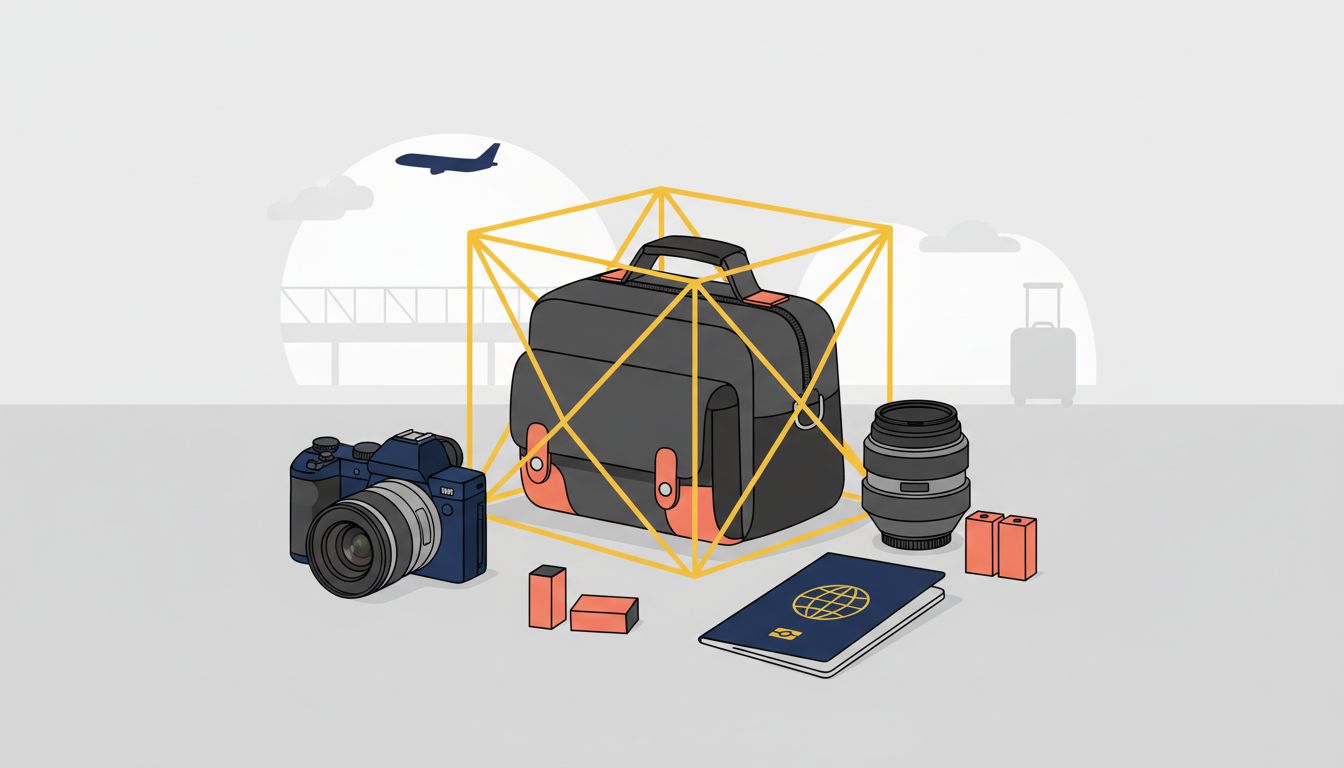
Your bag is part of the ticket. A camera body may cost more than the flight, yet a bag that misses a sizer by a few centimeters can still end up in the hold.
Searches for camera gear budget airlines often start with a price comparison. The real decision is whether your fully packed kit fits the airline’s free allowance without forcing you to check fragile equipment.
Treat the booking page as a packing brief, then build your kit around it.
Camera Gear Budget Airlines Rules Before You Book
Low-cost carriers sell space in small pieces. One fare may include only an under-seat bag, while a higher fare or add-on allows a full cabin bag. The rules can also differ on your return flight, even when both flights appear in one itinerary.
Ryanair’s standard free allowance is a small under-seat bag. Its current small-bag dimensions are commonly listed as 40 x 20 x 25 cm, while a 55 x 40 x 20 cm cabin bag with a 10 kg limit requires Priority or a qualifying fare. Check Ryanair’s current cabin bag rules before paying, because the booking flow is the policy that applies to your flight.
easyJet gives every passenger one small cabin bag up to 45 x 36 x 20 cm, including handles and wheels. It may weigh up to 15 kg, provided you can lift it yourself. A larger 56 x 45 x 25 cm bag needs to be included with your fare or added separately, as set out in easyJet’s cabin baggage allowance.
| Airline | Included small bag | Larger cabin bag |
|---|---|---|
| Ryanair | Up to 40 x 20 x 25 cm, under the seat | Up to 55 x 40 x 20 cm, 10 kg, with Priority or an eligible fare |
| easyJet | Up to 45 x 36 x 20 cm, 15 kg | Up to 56 x 45 x 25 cm, when included or purchased |
Those numbers change the kind of backpack you need. A 25-liter photo pack can fit one airline’s larger allowance but fail another airline’s free under-seat limit once its top handle, hip belt, or rear padding adds bulk.
Measure it at home.
A bag that reaches the maximum size while empty can bulge at the corners once lenses and a laptop go inside. Leave a little room around every dimension.
Build a Camera Bag That Fits the Sizer
Camera gear needs protection, but oversized inserts waste the space that a budget-airline bag limit gives you. Start with the bag, not the gear. A soft-sided backpack with a modest depth is easier to compress into a sizer than a rigid roller or a boxy hard-shell camera case.
For a short city shoot, carry the camera body with your primary lens attached. Put one additional lens in a padded divider, then add only items that support the planned work. A compact mirrorless body, a 24-70mm lens, a fast prime, spare batteries, cards, and a small microphone can cover a demanding shoot without turning your under-seat bag into a brick.
Use the remaining room with care:
- Put the heaviest item near your back, where it feels lighter and holds the bag’s shape.
- Keep batteries, memory cards, and lens cloths in a flat zip pouch near the top.
- Place a small tabletop tripod inside the bag, rather than strapping it outside.
- Wear your camera jacket during boarding if it holds a battery pouch or charger.
A full-frame body with three large zooms can consume most of a 10 kg limit before you add a laptop. In that case, paying for the larger cabin-bag option is often cheaper than gambling on a gate check or replacing damaged equipment.
The phrase camera gear budget airlines can make the problem sound universal. It isn’t. A creator shooting street video in Rome needs a different kit than a wildlife photographer transiting through Oslo. Pack for the next assignment, not every assignment you might get.
Carry Batteries, Cards, and Fragile Accessories Properly
Lithium batteries deserve their own plan. Spare camera batteries and power banks normally belong in cabin baggage, not checked luggage. Protect exposed terminals with original covers, a battery case, or tape, then keep each cell where you can show it quickly at security.
No loose cells.
Airlines and airport security teams can apply tighter limits, especially for high-capacity batteries. Check the carrier’s dangerous-goods guidance before travel if you use large V-mount batteries, a high-watt-hour power bank, drone batteries, or an external monitor battery.
Keep the camera kit easy to inspect. A security officer may ask you to remove a laptop, camera body, or power bank, so don’t bury every small item under foam dividers and cables. Put lens caps on before the tray. A padded wrap protects a body during screening better than loose gear does.
A real-world boarding detail matters here. Ryanair has said its cabin capacity is limited to 90 standard full-size cabin bags, so an eligible roller can still be sent to the hold when overhead lockers fill. Your essential camera gear should therefore fit inside the smaller bag that stays below the seat whenever possible.
That approach also protects files. Keep exposed memory cards, a small SSD, and the day’s backup with you. Checked baggage is the wrong place for irreplaceable footage.
Avoid the Gate Check Problem on European Low-Cost Flights
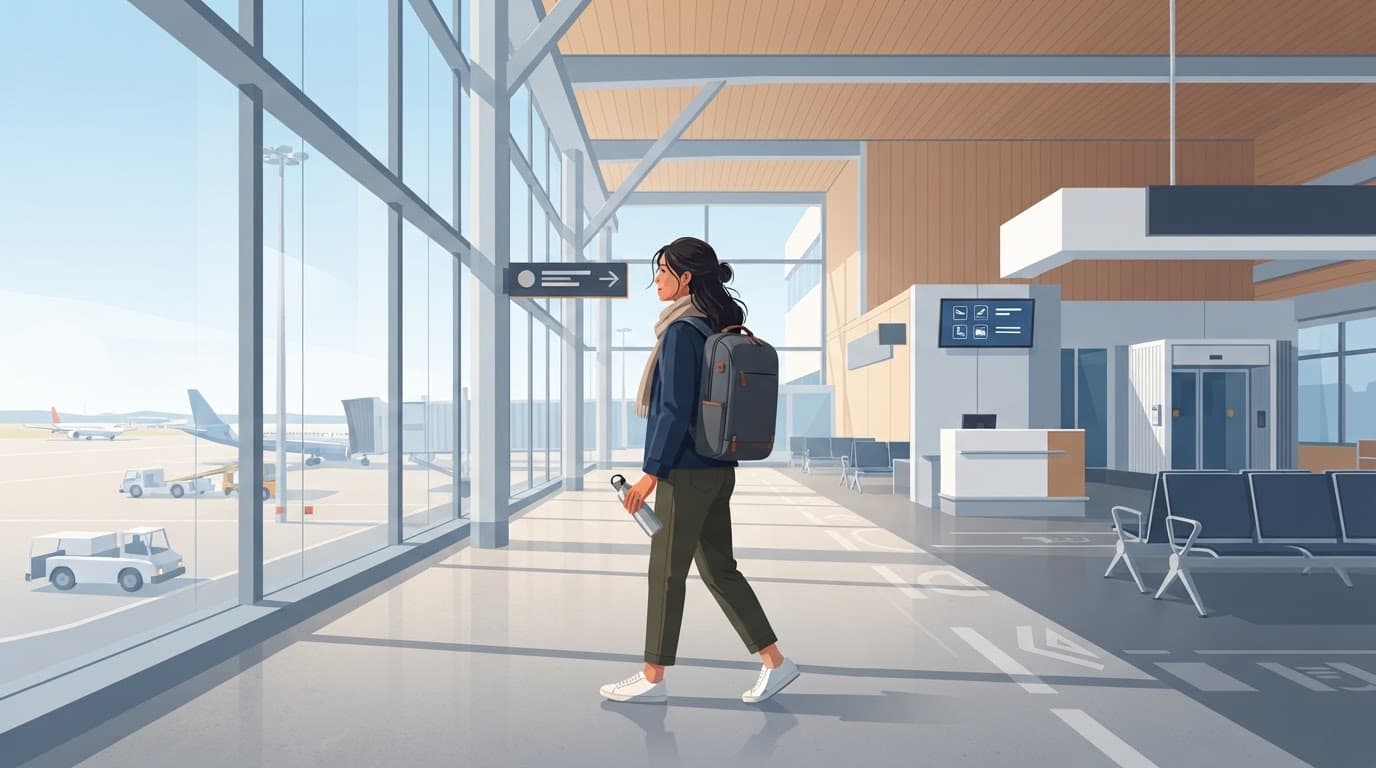
The gate is where a tidy packing plan meets a metal sizer. Staff may focus on bag dimensions, but a full cabin, a clearly overstuffed pack, or a second loose item can bring closer attention.
Although gate staff may not weigh every backpack, they can request a sizer test at any point, and a full overhead bin can turn an allowed cabin bag into an involuntary hold item. Don’t rely on a friendly check-in agent or an earlier flight where nobody looked.
Keep one bag on your body. Carrying a camera in one hand, a laptop sleeve under your arm, and a backpack on your shoulder makes you look like you have three items. Put everything inside before you reach the queue.
The 7:10 a.m. boarding line is a familiar cautionary scene: a backpack that seemed compact in a hotel room catches on the sizer because a jacket is stuffed behind the shoulder straps. That extra layer can be the difference between walking onboard and rearranging equipment while everyone waits.
If a gate check is unavoidable, remove the items that cannot safely leave your possession first. Take out batteries, memory cards, SSDs, camera bodies, and lenses if there is room in your personal item. Ask for a gate-check tag, then photograph the bag’s condition before handing it over.
A camera backpack should look smaller than it is. Clean exterior pockets and nothing strapped outside reduce scrutiny.
Book the Right Allowance and Rehearse the Journey
The cheapest fare isn’t always the lowest-cost choice. If you need two bodies, a laptop, stabilized audio gear, or a full day of batteries, add the larger cabin bag during booking instead of waiting until the airport. Fees can rise later, while the stress always costs more.
Read the allowance for each sector. A Ryanair Priority add-on doesn’t transfer to an easyJet flight, and a codeshare or separate booking may put you under another carrier’s rules. Screenshot the bag allowance after purchase, especially if your itinerary includes several European airlines.
Then do a complete test pack several days before departure. Load the actual camera body, lenses, cables, charger, batteries, laptop, and rain cover. Weigh it on a luggage scale. Measure the exterior at its widest points. Walk around your home with it for ten minutes.
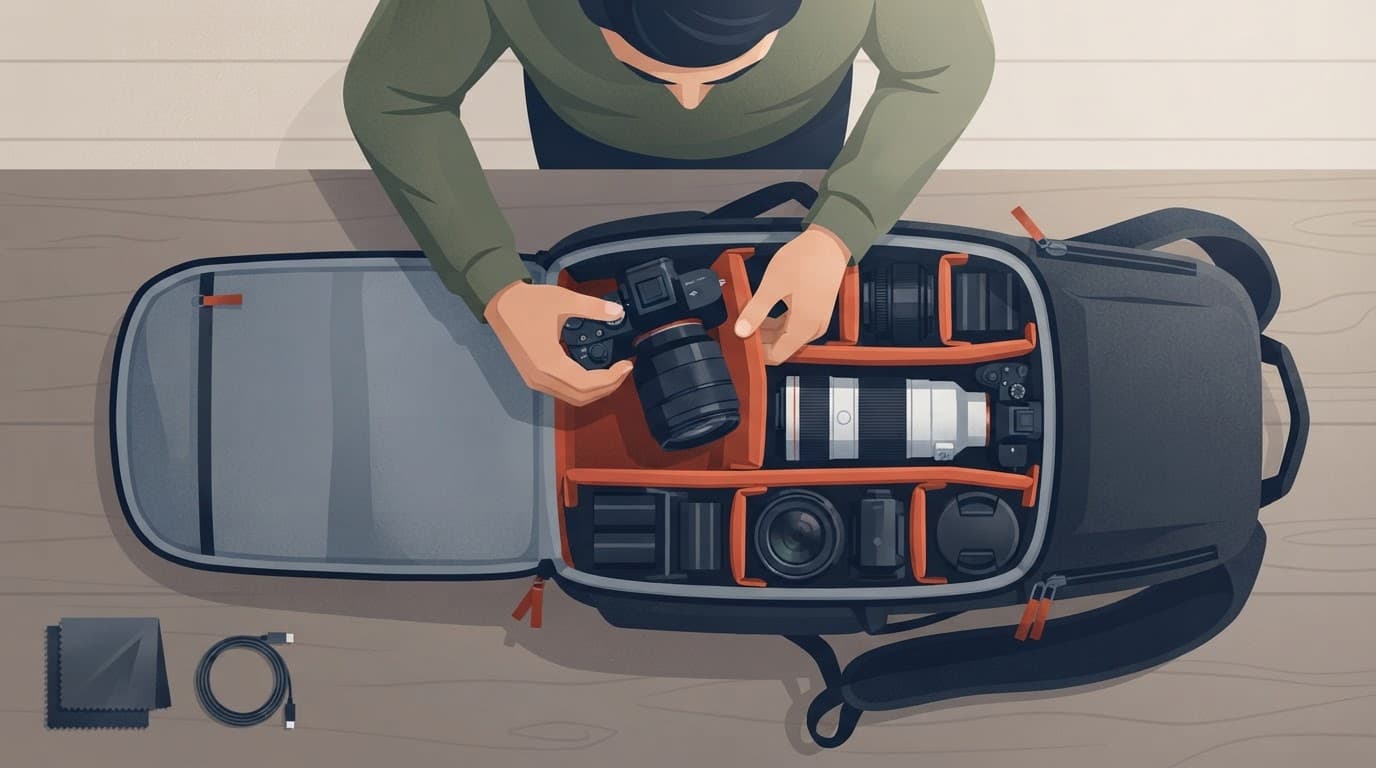
A packing cube is useful for clothing, but it shouldn’t displace the camera insert. Wear bulkier clothes, buy toiletries after arrival, and use your destination laundry service if a long trip makes the bag too heavy. Your camera bag should carry the equipment you cannot replace locally.
Keep the Camera Kit With You
Flying with camera gear budget airlines requires less gear than most photographers first pack. The safest setup is the one that meets the smallest allowance on your itinerary and still lets you do the work you booked.
Pay for space when the kit requires it. Otherwise, keep the backpack compact, protect every battery terminal, and make the under-seat bag your home for cameras, lenses, cards, and drives.
Before leaving for the airport, measure the loaded bag once more, including the top handle and every bulging pocket.
