
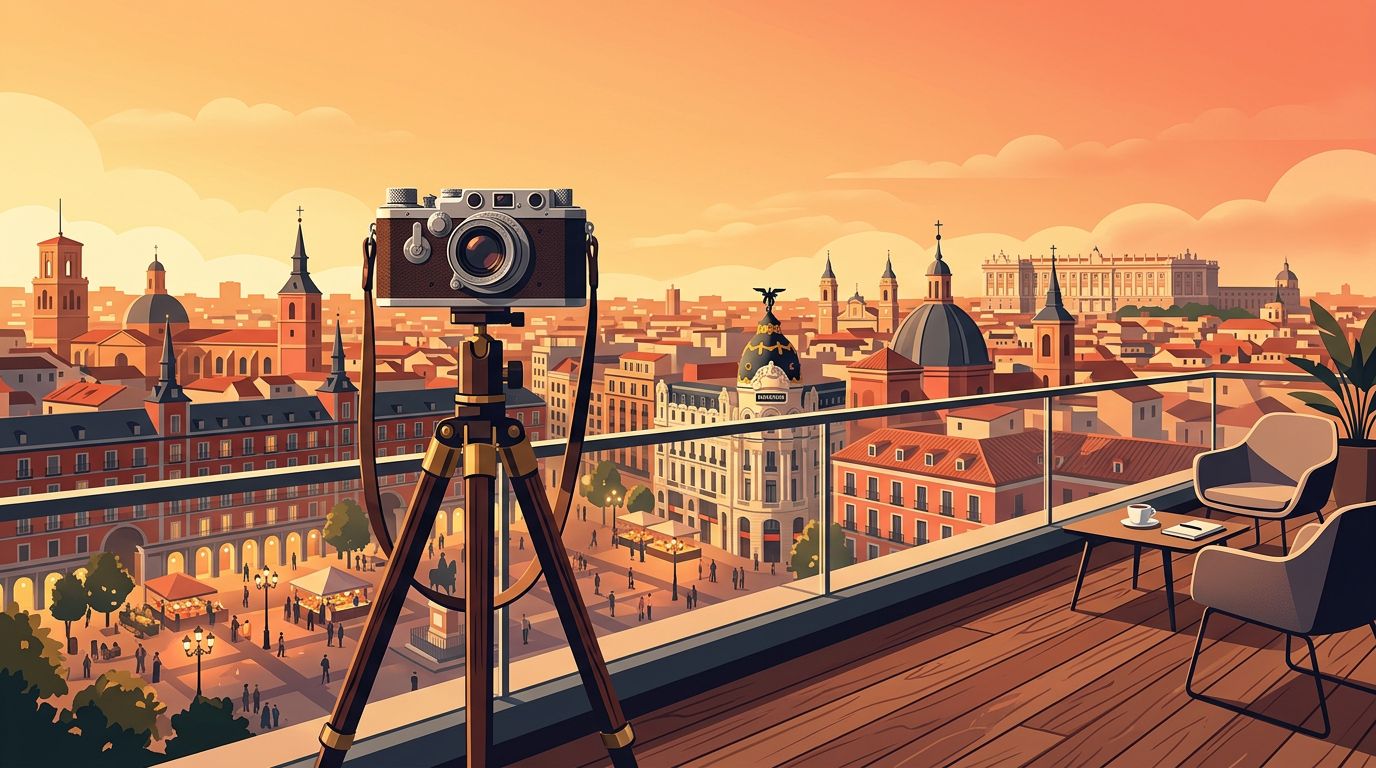
Madrid rewards photographers who stay after the sun drops behind the skyline. Although you can take a pleasant skyline image at almost any hour, Madrid photography spots look far stronger when a paid terrace gives you scale and a nearby plaza supplies human movement after facade colors begin to turn.
Your best frames rarely come from chasing every famous address. Pick one rooftop, pair it with a walkable square, and leave enough time for ticket queues and blue-hour shooting.
Arrive early for access.
Set Your Timing Before Choosing a Location
Golden hour in Madrid isn’t a fixed clock setting. In winter, sunset can fall shortly before 18:00, while late June evenings hold light until well after 21:30. Check the exact time on the day, then arrive 45 minutes before sunset.
The sky often stays useful longer than expected. Warm light fades quickly on west-facing facades, yet the best balance of sky color and street lights usually appears 15 to 30 minutes later.
Build a Simple Golden-Hour Schedule
Use these seasonal ranges as planning estimates, then confirm the day’s sunset time before leaving your hotel.
| Season | Approximate sunset window | Best time to reach your first spot |
|---|---|---|
| Winter | 17:45 to 18:15 | About 45 minutes earlier |
| Spring | 18:30 to 21:00 | About 50 minutes earlier |
| Summer | 20:45 to 21:45 | About one hour earlier |
| Autumn | 18:00 to 19:00 | About 45 minutes earlier |
Summer heat drains batteries. Carry water, a spare battery, and a small microfiber cloth for dusty lenses.
Pack for Movement, Not Perfection
Madrid’s central streets invite long walks, and rooftop security or staff may restrict bulky tripods. A compact camera, one versatile zoom, and a fast prime lens are easier to manage than a large bag.
For most scenes, a 24-70mm equivalent lens handles broad architecture and tighter details. A 35mm or 50mm lens also works well in crowded plazas, where a wider lens can make nearby people look stretched.
In a busy square, a clean frame usually comes from changing position by two metres, not waiting twenty minutes for every person to leave.
Madrid Photography Spots Above the Traffic
Rooftops put Madrid’s grand avenues into context. They also come with queues, music, drinks, and limited edge space, so treat them as shared public settings rather than private photo studios.
Círculo de Bellas Artes for Classic Madrid Lines
The Azotea del Círculo de Bellas Artes is one of the most practical central terraces. It sits near Calle de Alcalá, with views toward the Metropolis building, Gran Vía, Cibeles, and distant hills when the air is clear. Spain’s guide to Madrid viewpoints places its 360-degree panorama at 56 metres above the street.
General rooftop admission is currently EUR6. Opening hours run from 10:00 until 01:30 Sunday through Thursday, with a 02:00 close on Friday and Saturday. Prices and schedules can change, especially around private events, so check before setting out.
Get there before the sun softens. The terrace edge fills first, and a 50mm view toward Gran Vía often feels stronger than trying to capture every landmark at once.
RIU Plaza España 360 for a Wider Skyline
The 360 Rooftop Bar at RIU Plaza España gives you a high, open view over western Madrid and the dense Gran Vía corridor. It is a strong choice when you want a broader skyline, particularly as the sky turns orange behind Casa de Campo.
The rooftop currently opens daily from 11:00 to 02:00, with last entry at midnight. Non-guests pay EUR5 on weekdays before 17:00, then EUR10 later in the day. Weekend and public-holiday entry is EUR10, which puts most sunset photographers in the higher admission bracket.
Because this terrace is popular with visitors and hotel guests, arrive at least an hour before sunset on clear weekends, when the lift queue can take a meaningful slice of the usable light.
Golden-Hour Plazas With Real Street Life
Madrid’s plazas give a rooftop session an entirely different pace. At street level, you can use passing figures, cafe tables, cyclists, and changing shadows to make the scene feel lived-in.
Puerta del Sol After the Crowds Shift
Puerta del Sol is difficult to photograph empty, and that is part of its value. Use the movement rather than fighting it. Frame the clock on the Casa de Correos above a loose crowd, then lower your angle so pavement reflections and passing shoes fill the foreground.
The famous clock has framed Spain’s televised New Year’s Eve countdown since 1962. That familiar detail gives an evening photograph an immediate sense of place, especially when the blue sky begins to match the cooler tones of the square’s lighting.

Photo by Alex Moliski
Plaza Mayor for Arches and Warm Facades
Plaza Mayor works best when you slow down. Its red facades and repeated arches catch the last warm light, while the arcades offer shade that helps separate a person from a bright background.
Stand close to an arch and shoot diagonally across the square. This creates a dark frame around the sunlit buildings and avoids a flat postcard view. Later, shift toward the arcades and expose for the illuminated shops, because the central square can become a bright, crowded void after dark.
Space disappears fast. Keep your camera strap close and avoid blocking the narrow arcade paths.
Cibeles and Debod for a Different Evening Mood
Some Madrid photography spots need more patience than the famous rooftops. They are worthwhile when you want cleaner architecture or a visible horizon without terrace crowds.
Palacio de Cibeles and the Gran Vía Axis
Palacio de Cibeles gives you one of Madrid’s most recognizable facades. At ground level, shoot from the edge of Plaza de Cibeles with the fountain in view, then look east along Calle de Alcalá for receding traffic and building lights.
The Madrid city guide’s Cibeles viewpoint page also lists the Mirador Madrid observation deck inside the palace. Check current access details on the day, since cultural events and municipal schedules can affect entry.
A moderate telephoto lens helps here. It compresses the fountain, palace, and moving traffic into a tighter frame without forcing you into the middle of the roundabout.
Temple of Debod at Sunset
Temple of Debod faces one of Madrid’s most popular sunset horizons. The monument’s stone structure looks best when the sky still holds color, while the city beyond it turns into a dark silhouette.
Crowds gather early, particularly in warm weather. Instead of pushing toward the closest viewpoint, walk the perimeter and look for a gap where the temple’s shape remains clear against the sky. Don’t count on still water for a reflection, because conditions around the pools can change.
Check municipal notices before your visit. Temporary access changes can affect the most familiar angles.
Make Rooftop Images Feel Less Like Snapshots
A high viewpoint can make every scene look smaller. Give the eye one clear anchor, such as a dome, avenue, or lit facade, then use the rest of the skyline as supporting space.
Choose the Frame Before the Color Peaks
Start with your composition while daylight remains. If you wait until the sky is perfect, you may still be deciding where to stand as the light fades.
Vertical frames work well for Gran Vía and the Metropolis dome because the street naturally draws upward. Meanwhile, a horizontal composition suits the RIU terrace, where the horizon and distant hills need room. Leave some sky, but don’t let it dominate a scene with weak clouds.
A simple rule helps: keep the brightest subject away from the exact center unless the symmetry is the point.
After the Last Sun
Blue hour is when Madrid’s street lamps, signs, and traffic begin to carry the image. Lower your shutter speed carefully, brace against a railing where permitted, and take several frames as headlights pass through the scene.
For handheld work, raise ISO before accepting blur from moving people. If you use a tripod in a public plaza, keep it compact and move aside when foot traffic builds. Staff requests take priority.
The Círculo is a cultural institution rather than a hotel bar, which partly explains its accessible entry price and mixed crowd. A Círculo de Bellas Artes rooftop overview can help you recognize its position before you arrive.
Hold for Blue Hour
The most memorable Madrid evening photos often happen after the obvious sunset moment has passed. Stay with one scene long enough to notice how a warm facade, cobalt sky, and early headlights change the balance of the frame.
Keep the route short, because crossing central Madrid during peak evening crowds can cost more light than it saves. Set a 10-minute alarm for 20 minutes after sunset, then point the camera toward the first Gran Vía headlights.
